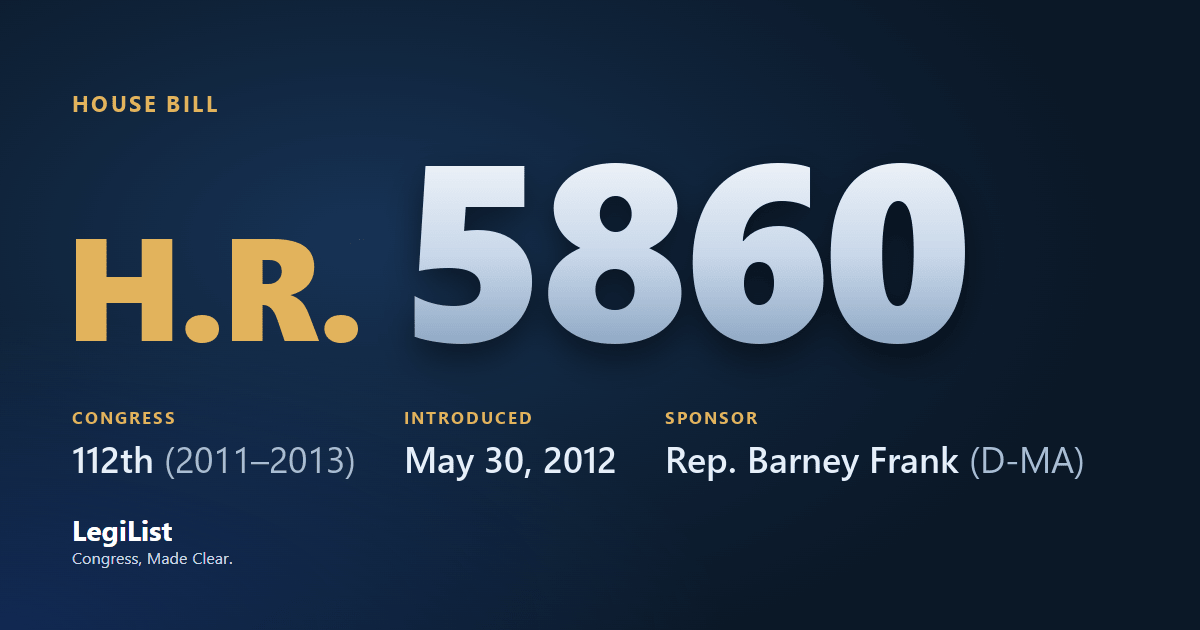
Executive Compensation Clawback Full Enforcement Act
Latest action · Jul 11, 2012 Referred to the Subcommittee on Financial Institutions and Consumer Credit.
Progress
Where this bill reached, and when. A stage with no date was not reached; one that failed a vote and later carried shows the date it carried.
- IntroducedMay 30, 2012
- Passed HouseNot reached
- Passed SenateNot reached
- To the PresidentNot reached
- Became lawNot reached
Summary
Executive Compensation Clawback Full Enforcement Act - Prohibits personnel or affiliated parties of depository institutions, depository institution holding companies, or nonbank financial companies who are required by federal financial regulatory law that imposes personal liability from insuring or hedging against, or otherwise transferring the risks associated with, personal liability for amounts owed as repayment of previously earned compensation or civil penalties.
States that such persons are not precluded from being provided funds from: (1) specified entities to defend against previously earned compensation recovery or civil money penalty, or (2) certain insurance that protects against personal liability.
Applies this Act to the personnel or affiliated party of a foreign nonbank financial company only to the extent such party is based in the United States.
Cosponsors 4
Members who signed on, in the order they did. Signatures ran from May 30, 2012 to Sep 14, 2012; 2 are original cosponsors, there from the day it was introduced.
| Seat | Cosponsor | Signed on | |
|---|---|---|---|
| D-MN | Collin C. Peterson | Original | May 30, 2012 |
| D-CA | Henry A. Waxman | Original | May 30, 2012 |
| D-MI | John Conyers, Jr. | Jun 18, 2012 | |
| D-OH | Dennis J. Kucinich | Sep 14, 2012 |
Committees 2
Where it was sent and what each committee and subcommittee did with it, in order.
| Chamber | Committee | What it did |
|---|---|---|
| House | Financial Services Committee | Referred May 30, 2012 |
| Capital Markets Subcommittee | Referred Jul 11, 2012 | |
| Consumer Protection and Financial Institutions Subcommittee | Referred Jul 11, 2012 | |
| House | Agriculture Committee | Referred May 30, 2012 |
| General Farm Commodities, Risk Management, and Credit Subcommittee | Referred Jun 27, 2012 |
Actions 5
Everything that happened, newest first.
- Jul 11, 2012Referred to the Subcommittee on Capital Markets and Government Sponsored Enterprises.
- Jul 11, 2012Referred to the Subcommittee on Financial Institutions and Consumer Credit.
- Jun 27, 2012Referred to the Subcommittee on General Farm Commodities and Risk Management.
- May 30, 2012Introduced in House
- May 30, 2012Referred to the Committee on Financial Services, and in addition to the Committee on Agriculture, for a period to be subsequently determined by the Speaker, in each case for consideration of such provisions as fall within the jurisdiction of the committee concerned.
Research
What has been written about this bill: committee reports, cost estimates, the sponsor’s authority statement, printed hearings and the Congressional Research Service’s work.
Constitutional authority
The sponsor’s statement, as printed in the page H3266.
Titles 2
Every title it has carried, official and short, at each stage.
- Official Title as Introduced
- To prohibit individuals from insuring against possible losses from having to repay illegally-received compensation or from having to pay civil penalties, and for other purposes.
- Short Titles as Introduced
- Executive Compensation Clawback Full Enforcement Act
Subjects
Assigned by the Library of Congress. Policy area: Finance and Financial Sector.
Text 1
Each version as it was printed, newest first.
- May 30, 2012Introduced in House
Support LegiList
This page is free, carries no paywall, and is built and maintained by one person. If the record here is useful to you, a few dollars keeps it going.
Everything here is as published by Congress: the summary is the Congressional Research Service's, the action wording is the clerks', and the subjects are the Library of Congress's. How far it got is read from the actions themselves, taking the most recent one of each kind, so a bill that failed a vote and later passed is shown as having passed. Records come from this bill on Congress.gov and govinfo.gov; cost estimates are the Congressional Budget Office's, and the hearings are the printed hearings GovInfo publishes, which can appear months after the hearing.