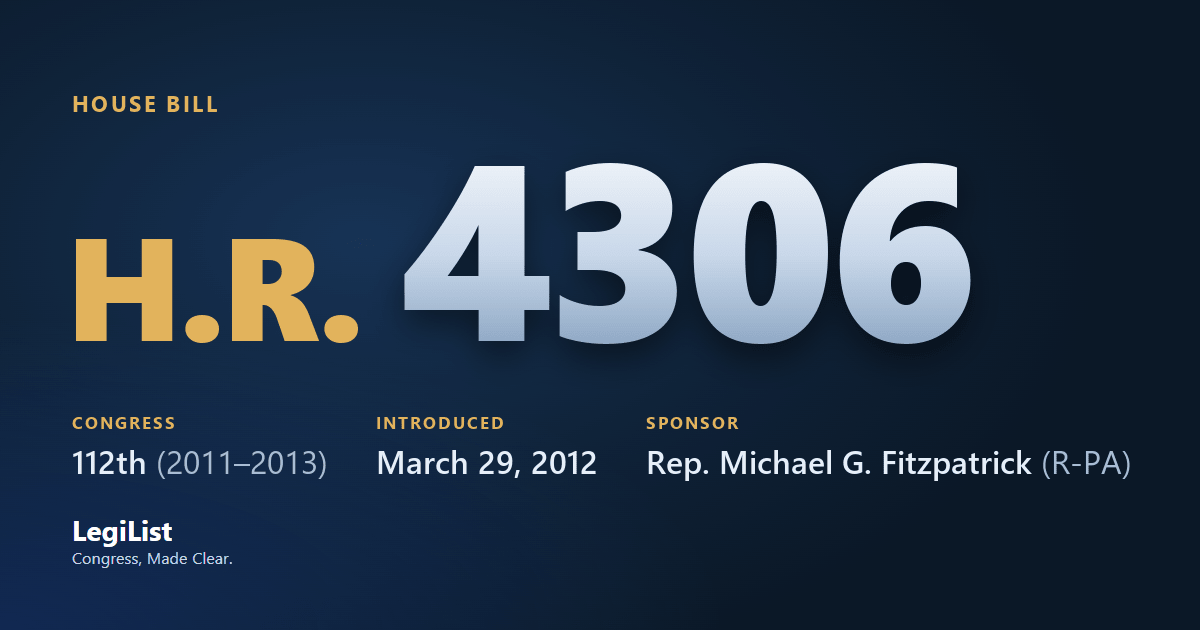
Captive Primate Safety Act
Latest action · Apr 16, 2012 Referred to the Subcommittee on Fisheries, Wildlife, Oceans, and Insular Affairs.
Progress
Where this bill reached, and when. A stage with no date was not reached; one that failed a vote and later carried shows the date it carried.
- IntroducedMar 29, 2012
- Passed HouseNot reached
- Passed SenateNot reached
- To the PresidentNot reached
- Became lawNot reached
Summary
Captive Primate Safety Act - Amends the Lacey Act Amendments of 1981 to add nonhuman primates to the definition of "prohibited wildlife species" for purposes of the prohibition against the sale or purchase of such species in interstate or foreign commerce.
Makes it unlawful for a person to import, export, transport, sell, receive, acquire, or purchase a live animal of any prohibited wildlife species in interstate or foreign commerce (i.e., for pet trade purposes). Sets forth exceptions to such prohibition, including, under certain conditions, for: (1) transporting a nonhuman primate to or from a veterinarian, (2) transporting a nonhuman primate to a legally designated caregiver as a result of the death of the preceding owner, and (3) transporting a single primate of the genus Cebus that was obtained from and trained by a charitable organization to assist a permanently disabled individual with a severe mobility impairment.
Sets forth civil and criminal penalties for violations of the requirements of this Act. Extends the authorization of appropriations to carry out such prohibition for FY2012-FY2016.
Cosponsors 9
Members who signed on, in the order they did. Signatures ran from Mar 29, 2012 to Nov 15, 2012; 1 is an original cosponsor, there from the day it was introduced.
| Seat | Cosponsor | Signed on | |
|---|---|---|---|
| D-OR | Earl Blumenauer | Original | Mar 29, 2012 |
| D-CA | Howard L. Berman | Apr 27, 2012 | |
| D-VA | James P. Moran | Apr 27, 2012 | |
| D-CA | Lynn C. Woolsey | Apr 27, 2012 | |
| D-CA | Fortney Pete Stark | May 17, 2012 | |
| D-NJ | Steven R. Rothman | May 31, 2012 | |
| D-MI | Hansen Clarke | Jun 7, 2012 | |
| D-CA | Sam Farr | Jun 27, 2012 | |
| R-CA | Elton Gallegly | Nov 15, 2012 |
Committees 1
Where it was sent and what each committee and subcommittee did with it, in order.
| Chamber | Committee | What it did |
|---|---|---|
| House | Natural Resources Committee | Referred Mar 29, 2012 |
| Fisheries, Wildlife, Oceans, and Insular Affairs Subcommittee | Referred Apr 16, 2012 |
Actions 3
Everything that happened, newest first.
- Apr 16, 2012Referred to the Subcommittee on Fisheries, Wildlife, Oceans, and Insular Affairs.
- Mar 29, 2012Introduced in House
- Mar 29, 2012Referred to the House Committee on Natural Resources.
Research
What has been written about this bill: committee reports, cost estimates, the sponsor’s authority statement, printed hearings and the Congressional Research Service’s work.
Constitutional authority
The sponsor’s statement, as printed in the page H1806.
Related bills 1
Companion bills and other measures the record links to this one.
| Bill | Title | Relationship | Latest action |
|---|---|---|---|
| S 1324 | Captive Primate Safety Act | Related bill | Jul 17, 2012 |
Titles 2
Every title it has carried, official and short, at each stage.
- Official Title as Introduced
- To amend the Lacey Act Amendments of 1981 to prohibit the importation, exportation, transportation, and sale, receipt, acquisition, or purchase in interstate or foreign commerce, of any live animal of any prohibited wildlife species, and for other purposes.
- Short Titles as Introduced
- Captive Primate Safety Act
Subjects
Assigned by the Library of Congress. Policy area: Animals.
Text 1
Each version as it was printed, newest first.
- Mar 29, 2012Introduced in House
Support LegiList
This page is free, carries no paywall, and is built and maintained by one person. If the record here is useful to you, a few dollars keeps it going.
Everything here is as published by Congress: the summary is the Congressional Research Service's, the action wording is the clerks', and the subjects are the Library of Congress's. How far it got is read from the actions themselves, taking the most recent one of each kind, so a bill that failed a vote and later passed is shown as having passed. Records come from this bill on Congress.gov and govinfo.gov; cost estimates are the Congressional Budget Office's, and the hearings are the printed hearings GovInfo publishes, which can appear months after the hearing.