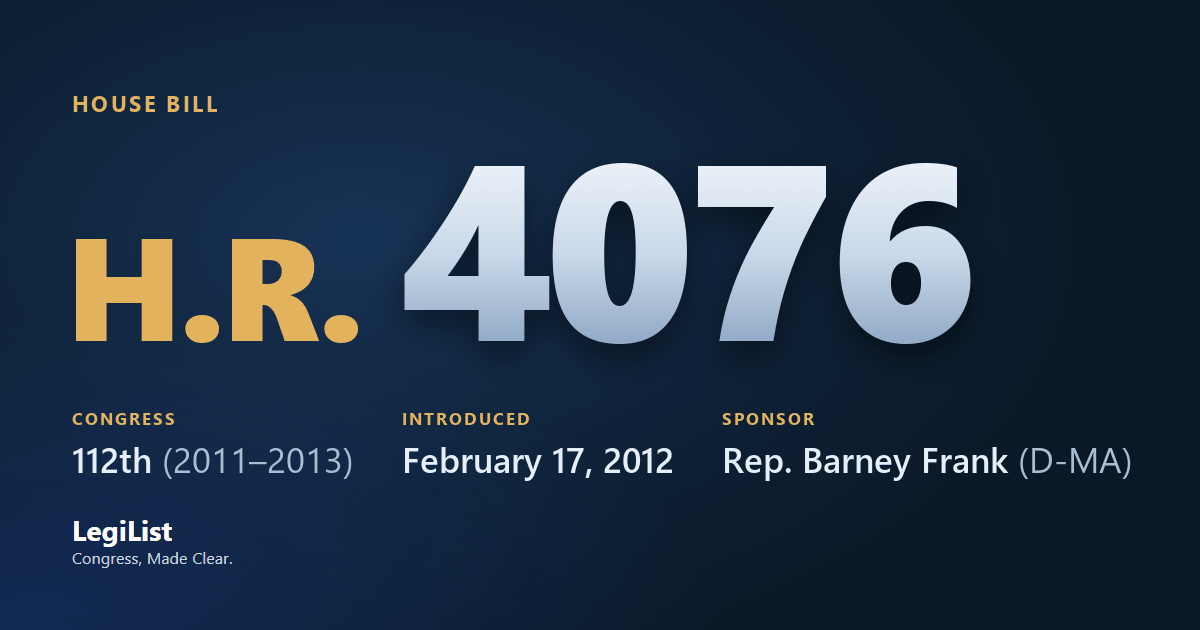
To amend the Truth in Lending Act to add a rule of construction relating to certain payments to an employee of a mortgage originator.
Latest action · Feb 23, 2012 Referred to the Subcommittee on Financial Institutions and Consumer Credit.
Progress
Where this bill reached, and when. A stage with no date was not reached; one that failed a vote and later carried shows the date it carried.
- IntroducedFeb 17, 2012
- Passed HouseNot reached
- Passed SenateNot reached
- To the PresidentNot reached
- Became lawNot reached
Summary
Amends the Truth in Lending Act to deny any construction of the prohibition against residential mortgage loan originator steering incentives as prohibiting a creditor or mortgage originator from reducing compensation to an employee mortgage originator if, after the employee mortgage originator has made the consumer an initial annual percentage rate (APR) offer, the employee mortgage originator makes a subsequent offer to the consumer that: (1) consists only of a reduction in the APR, and (2) is made in response to a lower APR offer to the consumer by another creditor or mortgage originator.
Cosponsors 3
Members who signed on, in the order they did. Signatures ran from Mar 22, 2012 to Jun 6, 2012.
| Seat | Cosponsor | Signed on | |
|---|---|---|---|
| D-CA | Fortney Pete Stark | Mar 22, 2012 | |
| R-CA | Gary G. Miller | Mar 22, 2012 | |
| R-MO | Billy Long | Jun 6, 2012 |
Actions 3
Everything that happened, newest first.
- Feb 23, 2012Referred to the Subcommittee on Financial Institutions and Consumer Credit.
- Feb 17, 2012Introduced in House
- Feb 17, 2012Referred to the House Committee on Financial Services.
Subjects
Assigned by the Library of Congress. Policy area: Housing and Community Development.
Text 1
Each version as it was printed, newest first.
- Feb 17, 2012Introduced in House
Everything here is as published by Congress: the summary is the Congressional Research Service's, the action wording is the clerks', and the subjects are the Library of Congress's. How far it got is read from the actions themselves, taking the most recent one of each kind, so a bill that failed a vote and later passed is shown as having passed. Records come from this bill on Congress.gov and govinfo.gov.