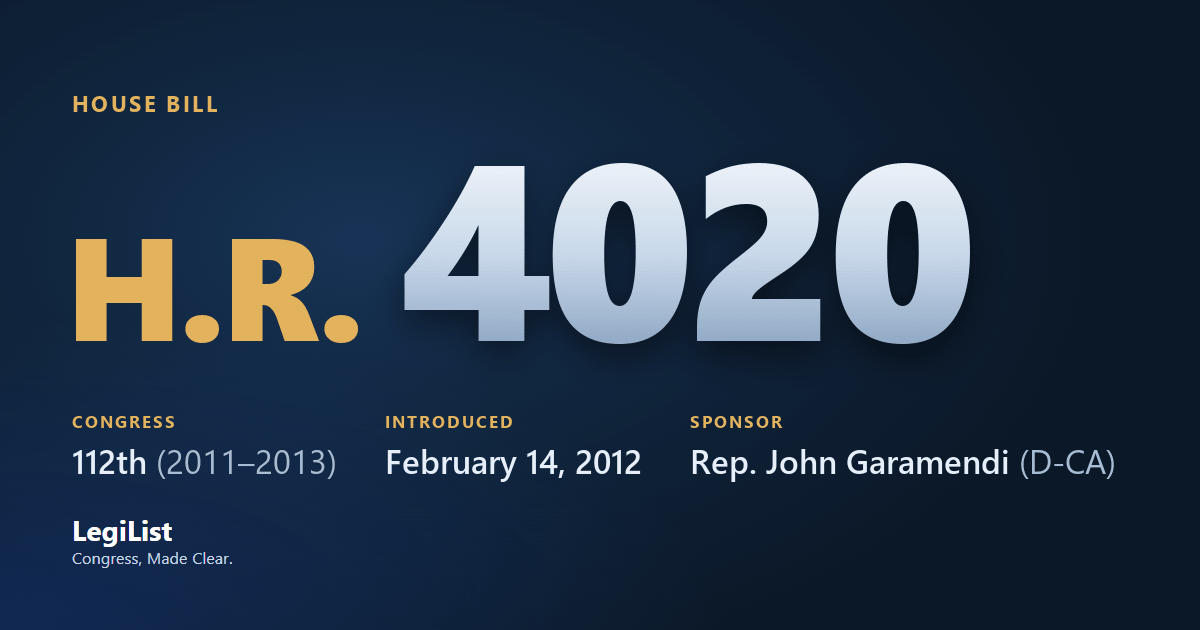
Flood Insurance for Farmers Act of 2012
Latest action · Feb 23, 2012 Referred to the Subcommittee on Insurance, Housing and Community Opportunity.
Progress
Where this bill reached, and when. A stage with no date was not reached; one that failed a vote and later carried shows the date it carried.
- IntroducedFeb 14, 2012
- Passed HouseNot reached
- Passed SenateNot reached
- To the PresidentNot reached
- Became lawNot reached
Summary
Flood Insurance for Farmers Act of 2012 - Amends the National Flood Insurance Act of 1968 with respect to development by the Administrator of the Federal Emergency Management Agency (FEMA) of comprehensive criteria designed to encourage adoption of adequate state and local measures for land-management programs in flood-prone areas.
Prohibits such criteria from placing prohibitions, restraints, or conditions, including requiring floodproofing or flood damage mitigation activities or related features, upon either new construction or substantial improvement of an agricultural structure in any area having special flood hazards.
Requires such criteria, with respect only to structures in certain levee-protected areas, to require any substantial improvement to an existing residential structure to have the lowest floor (including any basement) elevated to or above the base flood level.
Requires such criteria to permit a legacy community located in a covered levee-protected area to adopt adequate land use and control measures for: (1) repair or restoration to pre-damaged conditions, or (2) replacement of existing residential and non-residential structures other than repetitive loss structures.
Defines "legacy community" as one whose population is less than 2,000 and is located in an area for which a substantial portion of the economy currently is, and historically was, based upon agricultural production.
Directs the Administrator to make flood insurance coverage available upon request for: (1) an agricultural structure located in an area having special flood hazards, and (2) structures in covered levee-protected areas.
Directs the Administrator and the Secretary of Agriculture to establish jointly a task force to report to certain congressional committees on challenges faced by legacy communities located in areas having special flood hazards, including recommendations to: (1) strengthen the economic viability and vitality of such communities, and (2) allow infill development and building expansion.
Cosponsors 1
Members who signed on, in the order they did. All signed on Feb 14, 2012.
| Seat | Cosponsor | Signed on | |
|---|---|---|---|
| R-CA | Daniel E. Lungren | Original | Feb 14, 2012 |
Committees 1
Where it was sent and what each committee and subcommittee did with it, in order.
| Chamber | Committee | What it did |
|---|---|---|
| House | Financial Services Committee | Referred Feb 14, 2012 |
| Housing and Insurance Subcommittee | Referred Feb 23, 2012 |
Actions 3
Everything that happened, newest first.
- Feb 23, 2012Referred to the Subcommittee on Insurance, Housing and Community Opportunity.
- Feb 14, 2012Introduced in House
- Feb 14, 2012Referred to the House Committee on Financial Services.
Research
What has been written about this bill: committee reports, cost estimates, the sponsor’s authority statement, printed hearings and the Congressional Research Service’s work.
Constitutional authority
The sponsor’s statement, as printed in the page H726.
Titles 2
Every title it has carried, official and short, at each stage.
- Official Title as Introduced
- To amend the National Flood Insurance Act of 1968 to allow the construction and improvement of structures used for agricultural production in floodplains, and for other purposes.
- Short Titles as Introduced
- Flood Insurance for Farmers Act of 2012
Subjects
Assigned by the Library of Congress. Policy area: Emergency Management.
Text 1
Each version as it was printed, newest first.
- Feb 14, 2012Introduced in House
Everything here is as published by Congress: the summary is the Congressional Research Service's, the action wording is the clerks', and the subjects are the Library of Congress's. How far it got is read from the actions themselves, taking the most recent one of each kind, so a bill that failed a vote and later passed is shown as having passed. Records come from this bill on Congress.gov and govinfo.gov; cost estimates are the Congressional Budget Office's, and the hearings are the printed hearings GovInfo publishes, which can appear months after the hearing.