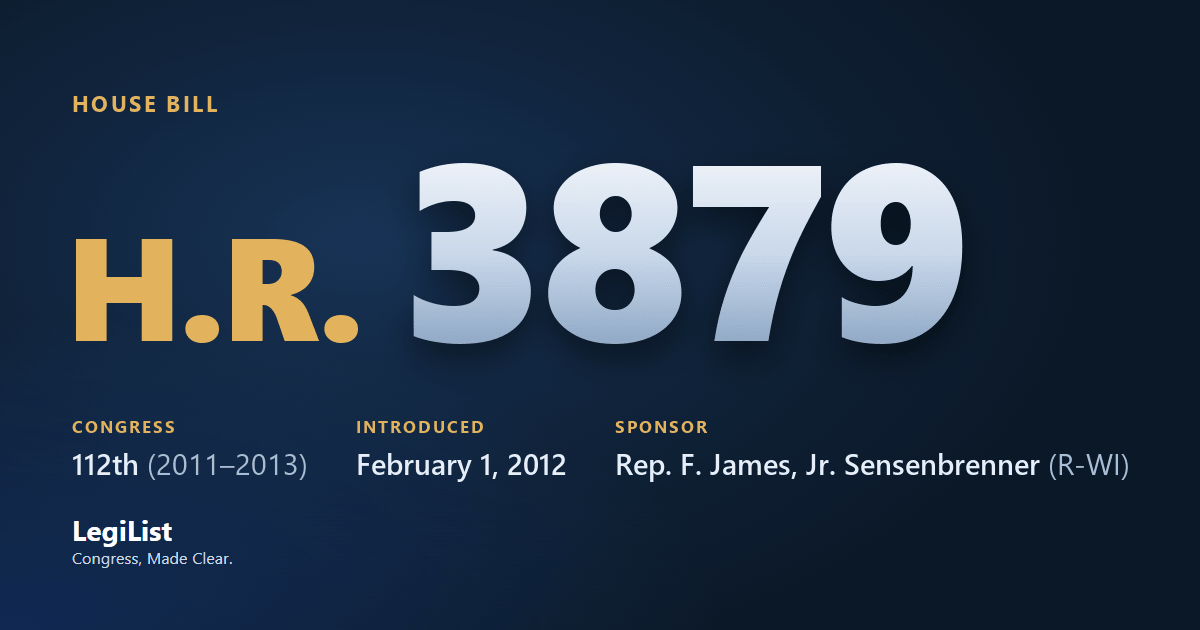
Refinery Streamlined Permitting Act of 2012
Latest action · Feb 23, 2012 Referred to the Subcommittee on Readiness.
Progress
Where this bill reached, and when. A stage with no date was not reached; one that failed a vote and later carried shows the date it carried.
- IntroducedFeb 1, 2012
- Passed HouseNot reached
- Passed SenateNot reached
- To the PresidentNot reached
- Became lawNot reached
Summary
Refinery Streamlined Permitting Act of 2012 - Directs the Secretary of Energy (DOE) to offer assistance to states to enable them to assign responsibilities delegated to them under federal law regarding coordinated and expeditious construction or expansion of a petroleum refining facility.
Requires all federal agencies and state agencies responsible for approving federal authorization for the construction or expansion of such a facility to: (1) enter into a memorandum of understanding that clearly defines all actions required to be taken for federal permit review and approval; (2) take final action to approve or disapprove the application within one year after receipt of a completed application; (3) give high priority to expediting an application for a refining facility that would allow for production of cleaner burning fuel or result in increased refining capacity; and (4) submit a Statement of Energy Effects to the Administrator of the Office of Information and Regulatory Affairs, Office of Management and Budget (OMB), for each proposed significant energy action.
Requires the President to designate at least three closed military installations (or portions of them) appropriate for siting a refinery for gasoline or other fuel.
Designates DOE as the lead agency for coordinating applicable federal refinery authorizations and related environmental reviews with respect to a designated refinery.
Gives the U.S. Court of Appeals for the District of Columbia exclusive jurisdiction over civil actions relating to federal refinery authorizations.
Cosponsors
Members who signed on, in the order they did.
Committees 2
Where it was sent and what each committee and subcommittee did with it, in order.
| Chamber | Committee | What it did |
|---|---|---|
| House | Energy and Commerce Committee | Referred Feb 1, 2012 |
| House | Armed Services Committee | Referred Feb 1, 2012 |
| Readiness Subcommittee | Referred Feb 23, 2012 |
Actions 3
Everything that happened, newest first.
- Feb 23, 2012Referred to the Subcommittee on Readiness.
- Feb 1, 2012Introduced in House
- Feb 1, 2012Referred to the Committee on Energy and Commerce, and in addition to the Committee on Armed Services, for a period to be subsequently determined by the Speaker, in each case for consideration of such provisions as fall within the jurisdiction of the committee concerned.
Research
What has been written about this bill: committee reports, cost estimates, the sponsor’s authority statement, printed hearings and the Congressional Research Service’s work.
Constitutional authority
The sponsor’s statement, as printed in the page H375.
Titles 3
Every title it has carried, official and short, at each stage.
- Official Title as Introduced
- To provide for streamlining the process of Federal approval for construction or expansion of petroleum refineries, and for other purposes.
- Short Titles as Introduced
- Refinery Streamlined Permitting Act of 2012
- Short Titles as Introduced for portions of this bill
- Refinery Streamlined Permitting Act of 2012
Subjects
Assigned by the Library of Congress. Policy area: Energy.
- Administrative law and regulatory procedures
- Building construction
- Department of Energy
- Energy
- Energy prices
- Energy storage, supplies, demand
- Environmental assessment, monitoring, research
- Environmental regulatory procedures
- Government information and archives
- Intergovernmental relations
- Judicial procedure and administration
- Judicial review and appeals
- Legal fees and court costs
- Licensing and registrations
- Military facilities and property
- Military readiness
- Oil and gas
- Pipelines
- State and local government operations
Text 1
Each version as it was printed, newest first.
- Feb 1, 2012Introduced in House
Support LegiList
This page is free, carries no paywall, and is built and maintained by one person. If the record here is useful to you, a few dollars keeps it going.
Everything here is as published by Congress: the summary is the Congressional Research Service's, the action wording is the clerks', and the subjects are the Library of Congress's. How far it got is read from the actions themselves, taking the most recent one of each kind, so a bill that failed a vote and later passed is shown as having passed. Records come from this bill on Congress.gov and govinfo.gov; cost estimates are the Congressional Budget Office's, and the hearings are the printed hearings GovInfo publishes, which can appear months after the hearing.