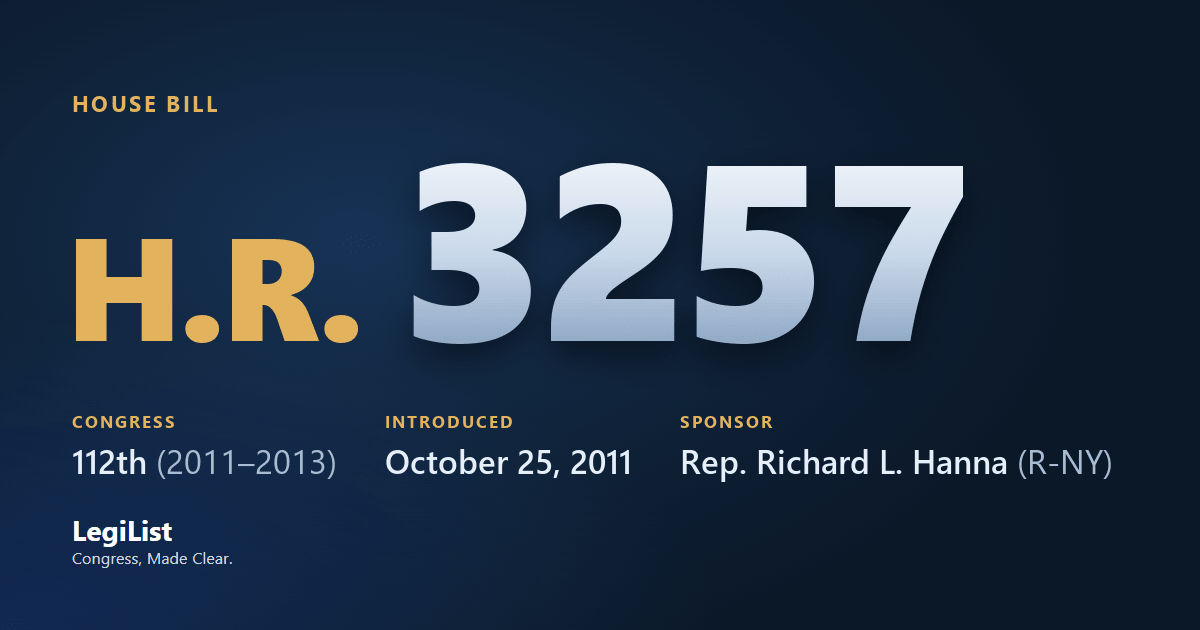
Regulatory Time-Out Act of 2011
Latest action · Nov 2, 2011 Referred to the Subcommittee on Courts, Commercial and Administrative Law.
Progress
Where this bill reached, and when. A stage with no date was not reached; one that failed a vote and later carried shows the date it carried.
- IntroducedOct 25, 2011
- Passed HouseNot reached
- Passed SenateNot reached
- To the PresidentNot reached
- Became lawNot reached
Summary
Regulatory Time-Out Act of 2011 - Prohibits covered regulations from being in effect or from taking effect during the period beginning on the enactment of this Act and ending on January 21, 2013 (time-out period). Prohibits publication of any general notice of a proposed rulemaking for what would be a covered regulation, and nullifies a rulemaking that was published but for which the comment period did not expire before enactment of this Act, during such period.
Defines a "covered regulation" as a final regulation that did not take effect before September 1, 2011, that increases costs on businesses in a manner that will have an adverse effect on job creation, job retention, productivity, competitiveness, or the efficient functioning of the economy and that is likely to: (1) have an annual effect on the economy of $100 million or more; (2) adversely affect in a material way the economy, productivity, competition, jobs, the environment, public health or safety, or state, local, or tribal governments or communities; (3) create a serious inconsistency or otherwise interfere with an action by another agency; (4) materially alter the budgetary impact of entitlements, grants, user fees, or loan programs or the rights and obligations of recipients; or (5) raise novel legal or policy issues.
Exempts regulations that are required by law. Allows agency heads to exempt covered regulations that: (1) are necessary due to an imminent threat to human health or safety or any other emergency; (2) are necessary to enforce criminal laws, (3) foster private sector job creation; (4) encourage economic growth; (5) reduce regulatory burdens; (6) pertain to a military or foreign affairs function; or (7) are limited to interpreting, implementing, or administering the Internal Revenue Code.
Cosponsors 5
Members who signed on, in the order they did. Signatures ran from Oct 25, 2011 to Nov 3, 2011; 1 is an original cosponsor, there from the day it was introduced.
| Seat | Cosponsor | Signed on | |
|---|---|---|---|
| R-NE | Lee Terry | Original | Oct 25, 2011 |
| R-WI | Reid J. Ribble | Nov 1, 2011 | |
| R-TX | Ron Paul | Nov 1, 2011 | |
| R-IN | Todd Young | Nov 1, 2011 | |
| R-OH | Robert E. Latta | Nov 3, 2011 |
Committees 2
Where it was sent and what each committee and subcommittee did with it, in order.
| Chamber | Committee | What it did |
|---|---|---|
| House | Oversight and Government Reform Committee | Referred Oct 25, 2011 |
| Environment Subcommittee | Referred Nov 2, 2011 | |
| House | Judiciary Committee | Referred Oct 25, 2011 |
| Courts, Intellectual Property, Artificial Intelligence, and the Internet Subcommittee | Referred Nov 2, 2011 |
Actions 4
Everything that happened, newest first.
- Nov 2, 2011Referred to the Subcommittee on Regulatory Affairs, Stimulus Oversight and Government Spending .
- Nov 2, 2011Referred to the Subcommittee on Courts, Commercial and Administrative Law.
- Oct 25, 2011Introduced in House
- Oct 25, 2011Referred to the Committee on Oversight and Government Reform, and in addition to the Committee on the Judiciary, for a period to be subsequently determined by the Speaker, in each case for consideration of such provisions as fall within the jurisdiction of the committee concerned.
Research
What has been written about this bill: committee reports, cost estimates, the sponsor’s authority statement, printed hearings and the Congressional Research Service’s work.
Constitutional authority
The sponsor’s statement, as printed in the page H7068.
Related bills 3
Companion bills and other measures the record links to this one.
| Bill | Title | Relationship | Latest action |
|---|---|---|---|
| S 1538 | Regulatory Time-Out Act of 2011 | Related bill | Sep 12, 2011 |
| S 1786 | Long-Term Surface Transportation Extension Act of 2011 | Related bill | Nov 3, 2011 |
| HR 3194 | Job Creation and Regulatory Freeze Act of 2011 | Related bill | Nov 2, 2011 |
Titles 2
Every title it has carried, official and short, at each stage.
- Official Title as Introduced
- To provide for a time-out on certain regulations, and for other purposes.
- Short Titles as Introduced
- Regulatory Time-Out Act of 2011
Subjects
Assigned by the Library of Congress. Policy area: Government Operations and Politics.
Text 1
Each version as it was printed, newest first.
- Oct 25, 2011Introduced in House
Support LegiList
This page is free, carries no paywall, and is built and maintained by one person. If the record here is useful to you, a few dollars keeps it going.
Everything here is as published by Congress: the summary is the Congressional Research Service's, the action wording is the clerks', and the subjects are the Library of Congress's. How far it got is read from the actions themselves, taking the most recent one of each kind, so a bill that failed a vote and later passed is shown as having passed. Records come from this bill on Congress.gov and govinfo.gov; cost estimates are the Congressional Budget Office's, and the hearings are the printed hearings GovInfo publishes, which can appear months after the hearing.