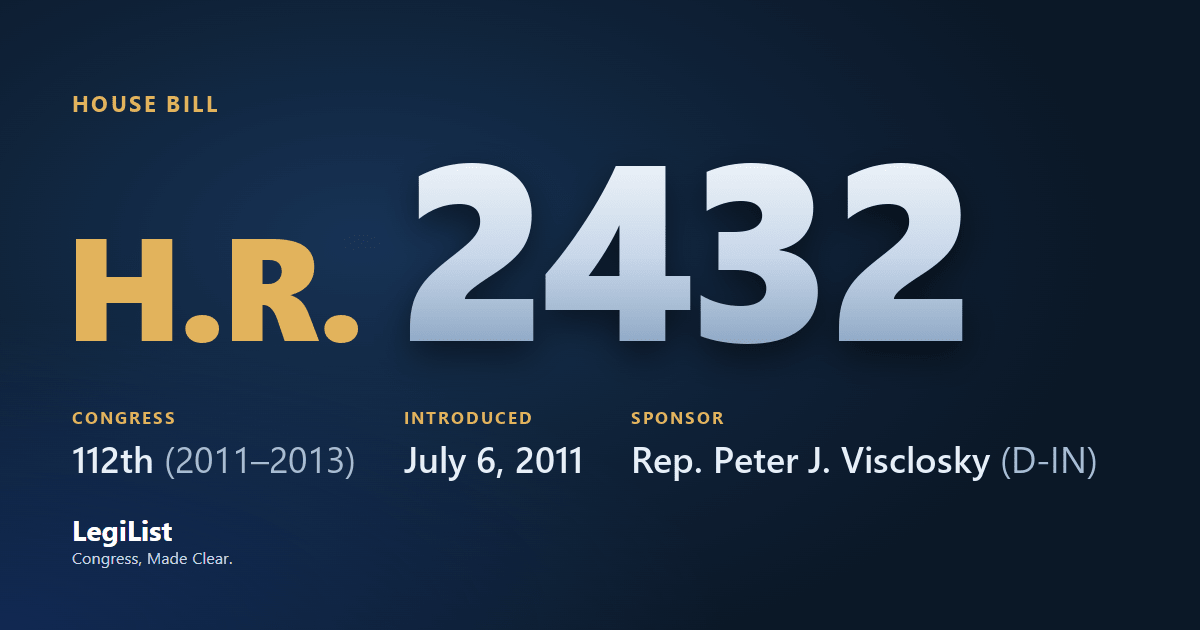
To provide for a feasibility study before carrying out any Federal action relating to the Chicago Area Water System.
Latest action · Jul 7, 2011 Referred to the Subcommittee on Water Resources and Environment.
Progress
Where this bill reached, and when. A stage with no date was not reached; one that failed a vote and later carried shows the date it carried.
- IntroducedJul 6, 2011
- Passed HouseNot reached
- Passed SenateNot reached
- To the PresidentNot reached
- Became lawNot reached
Summary
Directs the Chief of Engineers, prior to any major federal action to prevent the introduction or establishment of a population of aquatic nuisance species between the Great Lakes and the Mississippi River Basins that would impact the flow of commerce or commercial activity within the Chicago Area Water [sic] System, to prepare an economic impact statement regarding: (1) the impact on commerce and commercial activity and on jobs and job opportunities, (2) any adverse economic effects that could not be avoided, (3) alternatives to the proposed action, and (4) the relationship between any local short-term impacts on commerce or commercial activity and maintenance and enhancement of long-term productivity and environmental values.
Cosponsors 18
Members who signed on, in the order they did. Signatures ran from Jul 6, 2011 to Dec 8, 2011; 11 are original cosponsors, there from the day it was introduced.
| Seat | Cosponsor | Signed on | |
|---|---|---|---|
| R-IL | Adam Kinzinger | Original | Jul 6, 2011 |
| D-IN | André Carson | Original | Jul 6, 2011 |
| R-IN | Dan Burton | Original | Jul 6, 2011 |
| D-IN | Joe Donnelly | Original | Jul 6, 2011 |
| R-IL | Judy Biggert | Original | Jul 6, 2011 |
| R-IN | Larry Bucshon | Original | Jul 6, 2011 |
| R-IN | Marlin A. Stutzman | Original | Jul 6, 2011 |
| R-IN | Mike Pence | Original | Jul 6, 2011 |
| R-IL | Randy Hultgren | Original | Jul 6, 2011 |
| R-IN | Todd Rokita | Original | Jul 6, 2011 |
| R-IN | Todd Young | Original | Jul 6, 2011 |
| R-IL | Peter J. Roskam | Jul 11, 2011 | |
| R-IL | Aaron Schock | Sep 7, 2011 | |
| D-IL | Daniel Lipinski | Sep 13, 2011 | |
| D-IL | Jerry F. Costello | Sep 13, 2011 |
Committees 1
Where it was sent and what each committee and subcommittee did with it, in order.
| Chamber | Committee | What it did |
|---|---|---|
| House | Transportation and Infrastructure Committee | Referred Jul 6, 2011 |
| Water Resources and Environment Subcommittee | Referred Jul 7, 2011 |
Actions 3
Everything that happened, newest first.
- Jul 7, 2011Referred to the Subcommittee on Water Resources and Environment.
- Jul 6, 2011Introduced in House
- Jul 6, 2011Referred to the House Committee on Transportation and Infrastructure.
Research
What has been written about this bill: committee reports, cost estimates, the sponsor’s authority statement, printed hearings and the Congressional Research Service’s work.
Constitutional authority
The sponsor’s statement, as printed in the page H4672.
CRS reports 1
Congressional Research Service work that CRS links to this bill or the law it became, newest first.
Cite it 1
Products on other subjects that cite it, usually among other measures.
| Product | Title | Kind | Published |
|---|---|---|---|
| R41613 | Fishery, Aquaculture, and Marine Mammal Issues in the 112th Congress Archived | Report | Jan 22, 2013 |
Related bills 1
Companion bills and other measures the record links to this one.
| Bill | Title | Relationship | Latest action |
|---|---|---|---|
| S 1197 | A bill to provide for a feasibility study before carrying out any Federal action relating to the Chicago Area Water System. | Related bill | Jun 15, 2011 |
Titles 1
Every title it has carried, official and short, at each stage.
- Official Title as Introduced
- To provide for a feasibility study before carrying out any Federal action relating to the Chicago Area Water System.
Subjects
Assigned by the Library of Congress. Policy area: Water Resources Development.
Text 1
Each version as it was printed, newest first.
- Jul 6, 2011Introduced in House
Everything here is as published by Congress: the summary is the Congressional Research Service's, the action wording is the clerks', and the subjects are the Library of Congress's. How far it got is read from the actions themselves, taking the most recent one of each kind, so a bill that failed a vote and later passed is shown as having passed. Records come from this bill on Congress.gov and govinfo.gov; cost estimates are the Congressional Budget Office's, and the hearings are the printed hearings GovInfo publishes, which can appear months after the hearing.