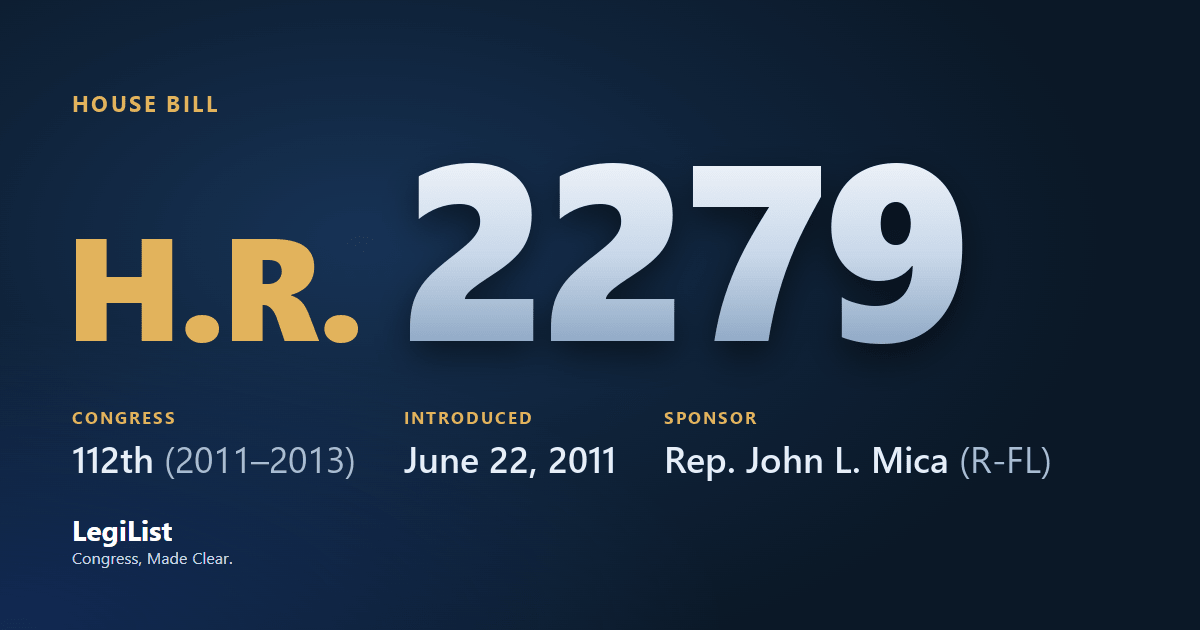
Airport and Airway Extension Act of 2011, Part III
Latest action · Jun 29, 2011 Became Public Law No: 112-21.
Progress
Where this bill reached, and when. A stage with no date was not reached; one that failed a vote and later carried shows the date it carried.
- IntroducedJun 22, 2011
- Passed HouseJun 24, 2011
- Passed SenateJun 27, 2011
- To the PresidentJun 28, 2011
- Became lawJun 29, 2011Public Law 112-21
Summary
(This measure has not been amended since it was introduced. The expanded summary of the Senate passed version is repeated here.)
Airport and Airway Extension Act of 2011, Part III - Amends the Internal Revenue Code to extend through July 22, 2011, increased excise taxes on aviation fuels, the excise tax on air transportation of persons and property, and the expenditure authority for the Airport and Airway Trust Fund.
Increases the authorization of appropriations for the period beginning on October 1, 2010, and ending on July 22, 2011, for airport planning and development and noise compatibility planning projects (known as airport improvement projects [AIPs]). Allows such funds to be obligated at any time through September 30, 2011, and to remain available until expended. Sets forth a formula for calculating AIP funding apportionments.
Extends through July 22, 2011, the authority of the Secretary of Transportation to make new AIP grants.
Extends until July 23, 2011: (1) the pilot program for passenger facility fee authorizations at non-hub airports, and (2) disclosure requirements for large and medium hub airports applying for AIP grants.
Directs the Secretary to extend through July 22, 2011, the termination date of insurance coverage for domestic or foreign-flag aircraft. Grants the Secretary discretionary authority to further extend such coverage through October 31, 2011. Extends through October 31, 2011, the authority of the Secretary to limit air carrier liability for claims arising out of acts of terrorism.
Extends through July 22, 2011: (1) grant eligibility for airports located in the Marshall Islands, Micronesia, and Palau; (2) grants to state and local governments for land use compatibility AIPs; and (3) authority for approving an application of the Metropolitan Washington Airports Authority for an airport development grant or for permission to impose a passenger facility fee.
Amends the Vision 100 - Century of Aviation Reauthorization Act to extend through Junly 22, 2011: (1) the temporary increase to 95% of the federal government's share of certain AIP costs, and (2) funding for airport development at Midway Island Airport.
Cosponsors 2
Members who signed on, in the order they did. All signed on Jun 22, 2011.
| Seat | Cosponsor | Signed on | |
|---|---|---|---|
| R-MI | Dave Camp | Original | Jun 22, 2011 |
| R-WI | Thomas E. Petri | Original | Jun 22, 2011 |
Committees 2
Where it was sent and what each committee and subcommittee did with it, in order.
| Chamber | Committee | What it did |
|---|---|---|
| House | Transportation and Infrastructure Committee | Referred Jun 22, 2011Discharged Jun 24, 2011 |
| Aviation Subcommittee | Referred Jun 23, 2011 | |
| House | Ways and Means Committee | Referred Jun 22, 2011Discharged Jun 24, 2011 |
Actions 14
Everything that happened, newest first.
- Jun 29, 2011Signed by President.
- Jun 29, 2011Became Public Law No: 112-21.
- Jun 28, 2011Message on Senate action sent to the House.
- Jun 28, 2011Presented to President.
- Jun 27, 2011Passed/agreed to in Senate: Received in the Senate, read twice, considered, read the third time, and passed without amendment by Unanimous Consent. (consideration: CR S4132)
In the Congressional Record 2
Days the Record’s own index lists this bill, newest first, with the pages and the members it names. Pages starting H are the House, S the Senate, E Extensions of Remarks.
| Where | In the Record | Members | Date |
|---|---|---|---|
| Senate | Debate and remarks S4132 | Harry Reid D-NV | Jun 27, 2011 |
| House | Debate and remarks H4533Text printed H4533 | Jerry F. Costello D-IL, John L. Mica R-FL | Jun 24, 2011 |
Research
What has been written about this bill: committee reports, cost estimates, the sponsor’s authority statement, printed hearings and the Congressional Research Service’s work.
Constitutional authority
The sponsor’s statement, as printed in the page H4458.
CRS reports 6
Congressional Research Service work that CRS links to this bill or the law it became, newest first.
Cite it 6
Products on other subjects that cite it, usually among other measures.
| Product | Title | Kind | Published |
|---|---|---|---|
| R47642 | On the Radio: Public Performance Rights in Sound Recordings | Report | Dec 8, 2025 |
| RS21255 | Motions to Proceed to Consider Measures in the Senate: Who Offers Them? | Report | Oct 3, 2024 |
| R42923 | Electrical Power: Overview of Congressional Issues Archived | Report | Jan 30, 2013 |
| R42928 | “First Day” Proceedings and Procedural Change in the Senate Archived | Report | Jan 18, 2013 |
| R41342 | Proposals to Change the Operation of Cloture in the Senate | Report | Jan 11, 2013 |
| R41886 | The Smart Grid and Cybersecurity—Regulatory Policy and Issues Archived | Report | Jun 15, 2011 |
Related bills 7
Companion bills and other measures the record links to this one.
| Bill | Title | Relationship | Latest action |
|---|---|---|---|
| S 340 | Airport and Airway Trust Fund Reauthorization Act of 2011 | Related bill | Feb 14, 2011 |
| HR 1034 | Airport and Airway Trust Fund Financing Reauthorization Act of 2011 | Related bill | Mar 29, 2011 |
| HR 1079 | Airport and Airway Extension Act of 2011 | Related bill | Mar 31, 2011 |
| S 1387 | Airport and Airway Extension Act of 2011, Part IV | Related bill | Jul 21, 2011 |
| HR 1893 | Airport and Airway Extension Act of 2011, Part II | Related bill | May 31, 2011 |
Titles 5
Every title it has carried, official and short, at each stage.
- Official Title as Introduced
- To amend the Internal Revenue Code of 1986 to extend the funding and expenditure authority of the Airport and Airway Trust Fund, to amend title 49, United States Code, to extend the airport improvement program, and for other purposes.
- Short Titles as Introduced
- Airport and Airway Extension Act of 2011, Part III
- Short Titles as Passed House
- Airport and Airway Extension Act of 2011, Part III
- Short Titles as Passed Senate
- Airport and Airway Extension Act of 2011, Part III
- Short Titles as Enacted
- Airport and Airway Extension Act of 2011, Part III
Subjects
Assigned by the Library of Congress. Policy area: Taxation.
Text 4
Each version as it was printed, newest first.
- —Enrolled Bill
- Jun 27, 2011Received in Senate
- Jun 24, 2011Engrossed in House
- Jun 22, 2011Introduced in House
Everything here is as published by Congress: the summary is the Congressional Research Service's, the action wording is the clerks', and the subjects are the Library of Congress's. How far it got is read from the actions themselves, taking the most recent one of each kind, so a bill that failed a vote and later passed is shown as having passed. Records come from this bill on Congress.gov and govinfo.gov; cost estimates are the Congressional Budget Office's, and the hearings are the printed hearings GovInfo publishes, which can appear months after the hearing.