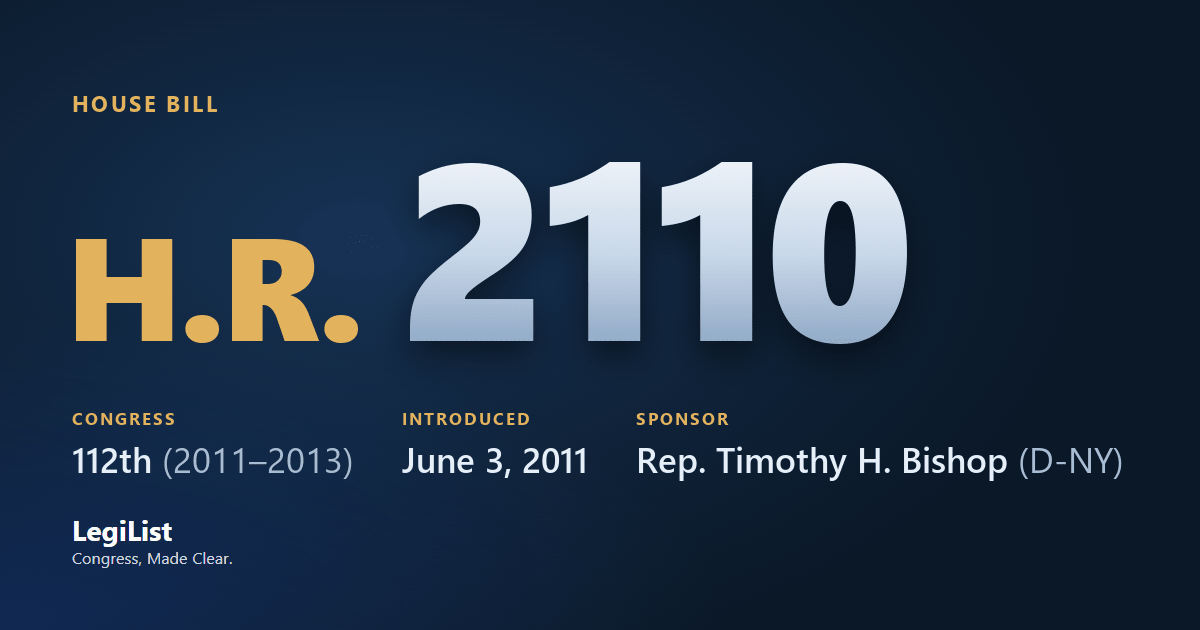
Long Island Sound Improvement Act Amendments of 2011
Latest action · Jun 6, 2011 Referred to the Subcommittee on Water Resources and Environment.
Progress
Where this bill reached, and when. A stage with no date was not reached; one that failed a vote and later carried shows the date it carried.
- IntroducedJun 3, 2011
- Passed HouseNot reached
- Passed SenateNot reached
- To the PresidentNot reached
- Became lawNot reached
Summary
Long Island Sound Improvement Act Amendments of 2011 - Amends the Federal Water Pollution Control Act (commonly known as the Clean Water Act) to create additional duties for the Long Island Sound Office of the Environmental Protection Agency (EPA), including studying the impacts of climate change on the Sound watershed.
Requires a municipality that owns or operates a municipal separate storm sewer system to obtain, without regard to the size of the population served by the system, a permit for discharges composed entirely of stormwater for any portion of the municipality that is located within both the Long Island Sound watershed and an urbanized area. Authorizes such permits to be issued on a regional basis.
Requires the EPA Administrator to ensure that: (1) permits held by industrial stormwater dischargers and permits held by construction activity dischargers conform to regional permits' conditions, and (2) monitoring requirements are included in a regional permit.
Authorizes the Administrator to provide technical assistance to municipalities with respect to establishing regional permits. Establishes: (1) reporting requirements for the Office; and (2) requirements directing agencies to ensure that their property, actions, and activities within the watershed are consistent with the Long Island Sound Comprehensive Conservation and Management Plan (Plan) and to develop plans to maximize forest cover and riparian habitat and minimize stormwater discharge on agency property.
Requires the Administrator to establish a voluntary interstate nitrogen trading program with respect to the Sound that includes the generation, trading, and use of nitrogen credits to facilitate the attainment and maintenance of the Sound Total Maximum Daily Load (TMDL). Authorizes: (1) grants for a prioritized list of projects and studies that will assist in meeting the Plan's goals and objectives; and (2) the Administrator to make grants for the construction of a publicly owned treatment work within Connecticut, Massachusetts, New Hampshire, New York, Rhode Island, and Vermont solely to a municipal or state agency if the state has established allocations for discharges within the state in a Long Island Sound TMDL.
Requires the Administrator to implement a pilot project to demonstrate the efficacy of nutrient bioextraction for the removal of nitrogen and phosphorous from the waters of the Sound watershed.
Cosponsors 13
Members who signed on, in the order they did. Signatures ran from Jun 3, 2011 to Aug 2, 2012; 1 is an original cosponsor, there from the day it was introduced.
| Seat | Cosponsor | Signed on | |
|---|---|---|---|
| R-NY | Peter T. King | Original | Jun 3, 2011 |
| D-NY | Carolyn McCarthy | Jun 13, 2011 | |
| D-CT | Christopher Murphy | Jun 13, 2011 | |
| D-NY | Eliot L. Engel | Jun 13, 2011 | |
| D-NY | Gary L. Ackerman | Jun 13, 2011 | |
| D-CT | James A. Himes | Jun 13, 2011 | |
| D-CT | Joe Courtney | Jun 13, 2011 | |
| D-NY | Jose E. Serrano | Jun 13, 2011 | |
| D-NY | Joseph Crowley | Jun 13, 2011 | |
| D-NY | Nita M. Lowey | Jun 13, 2011 | |
| D-CT | Rosa L. DeLauro | Jun 13, 2011 | |
| D-NY | Steve Israel | Jun 13, 2011 | |
| D-NY | Paul Tonko | Aug 2, 2012 |
Committees 2
Where it was sent and what each committee and subcommittee did with it, in order.
| Chamber | Committee | What it did |
|---|---|---|
| House | Transportation and Infrastructure Committee | Referred Jun 3, 2011 |
| Water Resources and Environment Subcommittee | Referred Jun 6, 2011 | |
| House | Budget Committee | Referred Jun 3, 2011 |
Actions 3
Everything that happened, newest first.
- Jun 6, 2011Referred to the Subcommittee on Water Resources and Environment.
- Jun 3, 2011Introduced in House
- Jun 3, 2011Referred to the Committee on Transportation and Infrastructure, and in addition to the Committee on the Budget, for a period to be subsequently determined by the Speaker, in each case for consideration of such provisions as fall within the jurisdiction of the committee concerned.
Research
What has been written about this bill: committee reports, cost estimates, the sponsor’s authority statement, printed hearings and the Congressional Research Service’s work.
Constitutional authority
The sponsor’s statement, as printed in the page H4036.
Printed hearings 1
Hearings whose printed record names this bill, newest first: hearings on it, and wider hearings where it came up.
| Number | Hearing | Committee | Held |
|---|---|---|---|
| Serial No. 112-39 | RUNNING ROUGHSHOD OVER STATES AND STAKEHOLDERS: EPA'S NUTRIENTS POLICIES193 pages | Transportation and Infrastructure Committee | Jun 24, 2011 |
CRS reports 1
Congressional Research Service work that CRS links to this bill or the law it became, newest first.
Cite it 1
Products on other subjects that cite it, usually among other measures.
| Product | Title | Kind | Published |
|---|---|---|---|
| R41613 | Fishery, Aquaculture, and Marine Mammal Issues in the 112th Congress Archived | Report | Jan 22, 2013 |
Related bills 1
Companion bills and other measures the record links to this one.
| Bill | Title | Relationship | Latest action |
|---|---|---|---|
| HR 3717 | Long Island Sound Restoration and Stewardship Act | Related bill | Jan 3, 2012 |
Titles 2
Every title it has carried, official and short, at each stage.
- Official Title as Introduced
- To amend the Federal Water Pollution Control Act to reauthorize and improve activities for the protection of the Long Island Sound watershed, and for other purposes.
- Short Titles as Introduced
- Long Island Sound Improvement Act Amendments of 2011
Subjects
Assigned by the Library of Congress. Policy area: Public Lands and Natural Resources.
- Administrative law and regulatory procedures
- Agricultural conservation and pollution
- Climate change and greenhouse gases
- Connecticut
- Ecology
- Environmental assessment, monitoring, research
- Environmental Protection Agency (EPA)
- Forests, forestry, trees
- Government information and archives
- Intergovernmental relations
- Internet and video services
- Internet, web applications, social media
- Lakes and rivers
- Licensing and registrations
- Long Island Sound
- Marine and coastal resources, fisheries
- Marine pollution
- Massachusetts
- New Hampshire
- New York State
- Public Lands and Natural Resources
- Rhode Island
- Solid waste and recycling
- State and local government operations
- Vermont
- Water quality
- Watersheds
- Wildlife conservation and habitat protection
Text 1
Each version as it was printed, newest first.
- Jun 3, 2011Introduced in House
Support LegiList
This page is free, carries no paywall, and is built and maintained by one person. If the record here is useful to you, a few dollars keeps it going.
Everything here is as published by Congress: the summary is the Congressional Research Service's, the action wording is the clerks', and the subjects are the Library of Congress's. How far it got is read from the actions themselves, taking the most recent one of each kind, so a bill that failed a vote and later passed is shown as having passed. Records come from this bill on Congress.gov and govinfo.gov; cost estimates are the Congressional Budget Office's, and the hearings are the printed hearings GovInfo publishes, which can appear months after the hearing.