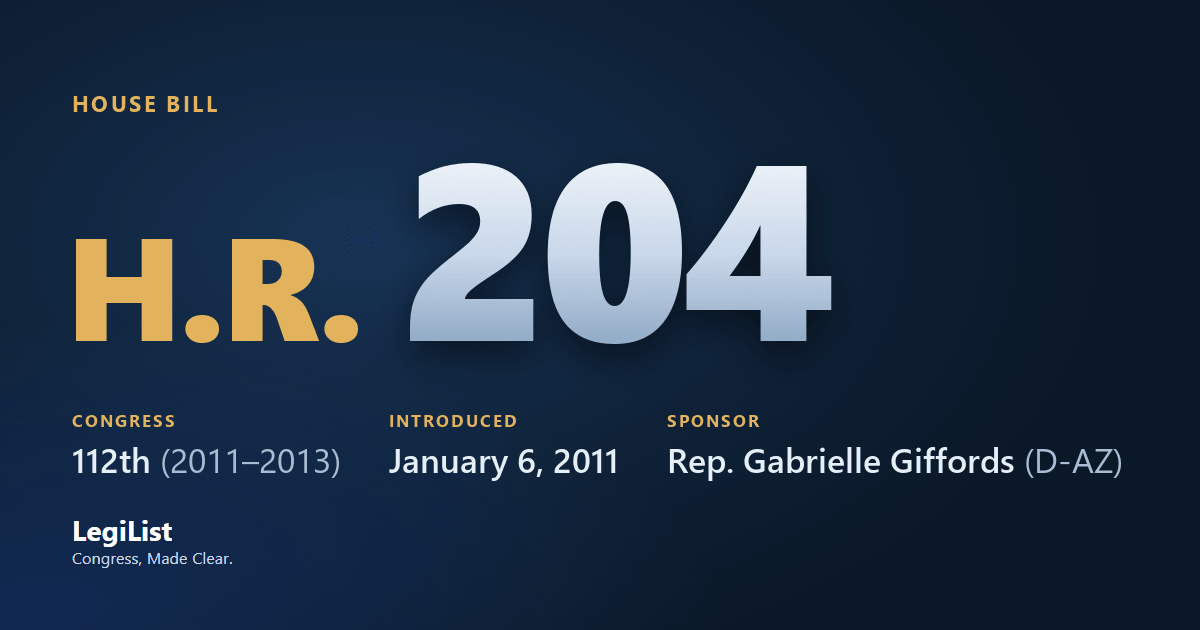
Congressional Pay Cut Act
Latest action · Feb 8, 2011 Referred to the Subcommittee on Federal Workforce, U.S. Postal Service, and Labor Policy .
Progress
Where this bill reached, and when. A stage with no date was not reached; one that failed a vote and later carried shows the date it carried.
- IntroducedJan 6, 2011
- Passed HouseNot reached
- Passed SenateNot reached
- To the PresidentNot reached
- Became lawNot reached
Summary
Congressional Pay Cut Act - Reduces the rate of basic pay for each Member of Congress by 5%, rounded to the nearest multiple of $100 (or, if midway between multiples of $100, to the next higher multiple of $100).
Declares that such adjustment shall be in lieu of any adjustment which (but for this Act) might otherwise take effect in pay periods beginning after the regularly scheduled general election for federal office held in November 2012.
Cosponsors 18
Members who signed on, in the order they did. All signed on Jan 6, 2011.
| Seat | Cosponsor | Signed on | |
|---|---|---|---|
| D-WA | Adam Smith | Original | Jan 6, 2011 |
| D-HI | Colleen Hanabusa | Original | Jan 6, 2011 |
| D-IA | David Loebsack | Original | Jan 6, 2011 |
| D-NC | Heath Shuler | Original | Jan 6, 2011 |
| D-CA | Jackie Speier | Original | Jan 6, 2011 |
| D-PA | Jason Altmire | Original | Jan 6, 2011 |
| D-CA | Jim Costa | Original | Jan 6, 2011 |
| D-IN | Joe Donnelly | Original | Jan 6, 2011 |
| D-GA | John Barrow | Original | Jan 6, 2011 |
| D-OR | Kurt Schrader | Original | Jan 6, 2011 |
| D-NC | Larry Kissell | Original | Jan 6, 2011 |
| D-IA | Leonard L. Boswell | Original | Jan 6, 2011 |
| D-PA | Mark S. Critz | Original | Jan 6, 2011 |
| D-MA | Niki Tsongas | Original | Jan 6, 2011 |
| D-OR | Peter A. DeFazio | Original | Jan 6, 2011 |
Committees 2
Where it was sent and what each committee and subcommittee did with it, in order.
| Chamber | Committee | What it did |
|---|---|---|
| House | Committee on House Administration | Referred Jan 6, 2011 |
| House | Oversight and Government Reform Committee | Referred Jan 6, 2011 |
| Information Technology Subcommittee | Referred Feb 8, 2011 |
Actions 3
Everything that happened, newest first.
- Feb 8, 2011Referred to the Subcommittee on Federal Workforce, U.S. Postal Service, and Labor Policy .
- Jan 6, 2011Introduced in House
- Jan 6, 2011Referred to the Committee on House Administration, and in addition to the Committee on Oversight and Government Reform, for a period to be subsequently determined by the Speaker, in each case for consideration of such provisions as fall within the jurisdiction of the committee concerned.
Research
What has been written about this bill: committee reports, cost estimates, the sponsor’s authority statement, printed hearings and the Congressional Research Service’s work.
Constitutional authority
The sponsor’s statement, as printed in the page H103.
CRS reports 1
Congressional Research Service work that CRS links to this bill or the law it became, newest first.
Cite it 1
Products on other subjects that cite it, usually among other measures.
| Product | Title | Kind | Published |
|---|---|---|---|
| 97-1011 | Salaries of Members of Congress: Recent Actions and Historical Tables | Report | Nov 18, 2026 |
Titles 2
Every title it has carried, official and short, at each stage.
- Official Title as Introduced
- To provide for a 5 percent reduction in the rates of basic pay for Members of Congress.
- Short Titles as Introduced
- Congressional Pay Cut Act
Subjects
Assigned by the Library of Congress. Policy area: Congress.
Text 1
Each version as it was printed, newest first.
- Jan 6, 2011Introduced in House
Support LegiList
This page is free, carries no paywall, and is built and maintained by one person. If the record here is useful to you, a few dollars keeps it going.
Everything here is as published by Congress: the summary is the Congressional Research Service's, the action wording is the clerks', and the subjects are the Library of Congress's. How far it got is read from the actions themselves, taking the most recent one of each kind, so a bill that failed a vote and later passed is shown as having passed. Records come from this bill on Congress.gov and govinfo.gov; cost estimates are the Congressional Budget Office's, and the hearings are the printed hearings GovInfo publishes, which can appear months after the hearing.