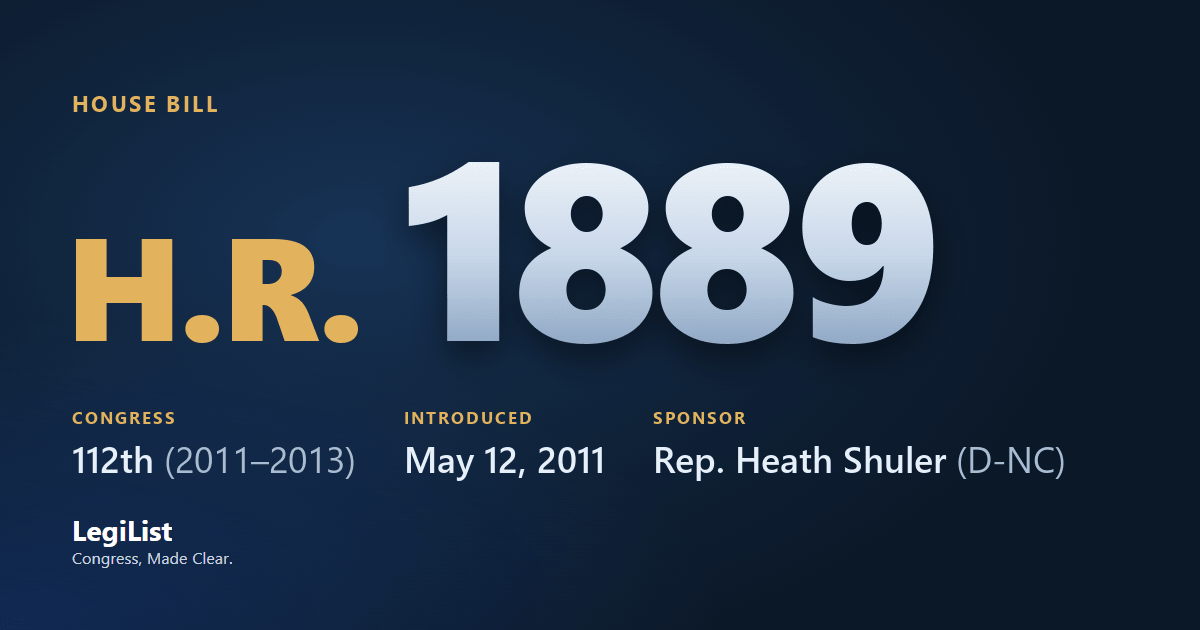
Gas Tax Holiday Act
Latest action · May 12, 2011 Referred to the House Committee on Ways and Means.
Progress
Where this bill reached, and when. A stage with no date was not reached; one that failed a vote and later carried shows the date it carried.
- IntroducedMay 12, 2011
- Passed HouseNot reached
- Passed SenateNot reached
- To the PresidentNot reached
- Became lawNot reached
Summary
Gas Tax Holiday Act - Amends the Internal Revenue Code to suspend the excise tax on highway motor fuels for 45 days beginning 7 days after the enactment of this Act. Expresses the sense of Congress that consumers should immediately receive the benefit from the suspension of such tax (i.e., 18.4 cents per gallon tax reduction).
Denies or limits for any company that is not a small, independent oil and gas company certain tax benefits for one year, including: (1) amortization of geological and geophysical expenditures; (2) the tax credits for producing oil and gas from marginal wells and for enhanced oil recovery costs; (3) the tax deductions for intangible drilling and development costs for oil and gas wells and for tertiary injectant expenses; (4) the percentage depletion allowance; (5) the exemption from limits on the deductibility of passive activity losses; and (6) the tax deduction for income attributable to domestic production activities relating to oil, natural gas, or any primary product thereof.
Prohibits the use of the last-in, first-out (LIFO) accounting method by major integrated oil companies.
Limits or denies the foreign tax credit and tax deferrals for amounts paid or accrued by a dual capacity taxpayer to a foreign country or U.S. possession for any period with respect to combined foreign oil and gas income. Defines "dual capacity taxpayer" as a person who is subject to a levy of a foreign country or U.S. possession and receives (or will receive) directly or indirectly a specific economic benefit from such county or possession.
Directs the Secretary of the Treasury to extend the one-year denial of tax benefits to any company that is not a small, independent oil and gas company if revenues raised during that period are insufficient to cover the cost of suspending the excise taxes on higway motor fuels.
Cosponsors
Members who signed on, in the order they did.
Committees 1
Where it was sent and what each committee and subcommittee did with it, in order.
| Chamber | Committee | What it did |
|---|---|---|
| House | Ways and Means Committee | Referred May 12, 2011 |
Actions 2
Everything that happened, newest first.
- May 12, 2011Introduced in House
- May 12, 2011Referred to the House Committee on Ways and Means.
Research
What has been written about this bill: committee reports, cost estimates, the sponsor’s authority statement, printed hearings and the Congressional Research Service’s work.
Constitutional authority
The sponsor’s statement, as printed in the page H3281.
Related bills 3
Companion bills and other measures the record links to this one.
| Bill | Title | Relationship | Latest action |
|---|---|---|---|
| HR 601 | End Big Oil Tax Subsidies Act of 2011 | Related bill | Feb 10, 2011 |
| HR 851 | Clean Energy Jobs Act of 2011 | Related bill | Mar 1, 2011 |
| HR 1813 | Gas Price Relief Act of 2011 | Related bill | May 10, 2011 |
Titles 2
Every title it has carried, official and short, at each stage.
- Official Title as Introduced
- To amend the Internal Revenue Code of 1986 to suspend the excise tax on highway motor fuels, and for other purposes.
- Short Titles as Introduced
- Gas Tax Holiday Act
Subjects
Assigned by the Library of Congress. Policy area: Taxation.
Text 1
Each version as it was printed, newest first.
- May 12, 2011Introduced in House
Everything here is as published by Congress: the summary is the Congressional Research Service's, the action wording is the clerks', and the subjects are the Library of Congress's. How far it got is read from the actions themselves, taking the most recent one of each kind, so a bill that failed a vote and later passed is shown as having passed. Records come from this bill on Congress.gov and govinfo.gov; cost estimates are the Congressional Budget Office's, and the hearings are the printed hearings GovInfo publishes, which can appear months after the hearing.