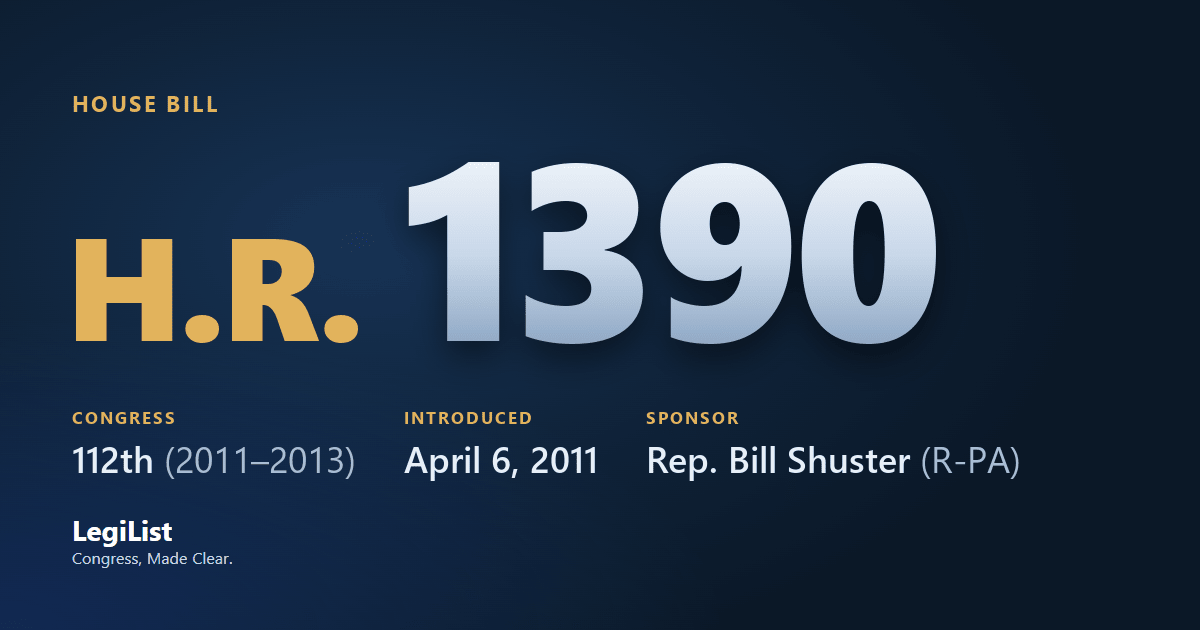
BUSES Act of 2011
Latest action · Apr 7, 2011 Referred to the Subcommittee on Highways and Transit.
Progress
Where this bill reached, and when. A stage with no date was not reached; one that failed a vote and later carried shows the date it carried.
- IntroducedApr 6, 2011
- Passed HouseNot reached
- Passed SenateNot reached
- To the PresidentNot reached
- Became lawNot reached
Summary
Bus Uniform Standards and Enhanced Safety Act of 2011 or the BUSES Act of 2011 - Directs the Secretary of Transportation to issue regulations to require: (1) monitoring of the safety performance of motorcoach service providers and other commercial motor carriers of passengers; and (2) progressive interventions to correct unsafe practices, and if they are not corrected, an enforcement action. Authorizes the Secretary to organize special enforcement strike forces to target commercial motor vehicle operators when appropriate.
Directs the Secretary to: (1) prescribe regulations to establish minimum training requirements for motorcoach drivers, (2) review testing requirements for a commercial driver's license passenger endorsement, (3) develop requirements for the testing of medical examiners who examine commercial motor vehicle operators for physical fitness and seek to be listed in the national registry, (4) review annually the implementation of the commercial driver's license requirements of at least 10 states to assess the validity of physical examination reports and medical certificates submitted by certified medical examiners, and (5) establish the national registry of medical examiners.
Sets forth additional Medical Review Board functions.
Requires the Secretary to review and report to Congress on federal commercial motor vehicle safety inspection standards.
Revises federal motor carrier registration requirements.
Directs the Secretary to prescribe federal motor vehicle safety standards for occupant protection systems for new and existing motorcoaches.
Amends the Internal Revenue Code to provide a qualified motorcoach safety credit to a taxpayer for the costs of new and existing motorcoaches to comply with the federal motor vehicle safety standards.
Requires the Secretary to provide grants (not to exceed $20,000 per vehicle) to motorcoach operators to assist with the cost of retrofitting motorcoaches in order to comply with such federal standards.
Amends the Small Business Act to grant the Administrator of the Small Business Administration (SBA) the authority to make SBA loans and loan guarantees to motorcoach operators to retrofit their buses and motorcoaches for occupant protection.
Cosponsors 9
Members who signed on, in the order they did. Signatures ran from Apr 6, 2011 to Jul 6, 2011; 2 are original cosponsors, there from the day it was introduced.
| Seat | Cosponsor | Signed on | |
|---|---|---|---|
| D-TX | Eddie Bernice Johnson | Original | Apr 6, 2011 |
| D-PA | Tim Holden | Original | Apr 6, 2011 |
| R-IN | Larry Bucshon | Apr 15, 2011 | |
| R-PA | Mike Kelly | Apr 15, 2011 | |
| R-OH | Jean Schmidt | Jun 2, 2011 | |
| D-TX | Sheila Jackson Lee | Jun 2, 2011 | |
| D-NY | Steve Israel | Jun 2, 2011 | |
| R-NH | Frank C. Guinta | Jul 6, 2011 | |
| R-LA | Jeffrey M. Landry | Jul 6, 2011 |
Committees 4
Where it was sent and what each committee and subcommittee did with it, in order.
| Chamber | Committee | What it did |
|---|---|---|
| House | Transportation and Infrastructure Committee | Referred Apr 6, 2011 |
| Highways and Transit Subcommittee | Referred Apr 7, 2011 | |
| House | Energy and Commerce Committee | Referred Apr 6, 2011 |
| Commerce, Manufacturing, and Trade Subcommittee | Referred Apr 6, 2011 | |
| House | Ways and Means Committee | Referred Apr 6, 2011 |
| House | Small Business Committee | Referred Apr 6, 2011 |
Actions 4
Everything that happened, newest first.
- Apr 7, 2011Referred to the Subcommittee on Highways and Transit.
- Apr 6, 2011Introduced in House
- Apr 6, 2011Referred to the Committee on Transportation and Infrastructure, and in addition to the Committees on Energy and Commerce, Ways and Means, and Small Business, for a period to be subsequently determined by the Speaker, in each case for consideration of such provisions as fall within the jurisdiction of the committee concerned.
- Apr 6, 2011Referred to the Subcommittee on Commerce, Manufacturing, and Trade.
Research
What has been written about this bill: committee reports, cost estimates, the sponsor’s authority statement, printed hearings and the Congressional Research Service’s work.
Constitutional authority
The sponsor’s statement, as printed in the page H2411.
Printed hearings 2
Hearings whose printed record names this bill, newest first: hearings on it, and wider hearings where it came up.
| Number | Hearing | Committee | Held |
|---|---|---|---|
| Serial No. 112-130 | MOTOR VEHICLE SAFETY PROVISIONS IN HOUSE AND SENATE HIGHWAY BILLS232 pages | Energy and Commerce Committee | Mar 22, 2012 |
| Serial No. 112-35 | HOW BEST TO IMPROVE BUS SAFETY ON OUR NATION'S HIGHWAYS134 pages | Transportation and Infrastructure Committee | Jun 13, 2011 |
Titles 3
Every title it has carried, official and short, at each stage.
- Official Title as Introduced
- To amend title 49, United States Code, to provide for enhanced motorcoach safety, and for other purposes.
- Short Titles as Introduced
- BUSES Act of 2011
- Bus Uniform Standards and Enhanced Safety Act of 2011
Subjects
Assigned by the Library of Congress. Policy area: Transportation and Public Works.
- Administrative law and regulatory procedures
- Business investment and capital
- Department of Transportation
- Government information and archives
- Government lending and loan guarantees
- Government studies and investigations
- Health information and medical records
- Health personnel
- Income tax credits
- Licensing and registrations
- Medical tests and diagnostic methods
- Motor carriers
- Motor vehicles
- Small business
- Transportation and Public Works
- Transportation employees
- Transportation programs funding
- Transportation safety and security
Text 1
Each version as it was printed, newest first.
- Apr 6, 2011Introduced in House
Everything here is as published by Congress: the summary is the Congressional Research Service's, the action wording is the clerks', and the subjects are the Library of Congress's. How far it got is read from the actions themselves, taking the most recent one of each kind, so a bill that failed a vote and later passed is shown as having passed. Records come from this bill on Congress.gov and govinfo.gov; cost estimates are the Congressional Budget Office's, and the hearings are the printed hearings GovInfo publishes, which can appear months after the hearing.