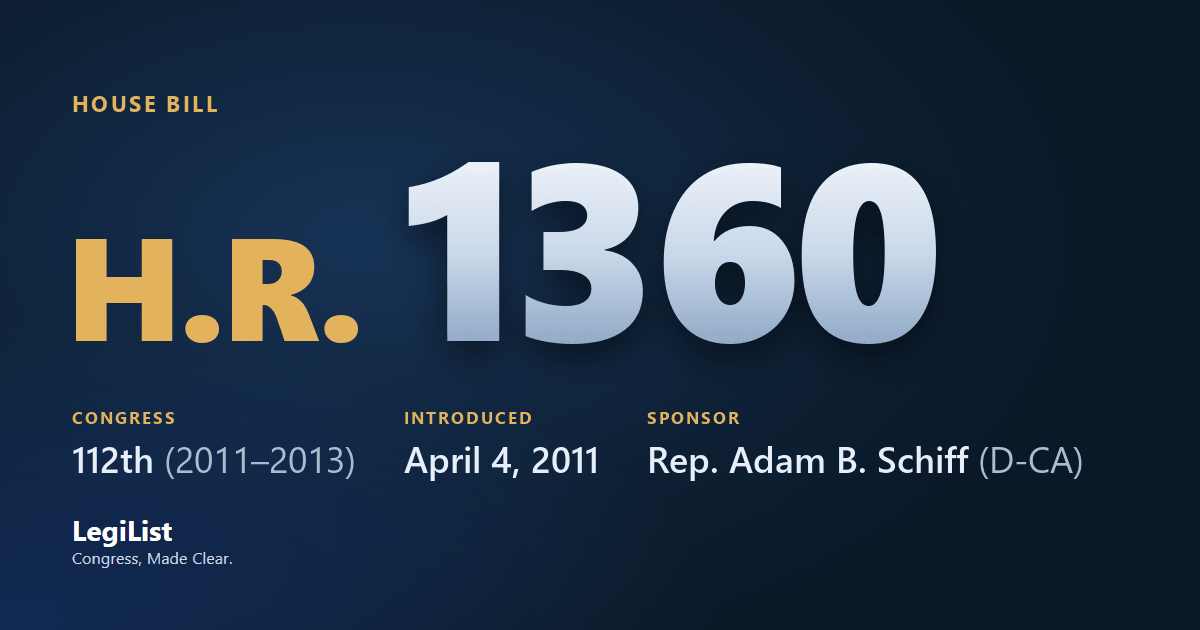
Child Protection Improvements Act of 2011
Latest action · Jul 11, 2011 Referred to the Subcommittee on Crime, Terrorism, and Homeland Security.
Progress
Where this bill reached, and when. A stage with no date was not reached; one that failed a vote and later carried shows the date it carried.
- IntroducedApr 4, 2011
- Passed HouseNot reached
- Passed SenateNot reached
- To the PresidentNot reached
- Became lawNot reached
Summary
Child Protection Improvements Act of 2011 - Amends the National Child Protection Act of 1993 to direct the Attorney General to: (1) establish policies and procedures for a program for national criminal history background checks for child-serving organizations, (2) assist such organizations in obtaining access to nationwide background checks, (3) establish procedures for ensuring the accuracy of criminal history records, (4) identify individuals convicted of serious misdemeanors or felonies involving children, and (5) collect demographic data relating to individuals and organizations covered by this Act and make reports to Congress on such data.
Limits the liability of a child-serving organization for failure to conduct criminal background checks or to take adverse action against employees with a criminal history. Imposes limitations on the disclosure or use of criminal history records.
Amends the PROTECT Act to extend the Child Safety Pilot Program.
Cosponsors 9
Members who signed on, in the order they did. Signatures ran from Apr 4, 2011 to Apr 17, 2012; 2 are original cosponsors, there from the day it was introduced.
| Seat | Cosponsor | Signed on | |
|---|---|---|---|
| D-MI | John Conyers, Jr. | Original | Apr 4, 2011 |
| R-MI | Mike Rogers | Original | Apr 4, 2011 |
| D-MA | Barney Frank | May 11, 2011 | |
| D-MI | Gary C. Peters | Mar 7, 2012 | |
| D-MA | James P. McGovern | Mar 7, 2012 | |
| D-CT | Joe Courtney | Mar 7, 2012 | |
| D-OK | Dan Boren | Apr 17, 2012 | |
| R-IL | Peter J. Roskam | Apr 17, 2012 | |
| R-IL | Robert J. Dold | Apr 17, 2012 |
Committees 1
Where it was sent and what each committee and subcommittee did with it, in order.
| Chamber | Committee | What it did |
|---|---|---|
| House | Judiciary Committee | Referred Apr 4, 2011 |
| Crime and Federal Government Surveillance Subcommittee | Referred Jul 11, 2011 |
Actions 3
Everything that happened, newest first.
- Jul 11, 2011Referred to the Subcommittee on Crime, Terrorism, and Homeland Security.
- Apr 4, 2011Introduced in House
- Apr 4, 2011Referred to the House Committee on the Judiciary.
Research
What has been written about this bill: committee reports, cost estimates, the sponsor’s authority statement, printed hearings and the Congressional Research Service’s work.
Constitutional authority
The sponsor’s statement, as printed in the page H2293.
Related bills 1
Companion bills and other measures the record links to this one.
| Bill | Title | Relationship | Latest action |
|---|---|---|---|
| S 645 | Child Protection Improvements Act of 2012 | Related bill | Sep 19, 2012 |
Titles 2
Every title it has carried, official and short, at each stage.
- Official Title as Introduced
- To amend the National Child Protection Act of 1993 to establish a permanent background check system.
- Short Titles as Introduced
- Child Protection Improvements Act of 2011
Subjects
Assigned by the Library of Congress. Policy area: Crime and Law Enforcement.
- Child care and development
- Child safety and welfare
- Civil actions and liability
- Crime and Law Enforcement
- Crimes against children
- Criminal justice information and records
- Elementary and secondary education
- Employment discrimination and employee rights
- Personnel records
- Preschool education
- Right of privacy
- Teaching, teachers, curricula
Text 1
Each version as it was printed, newest first.
- Apr 4, 2011Introduced in House
Support LegiList
This page is free, carries no paywall, and is built and maintained by one person. If the record here is useful to you, a few dollars keeps it going.
Everything here is as published by Congress: the summary is the Congressional Research Service's, the action wording is the clerks', and the subjects are the Library of Congress's. How far it got is read from the actions themselves, taking the most recent one of each kind, so a bill that failed a vote and later passed is shown as having passed. Records come from this bill on Congress.gov and govinfo.gov; cost estimates are the Congressional Budget Office's, and the hearings are the printed hearings GovInfo publishes, which can appear months after the hearing.