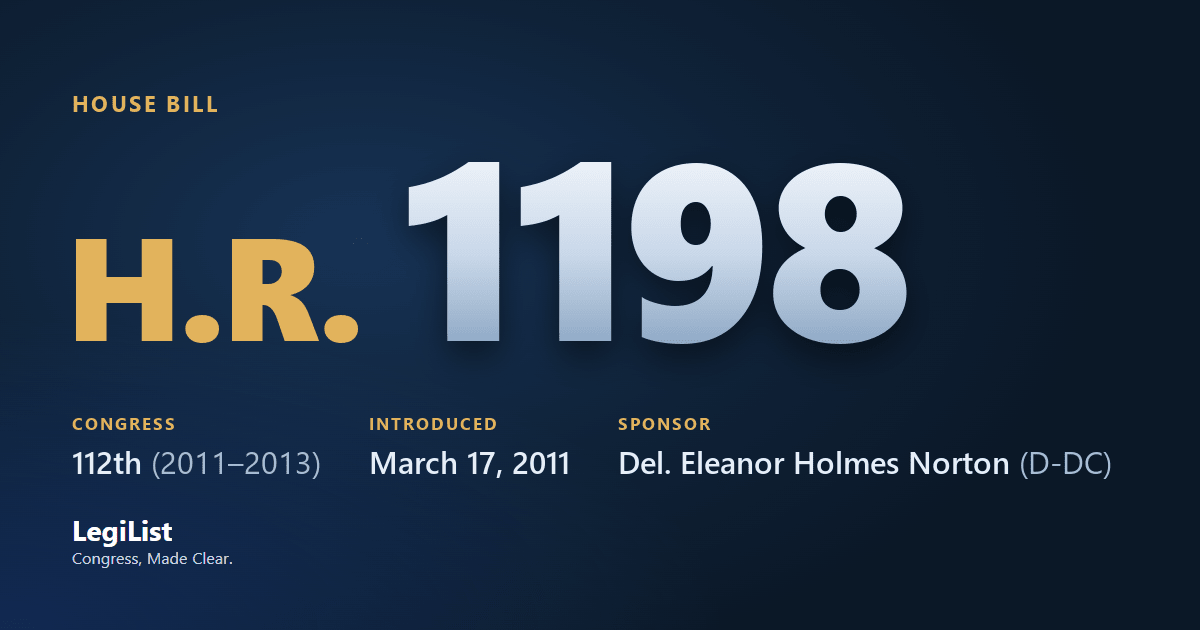
District of Columbia National Guard Home Rule Act
Latest action · May 18, 2011 Referred to the Subcommittee on Military Personnel.
Progress
Where this bill reached, and when. A stage with no date was not reached; one that failed a vote and later carried shows the date it carried.
- IntroducedMar 17, 2011
- Passed HouseNot reached
- Passed SenateNot reached
- To the PresidentNot reached
- Became lawNot reached
Summary
District of Columbia National Guard Home Rule Act - Amends the District of Columbia Code to make the Mayor of the District of Columbia (under current law, the President of the United States) the Commander-in-Chief of the National Guard of the District.
Provides that, notwithstanding the authority of the Mayor of the District of Columbia as such Commander-in-Chief, the President shall retain control over units and members of the District of Columbia National Guard to conduct necessary and appropriate homeland defense activities.
Cosponsors
Members who signed on, in the order they did.
Committees 2
Where it was sent and what each committee and subcommittee did with it, in order.
| Chamber | Committee | What it did |
|---|---|---|
| House | Oversight and Government Reform Committee | Referred Mar 17, 2011 |
| Health Care and Financial Services Subcommittee | Referred Apr 1, 2011 | |
| House | Armed Services Committee | Referred Mar 17, 2011 |
| Military Personnel Subcommittee | Referred May 18, 2011 |
Actions 5
Everything that happened, newest first.
- May 18, 2011Referred to the Subcommittee on Military Personnel.
- Apr 1, 2011Referred to the Subcommittee on Health Care, District of Columbia, Census and the National Archives.
- Mar 17, 2011Introduced in House
- Mar 17, 2011Sponsor introductory remarks on measure. (CR E523-524)
- Mar 17, 2011Referred to the Committee on Oversight and Government Reform, and in addition to the Committee on Armed Services, for a period to be subsequently determined by the Speaker, in each case for consideration of such provisions as fall within the jurisdiction of the committee concerned.
In the Congressional Record 1
Days the Record’s own index lists this bill, newest first, with the pages and the members it names. Pages starting H are the House, S the Senate, E Extensions of Remarks.
| Where | In the Record | Members | Date |
|---|---|---|---|
| Extensions | Debate and remarks E523 | Eleanor Holmes Norton D-DC | Mar 17, 2011 |
Research
What has been written about this bill: committee reports, cost estimates, the sponsor’s authority statement, printed hearings and the Congressional Research Service’s work.
Constitutional authority
The sponsor’s statement, as printed in the page H1987.
Titles 2
Every title it has carried, official and short, at each stage.
- Official Title as Introduced
- To extend to the Mayor of the District of Columbia the same authority over the National Guard of the District of Columbia as the Governors of the several States exercise over the National Guard of those States with respect to administration of the National Guard and its use to respond to natural disasters and other civil disturbances, while ensuring that the President retains control of the National Guard of the District of Columbia to respond to homeland defense emergencies.
- Short Titles as Introduced
- District of Columbia National Guard Home Rule Act
Subjects
Assigned by the Library of Congress. Policy area: Government Operations and Politics.
Text 1
Each version as it was printed, newest first.
- Mar 17, 2011Introduced in House
Everything here is as published by Congress: the summary is the Congressional Research Service's, the action wording is the clerks', and the subjects are the Library of Congress's. How far it got is read from the actions themselves, taking the most recent one of each kind, so a bill that failed a vote and later passed is shown as having passed. Records come from this bill on Congress.gov and govinfo.gov; cost estimates are the Congressional Budget Office's, and the hearings are the printed hearings GovInfo publishes, which can appear months after the hearing.