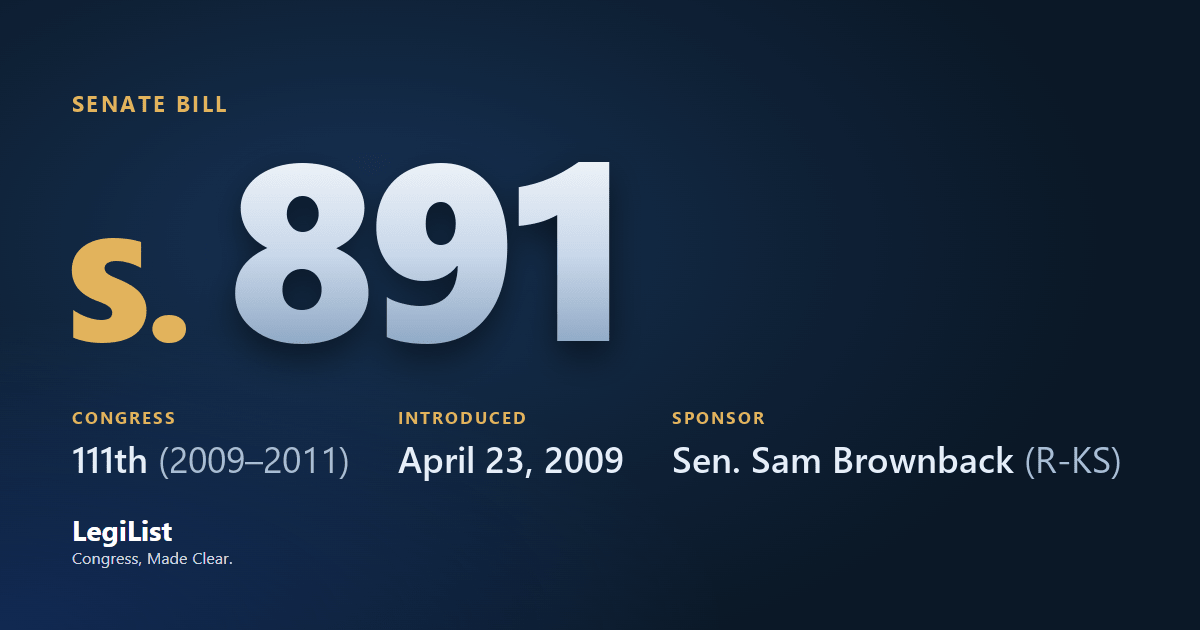
Congo Conflict Minerals Act of 2009
Latest action · Apr 23, 2009 Read twice and referred to the Committee on Banking, Housing, and Urban Affairs.
Progress
Where this bill reached, and when. A stage with no date was not reached; one that failed a vote and later carried shows the date it carried.
- IntroducedApr 23, 2009
- Passed SenateNot reached
- Passed HouseNot reached
- To the PresidentNot reached
- Became lawNot reached
Summary
Congo Conflict Minerals Act of 2009 - Declares it is U.S. policy to promote peace and security in the Democratic Republic of Congo (DRC) by supporting the efforts of the DRC, other governments in the Great Lakes Region of Africa, and the international community to: (1) monitor and stop commercial activities involving the natural resources of the DRC (the minerals columbite-tantalite [coltan], cassiterite, wolframite, and gold) that contribute to illegal armed groups and human rights violations in the eastern region of the DRC; and (2) develop stronger governance and economic institutions that can facilitate and improve transparency in the cross-border trade involving such natural resources in order to reduce exploitation by illegal armed groups and promote local and regional development.
Directs the President, acting through the Secretary of State, the U.S. Permanent Representative to the United Nations (UN), and other appropriate U.S. officials to use the voice of the United States at the UN Security Council to renew the mandate and strengthen the capacity of the UN Group of Experts on the DRC to investigate links between such minerals and the financing of illegal armed groups.
Directs the Secretary to work with UN member states and local and international organizations to: (1) produce, and make public, a map of mineral-rich zones and illegal armed groups in the eastern region of the DRC; and (2) provide guidance to commercial entities to ensure that the raw materials used in their products do not finance armed conflict, result in labor or human rights violations, or damage the environment.
Requires the Secretary, working with the Administrator of the U.S. Agency for International Development (USAID), to report to Congress on a strategy to address the links that exist between human rights abuses, armed groups, and the mining of the minerals in the DRC.
Requires specified annual reports to cover such links.
Amends the Securities Exchange Act of 1934 to require the Securities and Exchange Commission (SEC) to promulgate rules to require certain persons who engage in the trade or use of coltan, cassiterite, and wolframite to disclose annually to the SEC the country of origin and mine of origin of such minerals.
Expresses the sense of Congress on assistance to communities in the eastern DRC that depend economically on the mineral trade, particularly those affected by sexual and gender-based violence, as well as individuals displaced by violence.
Cosponsors 22
Members who signed on, in the order they did. Signatures ran from Apr 23, 2009 to May 10, 2010; 2 are original cosponsors, there from the day it was introduced.
| Seat | Cosponsor | Signed on | |
|---|---|---|---|
| D-IL | Richard J. Durbin | Original | Apr 23, 2009 |
| D-WI | Russell D. Feingold | Original | Apr 23, 2009 |
| D-NY | Charles E. Schumer | Apr 30, 2009 | |
| D-AK | Mark Begich | May 20, 2009 | |
| D-MD | Benjamin L. Cardin | Jun 3, 2009 | |
| D-IL | Roland Burris | Jun 8, 2009 | |
| R-MS | Roger F. Wicker | Jun 15, 2009 | |
| D-CA | Barbara Boxer | Jul 10, 2009 | |
| D-RI | Sheldon Whitehouse | Sep 23, 2009 | |
| I-VT | Bernard Sanders | Oct 26, 2009 | |
| D-CA | Dianne Feinstein | Dec 14, 2009 | |
| D-PA | Robert P. Casey Jr. | Dec 22, 2009 | |
| D-OH | Sherrod Brown | Dec 23, 2009 | |
| D-SD | Tim Johnson | Dec 24, 2009 | |
| D-IN | Evan Bayh | Jan 20, 2010 | |
| D-NJ | Frank R. Lautenberg | Jan 20, 2010 | |
| D-VT | Patrick J. Leahy | Feb 2, 2010 | |
| D-OR | Ron Wyden | Mar 3, 2010 | |
| D-PA | Arlen Specter | Apr 14, 2010 | |
| I-CT | Joseph I. Lieberman | Apr 19, 2010 | |
| D-MD | Barbara A. Mikulski | Apr 27, 2010 | |
| D-OR | Jeff Merkley | May 10, 2010 |
Committees 1
Where it was sent and what each committee and subcommittee did with it, in order.
| Chamber | Committee | What it did |
|---|---|---|
| Senate | Banking, Housing, and Urban Affairs Committee | Referred Apr 24, 2009 |
Actions 3
Everything that happened, newest first.
- Apr 23, 2009Introduced in Senate
- Apr 23, 2009Sponsor introductory remarks on measure. (CR S4696-4697)
- Apr 23, 2009Read twice and referred to the Committee on Banking, Housing, and Urban Affairs.
In the Congressional Record 3
Days the Record’s own index lists this bill, newest first, with the pages and the members it names. Pages starting H are the House, S the Senate, E Extensions of Remarks.
| Where | In the Record | Members | Date |
|---|---|---|---|
| Senate | Debate and remarks S13030 | Russell D. Feingold D-WI | Dec 11, 2009 |
| Senate | Debate and remarks S4745 | Richard J. Durbin D-IL | Apr 27, 2009 |
| Senate | Debate and remarks S4696–S4698 | Russell D. Feingold D-WI, Sam Brownback R-KS | Apr 23, 2009 |
Research
What has been written about this bill: committee reports, cost estimates, the sponsor’s authority statement, printed hearings and the Congressional Research Service’s work.
CRS reports 1
Congressional Research Service work that CRS links to this bill or the law it became, newest first.
Cite it 1
Products on other subjects that cite it, usually among other measures.
| Product | Title | Kind | Published |
|---|---|---|---|
| R42618 | Conflict Minerals in Central Africa: U.S. and International Responses Archived | Report | Jul 20, 2012 |
Titles 2
Every title it has carried, official and short, at each stage.
- Official Title as Introduced
- A bill to require annual disclosure to the Securities and Exchange Commission of activities involving columbite-tantalite, cassiterite, and wolframite from the Democratic Republic of Congo, and for other purposes.
- Short Titles as Introduced
- Congo Conflict Minerals Act of 2009
Subjects
Assigned by the Library of Congress. Policy area: International Affairs.
- Administrative law and regulatory procedures
- Africa
- Agricultural trade
- Conflicts and wars
- Congressional oversight
- Crime victims
- Crimes against women
- Democratic Republic of the Congo
- Employment discrimination and employee rights
- Environmental assessment, monitoring, research
- Foreign aid and international relief
- Government studies and investigations
- Human rights
- International Affairs
- International organizations and cooperation
- Metals
- Mining
- Securities
- Securities and Exchange Commission (SEC)
- Sex offenses
- Sovereignty, recognition, national governance and status
- Trade restrictions
- United Nations
- Women's rights
Text 1
Each version as it was printed, newest first.
- Apr 23, 2009Introduced in Senate
Everything here is as published by Congress: the summary is the Congressional Research Service's, the action wording is the clerks', and the subjects are the Library of Congress's. How far it got is read from the actions themselves, taking the most recent one of each kind, so a bill that failed a vote and later passed is shown as having passed. Records come from this bill on Congress.gov and govinfo.gov; cost estimates are the Congressional Budget Office's, and the hearings are the printed hearings GovInfo publishes, which can appear months after the hearing.