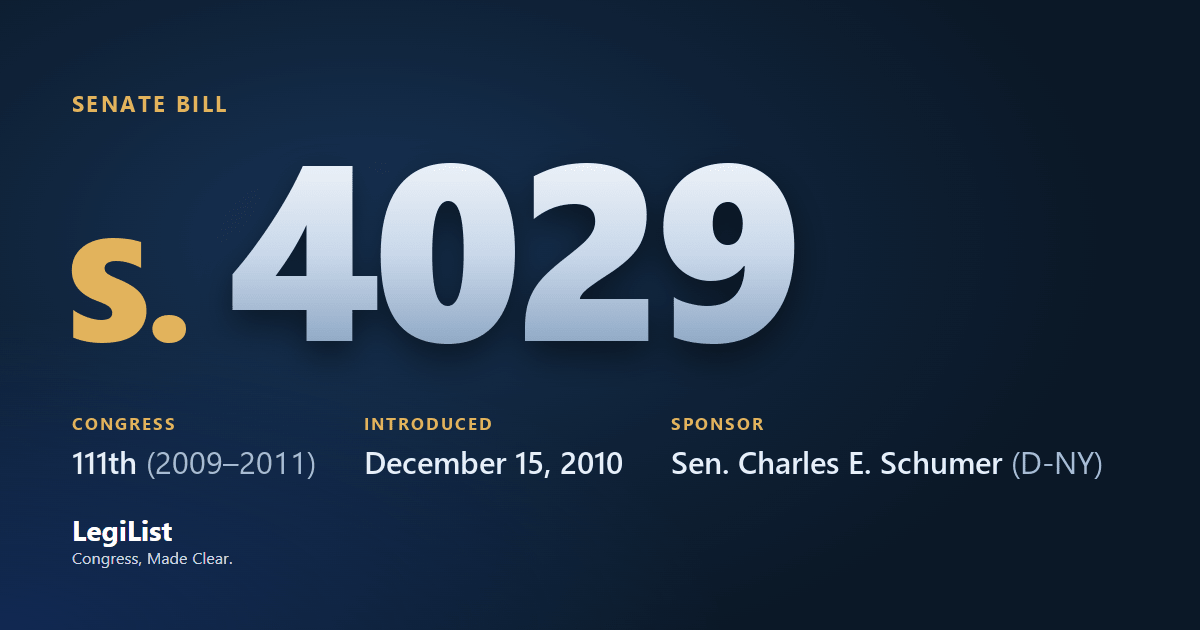
Preventing Sex Offenders Access to Children in Our Communities Act of 2010
Latest action · Dec 15, 2010 Read twice and referred to the Committee on the Judiciary.
Progress
Where this bill reached, and when. A stage with no date was not reached; one that failed a vote and later carried shows the date it carried.
- IntroducedDec 15, 2010
- Passed SenateNot reached
- Passed HouseNot reached
- To the PresidentNot reached
- Became lawNot reached
Summary
Preventing Sex Offenders Access to Children in Our Communities Act of 2010 - Amends the Sex Offender Notification and Registration Act to require jurisdictions subject to such Act (i.e., states, the District of Columbia, the Commonwealth of Puerto Rico, Guam, American Samoa, the Northern Mariana Islands, the U.S. Virgin Islands, and certain Indian tribes) to prohibit registered sex offenders from: (1) accepting a position of employment, including a volunteer position, which by the inherent nature of the position places such sex offender in direct and substantial contact with minors; or (2) obtaining a permit or permission to carry out an activity or performance that would present direct and substantial contact with minors.
Authorizes the Attorney General to award grants and enter into contracts with public agencies or nonprofit private organizations to establish a community accessible sex offender tips and support program to provide for anonymous or confidential tips regarding sex offenders who are not complying with registration or other applicable requirements.
Requires the Director of the Office of Management and Budget (OMB) to: (1) coordinate with the head of each executive agency to determine which government publications could be made available on government web sites and no longer printed; (2) devise a strategy to reduce overall government printing costs by not less than $15 million over a five-year period beginning with FY2011; and (3) ensure that essential printed documents continue to be made available to Social Security and Medicare beneficiaries and individuals living in areas with limited Internet access or use.
Cosponsors 2
Members who signed on, in the order they did. All signed on Dec 15, 2010.
| Seat | Cosponsor | Signed on | |
|---|---|---|---|
| D-NH | Jeanne Shaheen | Original | Dec 15, 2010 |
| R-MA | Scott P. Brown | Original | Dec 15, 2010 |
Committees 1
Where it was sent and what each committee and subcommittee did with it, in order.
| Chamber | Committee | What it did |
|---|---|---|
| Senate | Judiciary Committee | Referred Dec 15, 2010 |
Actions 2
Everything that happened, newest first.
- Dec 15, 2010Introduced in Senate
- Dec 15, 2010Read twice and referred to the Committee on the Judiciary.
Related bills 1
Companion bills and other measures the record links to this one.
| Bill | Title | Relationship | Latest action |
|---|---|---|---|
| HR 6566 | Preventing Sex Offenders Access to Children in Our Communities Act of 2010 | Identical bill | Dec 21, 2010 |
Titles 2
Every title it has carried, official and short, at each stage.
- Official Title as Introduced
- A bill to protect children from registered sex offenders, and for other purposes.
- Short Titles as Introduced
- Preventing Sex Offenders Access to Children in Our Communities Act of 2010
Subjects
Assigned by the Library of Congress. Policy area: Crime and Law Enforcement.
- Administrative law and regulatory procedures
- Child safety and welfare
- Crime and Law Enforcement
- Crimes against children
- Criminal justice information and records
- Department of Justice
- Government information and archives
- Internet and video services
- Internet, web applications, social media
- Law enforcement administration and funding
- Sex offenses
- Social work, volunteer service, charitable organizations
Text 1
Each version as it was printed, newest first.
- Dec 15, 2010Introduced in Senate
Everything here is as published by Congress: the summary is the Congressional Research Service's, the action wording is the clerks', and the subjects are the Library of Congress's. How far it got is read from the actions themselves, taking the most recent one of each kind, so a bill that failed a vote and later passed is shown as having passed. Records come from this bill on Congress.gov and govinfo.gov; cost estimates are the Congressional Budget Office's, and the hearings are the printed hearings GovInfo publishes, which can appear months after the hearing.