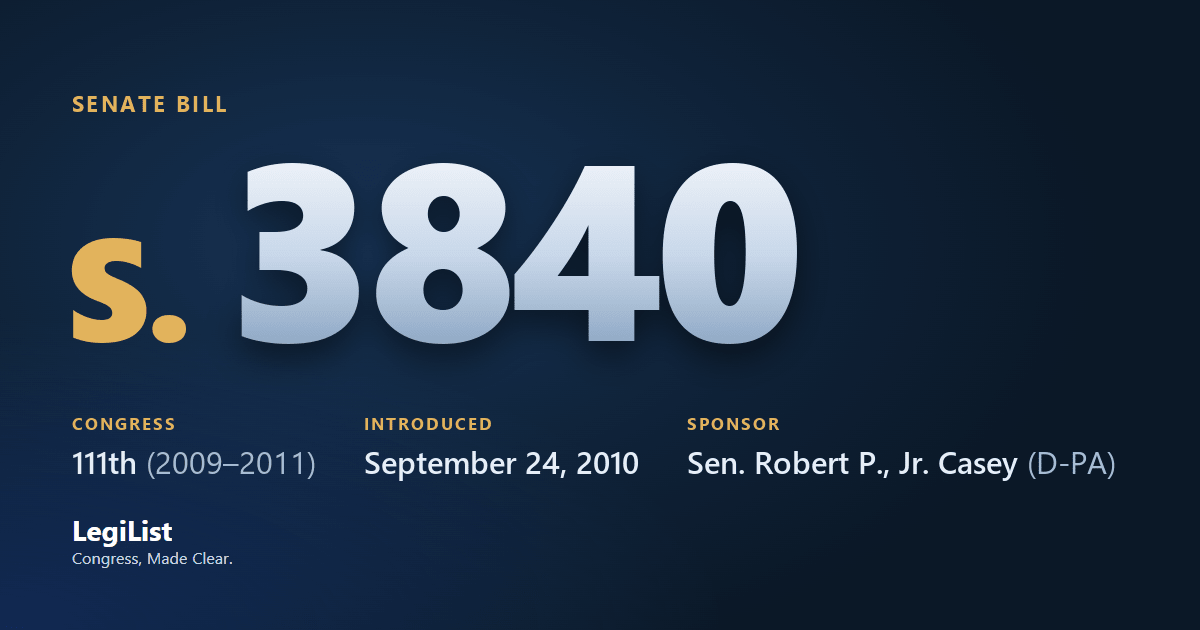
Working Families Flexibility Act
Latest action · Sep 24, 2010 Read twice and referred to the Committee on Health, Education, Labor, and Pensions.
Progress
Where this bill reached, and when. A stage with no date was not reached; one that failed a vote and later carried shows the date it carried.
- IntroducedSep 24, 2010
- Passed SenateNot reached
- Passed HouseNot reached
- To the PresidentNot reached
- Became lawNot reached
Summary
Working Families Flexibility Act - Authorizes an employee to request from an employer a change in the terms or conditions of the employee's employment if the request relates to: (1) the number of hours the employee is required to work; (2) the times when the employee is required to work; or (3) where the employee is required to work. Sets forth certain employer duties with respect to such requests.
Makes it unlawful for an employer to interfere with any rights provided to an employee under this Act. Authorizes an employee to file a complaint with the Administrator of the Wage and Hour Division of the Employment Standards Administration of the Department of Labor for any violations of such rights. Provides for the investigation and assessment of civil penalties or the award of relief for alleged violations, including the review in federal courts of appeal of orders of the Administrator.
Requires the Secretary of Labor to carry out a research, education, and technical assistance program for employers, labor organizations, and the general public regarding compliance with this Act.
Applies the requirements of this Act to certain classes of employees, including employees of the Government Accountability Office (GAO) and the Library of Congress.
Cosponsors 1
Members who signed on, in the order they did. All signed on Sep 24, 2010.
| Seat | Cosponsor | Signed on | |
|---|---|---|---|
| D-IA | Tom Harkin | Original | Sep 24, 2010 |
Committees 1
Where it was sent and what each committee and subcommittee did with it, in order.
| Chamber | Committee | What it did |
|---|---|---|
| Senate | Health, Education, Labor, and Pensions Committee | Referred Sep 24, 2010 |
Actions 3
Everything that happened, newest first.
- Sep 24, 2010Introduced in Senate
- Sep 24, 2010Sponsor introductory remarks on measure. (CR S7447)
- Sep 24, 2010Read twice and referred to the Committee on Health, Education, Labor, and Pensions.
In the Congressional Record 1
Days the Record’s own index lists this bill, newest first, with the pages and the members it names. Pages starting H are the House, S the Senate, E Extensions of Remarks.
| Where | In the Record | Members | Date |
|---|---|---|---|
| Senate | Debate and remarks S7447 | Robert P. Casey Jr. D-PA | Sep 24, 2010 |
Related bills 1
Companion bills and other measures the record links to this one.
| Bill | Title | Relationship | Latest action |
|---|---|---|---|
| HR 1274 | Working Families Flexibility Act | Related bill | Aug 19, 2009 |
Titles 2
Every title it has carried, official and short, at each stage.
- Official Title as Introduced
- A bill to permit employees to request, and to ensure employers consider requests for, flexible work terms and conditions, and for other purposes.
- Short Titles as Introduced
- Working Families Flexibility Act
Subjects
Assigned by the Library of Congress. Policy area: Labor and Employment.
- Administrative remedies
- Civil actions and liability
- Congressional agencies
- Congressional officers and employees
- Department of Labor
- Employment discrimination and employee rights
- Government Accountability Office (GAO)
- Government employee pay, benefits, personnel management
- Government information and archives
- Judicial review and appeals
- Labor and Employment
- Labor-management relations
- Library of Congress
Text 1
Each version as it was printed, newest first.
- Sep 24, 2010Introduced in Senate
Support LegiList
This page is free, carries no paywall, and is built and maintained by one person. If the record here is useful to you, a few dollars keeps it going.
Everything here is as published by Congress: the summary is the Congressional Research Service's, the action wording is the clerks', and the subjects are the Library of Congress's. How far it got is read from the actions themselves, taking the most recent one of each kind, so a bill that failed a vote and later passed is shown as having passed. Records come from this bill on Congress.gov and govinfo.gov; cost estimates are the Congressional Budget Office's, and the hearings are the printed hearings GovInfo publishes, which can appear months after the hearing.