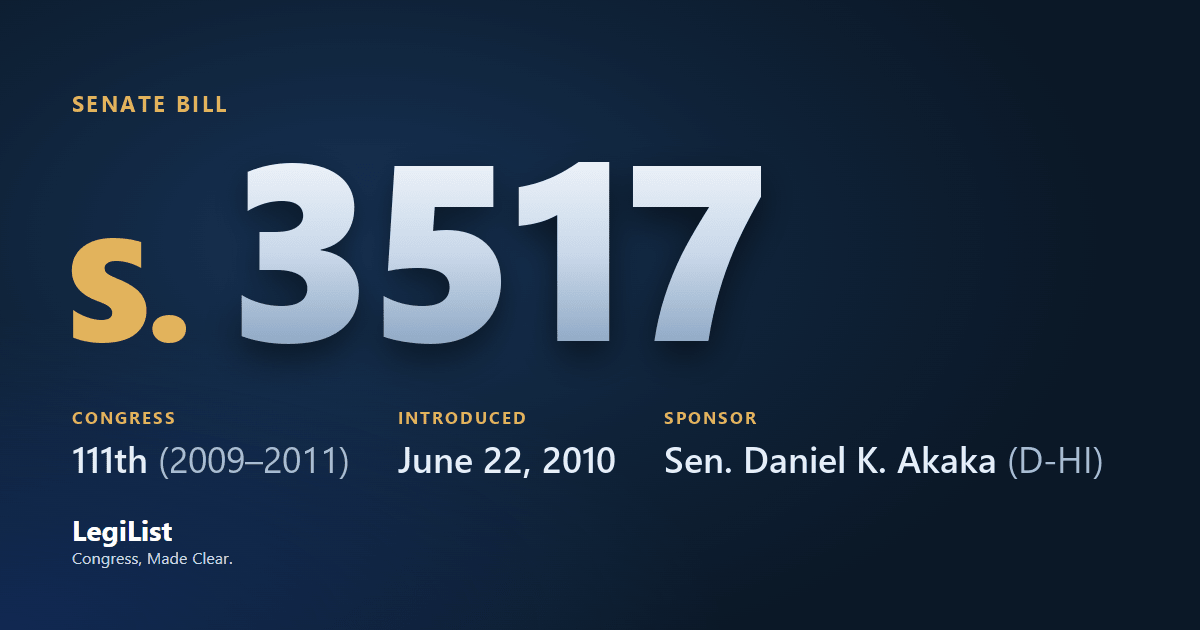
Claims Processing Improvement Act of 2010
Latest action · Nov 29, 2010 Placed on Senate Legislative Calendar under General Orders. Calendar No. 654.
Progress
Where this bill reached, and when. A stage with no date was not reached; one that failed a vote and later carried shows the date it carried.
- IntroducedJun 22, 2010
- Passed SenateNot reached
- Passed HouseNot reached
- To the PresidentNot reached
- Became lawNot reached
Summary
Claims Processing Improvement Act of 2010 - (Sec. 2) Directs the Secretary of Veterans Affairs (VA), in the case of a veteran's disability claim with multiple conditions, to assign a disability rating for the condition(s) that can be assigned without further development, and to continue development of the remaining condition(s). Requires the Secretary to continue development of any condition for which a rating has been assigned and to reassess such rating, if the Secretary determines that further development could result in the assignment of a higher rating.
(Sec. 3) Provides that if a VA claimant in under 18 years old, mentally incompetent, or unable to sign a claim form, such form may be signed by a court-appointed representative or other person responsible for the claimant's care, including a spouse or other relative. Provides that if an individual is in the care of an institution, the manager or principal officer of such institution may sign.
(Sec. 4) Requires the Secretary to notify a claimant and the claimant's representative of additional information or medical or lay evidence required to substantiate and grant a claim, as long as the original application was substantially complete.
(Sec. 5) Requires the Secretary to: (1) treat a private medical opinion in support of a claim for compensation with the same deference as a medical opinion provided by a VA health care provider; and (2) obtain from a VA health care provider supplemental information in support of a private medical opinion that was submitted in order to assign a disability rating or to determine service-connection of a disability.
(Sec. 6) Directs the Secretary to: (1) establish a process for the rapid identification of initial disability claims that should receive review priority; (2) assign experienced VA claim processors to review initial claims to determine those that have the potential for quick adjudication or for priority treatment; and (3) give review priority to claims identified as having the potential for quick adjudication.
Authorizes the Secretary, upon notification that a claimant has no additional information or evidence to submit, to determine that the claim is fully developed, and decide the claim based on all evidence of record.
(Sec. 7) Authorizes the Secretary to provide an effective date of an award of disability compensation, in the case of a veteran who submits a fully-developed claim, of up to one year before the date of receipt of such claim.
(Sec. 8) Requires the Secretary to include with notifications of claims decisions a notice-of-disagreement form that may be used to initiate appellate review of such decision.
(Sec. 9) Deems any form for VA survivor benefits as an application for both VA dependency and indemnity compensation (DIC) and social security benefits.
(Sec. 10) Allows the Secretary to require any person recognized as a fiduciary for a VA beneficiary to provide authorization for the Secretary to obtain from financial institutions any financial records determined necessary: (1) for the administration of a VA program; or (2) to safeguard the beneficiary's benefits against neglect, misappropriation, or fraud. Deems such an authorization as meeting the requirements of the Right to Financial Privacy Act of 1978. Requires the Secretary to inform any person providing such authorization of its duration and scope.
(Sec. 11) Treats as a motion for reconsideration of a decision of the Board of Veterans' Appeals (Board) a document filed with the Board or the agency of original jurisdiction that expresses disagreement with the decision, as long as such document was filed within 120 days after such decision.
(Sec. 12) Requires forms representing a notice of disagreement with a VA claim decision to be filed within 180 days (under current law, one year) after notification of the claim decision. Allows an extension of such deadline for up to 186 additional days, for good cause shown.
(Sec. 13) Replaces VA responsibility to provide a "statement of the case" after the filing of a notice of disagreement with a claim decision with a "post-notice of disagreement decision." Requires additional information to be provided in the post-notice of disagreement decision, including the date by which a substantive appeal must be filed in order to obtain further review.
(Sec. 14) Allows a claimant up to 60 days from the date the post-notice of disagreement decision is mailed to file a substantive appeal. Allows an additional 60 days for such filing, for good cause shown.
(Sec. 15) Requires initial review by the Board of a substantive appeal containing new evidence, unless the claimant, within 30 days after submission of the new evidence, requests review by the agency of original jurisdiction.
(Sec. 16) Requires the Board, upon request by an appellant for a hearing before the Board, to determine the location and manner of appearance (in-person, teleconferencing, videoconferencing) for such hearing.
(Sec. 17) Directs the Court of Appeals for Veterans Claims (Court), in carrying out a review of a Board decision, to render a decision on every issue raised by the appellant.
(Sec. 18) Allows the Court to extend the 120-day period for the filing of a notice of appeal of a Board decision by an additional 120 days, for good cause shown.
(Sec. 19) Directs the Secretary to carry out a pilot program to assess the feasibility and advisability of participating with local governments and tribal organizations to improve the quality of disability claims submitted by veterans, and to provide claim assistance to such veterans.
(Sec. 20) Increases the annual pension payable to disabled veterans married to one another and both of whom require regular aid and attendance.
(Sec. 21) Requires the Secretary to increase annually the rates of various veterans' disability compensation and DIC by the same annual percentage increase payable under title II (Old Age, Survivors and Disability Insurance) of the Social Security Act, on the same effective date.
(Sec. 22) Directs the Secretary to submit to Congress an action plan for improving the correlation between the pay, advancement, and awards of VA employees with their job performance, particularly with respect to employees who process and adjudicate compensation claims.
Cosponsors 4
Members who signed on, in the order they did. Signatures ran from Aug 3, 2010 to Nov 18, 2010.
| Seat | Cosponsor | Signed on | |
|---|---|---|---|
| D-WA | Patty Murray | Aug 3, 2010 | |
| D-NY | Charles E. Schumer | Sep 28, 2010 | |
| D-WV | John D. Rockefeller IV | Sep 29, 2010 | |
| D-NH | Jeanne Shaheen | Nov 18, 2010 |
Committees 1
Where it was sent and what each committee and subcommittee did with it, in order.
| Chamber | Committee | What it did |
|---|---|---|
| Senate | Veterans' Affairs Committee | Referred Jun 22, 2010Markup Aug 5, 2010Reported Nov 29, 2010 |
Actions 6
Everything that happened, newest first.
- Nov 29, 2010Committee on Veterans' Affairs. Reported by Senator Akaka with an amendment in the nature of a substitute. With written report No. 111-354.
- Nov 29, 2010Placed on Senate Legislative Calendar under General Orders. Calendar No. 654.
- Aug 5, 2010Committee on Veterans' Affairs. Ordered to be reported with an amendment favorably.
- Jun 22, 2010Introduced in Senate
- Jun 22, 2010Sponsor introductory remarks on measure. (CR S5270)
- Jun 22, 2010Read twice and referred to the Committee on Veterans' Affairs. (text of measure as introduced: CR S5270-5275)
In the Congressional Record 1
Days the Record’s own index lists this bill, newest first, with the pages and the members it names. Pages starting H are the House, S the Senate, E Extensions of Remarks.
| Where | In the Record | Members | Date |
|---|---|---|---|
| Senate | Debate and remarks S5270Text printed S5270–S5275 | Daniel K. Akaka D-HI (text) | Jun 22, 2010 |
Research
What has been written about this bill: committee reports, cost estimates, the sponsor’s authority statement, printed hearings and the Congressional Research Service’s work.
Committee report
Congressional Budget Office cost estimates 2
- Nov 19, 2010S. 3517, Claims Processing Improvement Act of 2010<p>Cost estimate for the bill as ordered reported by the Senate Committee on Veterans' Affairs on August 5, 2010</p>
- Nov 19, 2010S. 3517, Claims Processing Improvement Act of 2010Cost estimate for the bill as ordered reported by the Senate Committee on Veterans' Affairs on August 5, 2010
Printed hearings 1
Hearings whose printed record names this bill, newest first: hearings on it, and wider hearings where it came up.
| Number | Hearing | Committee | Held |
|---|---|---|---|
| S. Hrg. 111-829 | REVIEW OF VETERANS' CLAIMS PROCESSING: ARE CURRENT EFFORTS WORKING?125 pages | Veterans' Affairs Committee | Jul 14, 2010 |
Titles 3
Every title it has carried, official and short, at each stage.
- Official Title as Introduced
- A bill to amend title 38, United States Code, to improve the processing of claims for disability compensation filed with the Department of Veterans Affairs, and for other purposes.
- Short Titles as Introduced
- Claims Processing Improvement Act of 2010
- Short Titles as Reported to Senate
- Claims Processing Improvement Act of 2010
Subjects
Assigned by the Library of Congress. Policy area: Armed Forces and National Security.
- Administrative remedies
- Armed Forces and National Security
- Congressional oversight
- Department of Veterans Affairs
- Disability and paralysis
- Evidence and witnesses
- Government information and archives
- Health information and medical records
- Intergovernmental relations
- Judicial review and appeals
- Musculoskeletal and skin diseases
- Veterans' pensions and compensation
Text 2
Each version as it was printed, newest first.
- Nov 29, 2010Reported to Senate
- Jun 22, 2010Introduced in Senate
Support LegiList
This page is free, carries no paywall, and is built and maintained by one person. If the record here is useful to you, a few dollars keeps it going.
Everything here is as published by Congress: the summary is the Congressional Research Service's, the action wording is the clerks', and the subjects are the Library of Congress's. How far it got is read from the actions themselves, taking the most recent one of each kind, so a bill that failed a vote and later passed is shown as having passed. Records come from this bill on Congress.gov and govinfo.gov; cost estimates are the Congressional Budget Office's, and the hearings are the printed hearings GovInfo publishes, which can appear months after the hearing.