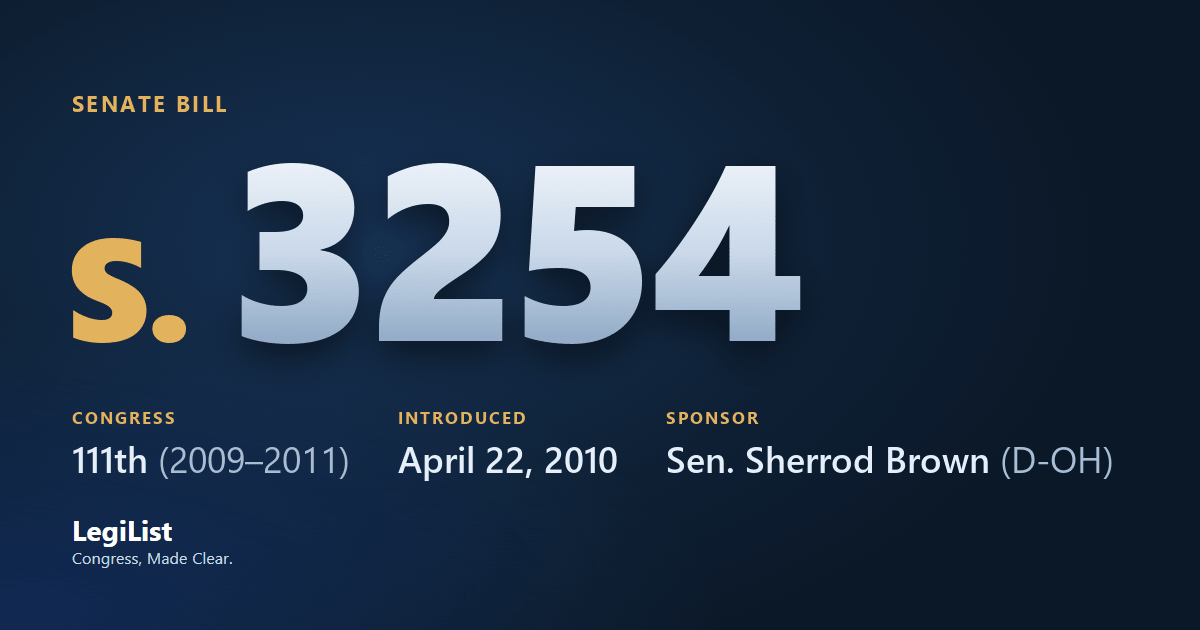
Employee Misclassification Prevention Act
Latest action · Jun 17, 2010 Committee on Health, Education, Labor, and Pensions. Hearings held. Hearings printed: S.Hrg. 111-1146.
Progress
Where this bill reached, and when. A stage with no date was not reached; one that failed a vote and later carried shows the date it carried.
- IntroducedApr 22, 2010
- Passed SenateNot reached
- Passed HouseNot reached
- To the PresidentNot reached
- Became lawNot reached
Summary
Employee Misclassification Prevention Act - Amends the Fair Labor Standards Act of 1938 (FLSA) to require every person to: (1) keep records of non-employees (contractors) who perform labor or services (except substitute work), including through an entity such as a trust, estate, partnership, association, company, or corporation, for remuneration; and (2) provide certain notice to each new employee and new non-employee, including their classification as an employee or non-employee and information concerning their rights under the law.
Makes it unlawful for any person to: (1) discharge or otherwise discriminate against an individual (including an employee) who has opposed any practice, or filed a complaint or instituted any proceeding related to this Act, including with respect to an individual's status as an employee or non-employee; and (2) fail to classify accurately an employee or non-employee.
Doubles the amount of liquidated damages for maximum hours, minimum wage, and notice of classification violations by an employer. Subjects a person who: (1) violates such requirements (including recordkeeping requirements) to a civil penalty of up to $1,100; or (2) repeatedly or willfully violates such requirements to a civil penalty of up to $5,000 for each violation.
Directs the Secretary of Labor to establish a webpage on the Department of Labor website that summarizes the rights of employees under this Act and other appropriate information.
Amends the Social Security Act to require, as a condition for a federal grant for the administration of state unemployment compensation, for the state's unemployment compensation law to include a provision for: (1) auditing programs that identify employers that have not registered under the state law or that are paying unreported compensation where the effect is to exclude employees from unemployment compensation coverage; and (2) establishing administrative penalties for misclassifying employees or paying unreported unemployment compensation to employees.
Requires any office, administration, or division of the Department of Labor to report any misclassification of an employee by a person subject to the FLSA that it discovers to the Department's Wage and Hour Division (WHD). Authorizes the WHD to report such information to the Internal Revenue Service (IRS).
Cosponsors 8
Members who signed on, in the order they did. Signatures ran from Apr 22, 2010 to Jun 18, 2010; 5 are original cosponsors, there from the day it was introduced.
| Seat | Cosponsor | Signed on | |
|---|---|---|---|
| D-OR | Jeff Merkley | Original | Apr 22, 2010 |
| D-WA | Patty Murray | Original | Apr 22, 2010 |
| D-IL | Richard J. Durbin | Original | Apr 22, 2010 |
| D-PA | Robert P. Casey Jr. | Original | Apr 22, 2010 |
| D-IA | Tom Harkin | Original | Apr 22, 2010 |
| D-MN | Al Franken | Apr 26, 2010 | |
| D-MD | Barbara A. Mikulski | Apr 28, 2010 | |
| D-MT | Jon Tester | Jun 18, 2010 |
Committees 1
Where it was sent and what each committee and subcommittee did with it, in order.
| Chamber | Committee | What it did |
|---|---|---|
| Senate | Health, Education, Labor, and Pensions Committee | Referred Apr 22, 2010Hearings Jun 17, 2010 |
Actions 3
Everything that happened, newest first.
- Jun 17, 2010Committee on Health, Education, Labor, and Pensions. Hearings held. Hearings printed: S.Hrg. 111-1146.
- Apr 22, 2010Introduced in Senate
- Apr 22, 2010Read twice and referred to the Committee on Health, Education, Labor, and Pensions.
Research
What has been written about this bill: committee reports, cost estimates, the sponsor’s authority statement, printed hearings and the Congressional Research Service’s work.
Printed hearings 1
Hearings whose printed record names this bill, newest first: hearings on it, and wider hearings where it came up.
| Number | Hearing | Committee | Held |
|---|---|---|---|
| S. Hrg. 111-1146 | LEVELING THE PLAYING FIELD: PROTECTING WORKERS AND BUSINESSES AFFECTED BY MISCLASSIFICATION93 pages | Health, Education, Labor, and Pensions Committee | Jun 17, 2010 |
Related bills 1
Companion bills and other measures the record links to this one.
| Bill | Title | Relationship | Latest action |
|---|---|---|---|
| HR 5107 | Employee Misclassification Prevention Act | Identical bill | May 3, 2010 |
Titles 2
Every title it has carried, official and short, at each stage.
- Official Title as Introduced
- A bill to amend the Fair Labor Standards Act of 1938 to require persons to keep records of non-employees who perform labor or services for remuneration and to provide a special penalty for persons who misclassify employees as non-employees, and for other purposes.
- Short Titles as Introduced
- Employee Misclassification Prevention Act
Subjects
Assigned by the Library of Congress. Policy area: Labor and Employment.
- Administrative law and regulatory procedures
- Department of Labor
- Employment discrimination and employee rights
- Government information and archives
- Government studies and investigations
- Labor and Employment
- Labor standards
- Performance measurement
- Personnel records
- Tax administration and collection, taxpayers
- Unemployment
- Wages and earnings
Text 1
Each version as it was printed, newest first.
- Apr 22, 2010Introduced in Senate
Everything here is as published by Congress: the summary is the Congressional Research Service's, the action wording is the clerks', and the subjects are the Library of Congress's. How far it got is read from the actions themselves, taking the most recent one of each kind, so a bill that failed a vote and later passed is shown as having passed. Records come from this bill on Congress.gov and govinfo.gov; cost estimates are the Congressional Budget Office's, and the hearings are the printed hearings GovInfo publishes, which can appear months after the hearing.