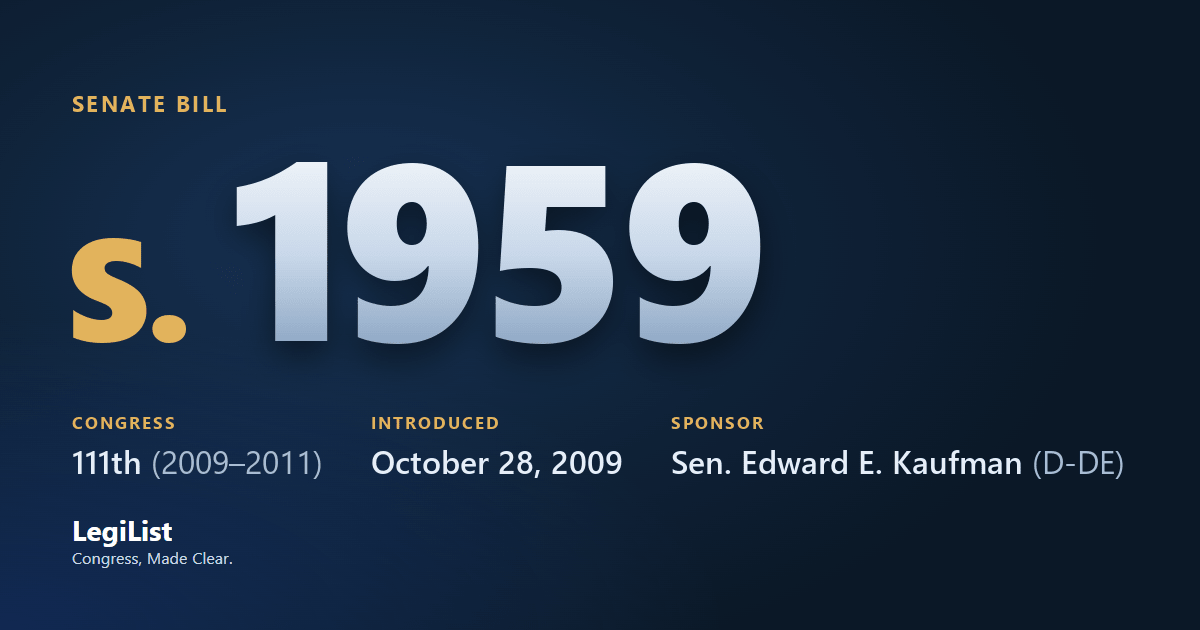
Health Care Fraud Enforcement Act of 2009
Latest action · Oct 28, 2009 Read twice and referred to the Committee on the Judiciary.
Progress
Where this bill reached, and when. A stage with no date was not reached; one that failed a vote and later carried shows the date it carried.
- IntroducedOct 28, 2009
- Passed SenateNot reached
- Passed HouseNot reached
- To the PresidentNot reached
- Became lawNot reached
Summary
Health Care Fraud Enforcement Act of 2009 - Directs the United States Sentencing Commission to review and amend guidelines and policy statements relating to health care fraud to increase the sentences for such crimes based upon the dollar amount of fraud involved.
Expands the definition of "health care fraud" to include anti-fraud provisions of the Social Security Act relating to kickbacks, bribes, or rebates, the Food, Drug and Cosmetic Act, and the Employee Retirement Income Security Act of 1974 (ERISA). Makes a health care fraud violation under such statutes a false or fraudulent claim for purposes of the False Claims Act.
Amends the federal criminal code to allow a conviction for health care fraud without actual knowledge of a fraud prohibition or a specific intent to commit a health care fraud violation.
Amends the Civil Rights of Institutionalized Persons Act to expand the power of the Attorney General to issue subpoenas for records under such Act.
Authorizes additional appropriations to the Department of Justice (DOJ) for FY2011-FY2016 for investigations and prosecutions relating to fraud and abuse in connection with any health care benefit program.
Cosponsors 5
Members who signed on, in the order they did. All signed on Oct 28, 2009.
| Seat | Cosponsor | Signed on | |
|---|---|---|---|
| D-MN | Amy Klobuchar | Original | Oct 28, 2009 |
| D-PA | Arlen Specter | Original | Oct 28, 2009 |
| D-NY | Charles E. Schumer | Original | Oct 28, 2009 |
| D-WI | Herb Kohl | Original | Oct 28, 2009 |
| D-VT | Patrick J. Leahy | Original | Oct 28, 2009 |
Committees 1
Where it was sent and what each committee and subcommittee did with it, in order.
| Chamber | Committee | What it did |
|---|---|---|
| Senate | Judiciary Committee | Referred Oct 28, 2009 |
Actions 3
Everything that happened, newest first.
- Oct 28, 2009Introduced in Senate
- Oct 28, 2009Sponsor introductory remarks on measure. (CR S10852-10854)
- Oct 28, 2009Read twice and referred to the Committee on the Judiciary.
In the Congressional Record 1
Days the Record’s own index lists this bill, newest first, with the pages and the members it names. Pages starting H are the House, S the Senate, E Extensions of Remarks.
| Where | In the Record | Members | Date |
|---|---|---|---|
| Senate | Debate and remarks S10852–S10854 | Edward E. Kaufman D-DE, Patrick J. Leahy D-VT | Oct 28, 2009 |
Related bills 1
Companion bills and other measures the record links to this one.
| Bill | Title | Relationship | Latest action |
|---|---|---|---|
| HR 3590 | Patient Protection and Affordable Care Act | Related bill | Mar 23, 2010 |
Titles 2
Every title it has carried, official and short, at each stage.
- Official Title as Introduced
- A bill to improve health care fraud enforcement.
- Short Titles as Introduced
- Health Care Fraud Enforcement Act of 2009
Subjects
Assigned by the Library of Congress. Policy area: Crime and Law Enforcement.
- Administrative law and regulatory procedures
- Civil actions and liability
- Crime and Law Enforcement
- Criminal investigation, prosecution, interrogation
- Criminal procedure and sentencing
- Fraud offenses and financial crimes
- Health care costs and insurance
- Health programs administration and funding
- U.S. Sentencing Commission
Text 1
Each version as it was printed, newest first.
- Oct 28, 2009Introduced in Senate
Support LegiList
This page is free, carries no paywall, and is built and maintained by one person. If the record here is useful to you, a few dollars keeps it going.
Everything here is as published by Congress: the summary is the Congressional Research Service's, the action wording is the clerks', and the subjects are the Library of Congress's. How far it got is read from the actions themselves, taking the most recent one of each kind, so a bill that failed a vote and later passed is shown as having passed. Records come from this bill on Congress.gov and govinfo.gov; cost estimates are the Congressional Budget Office's, and the hearings are the printed hearings GovInfo publishes, which can appear months after the hearing.