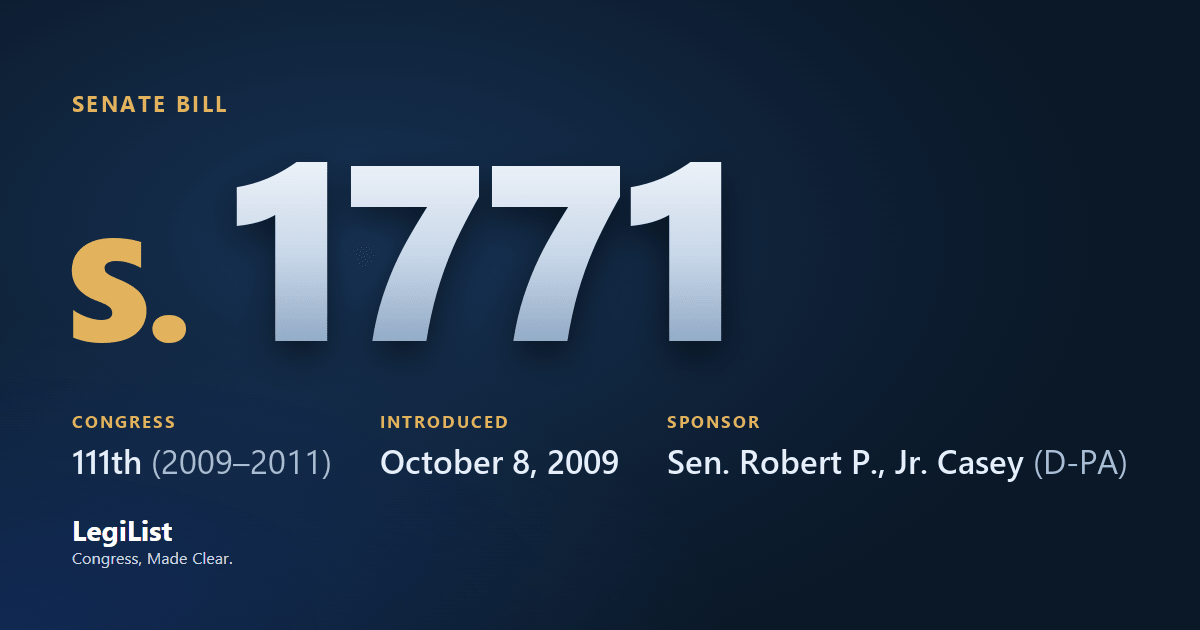
Medical Education Development Act of 2009
Latest action · Oct 8, 2009 Read twice and referred to the Committee on Health, Education, Labor, and Pensions.
Progress
Where this bill reached, and when. A stage with no date was not reached; one that failed a vote and later carried shows the date it carried.
- IntroducedOct 8, 2009
- Passed SenateNot reached
- Passed HouseNot reached
- To the PresidentNot reached
- Became lawNot reached
Summary
Medical Education Development Act of 2000 - Directs the Secretary of Health and Human Services (HHS) to establish a program of grants to newly accredited allopathic medical schools to support scholarships, develop residencies, build infrastructure, recruit and retain faculty, and develop research programs, for the purpose of increasing the supply of physicians.
Directs the Secretary to: (1) give first priority to schools accredited to admit students from FY2009-FY2014; (2) provide increased funding to schools that enroll larger classes while maintaining competitive faculty-to-student ratios; and (3) allocate funds to only schools that provide accountability and transparency in expending such funds.
Requires: (1) each school to report annually on the specific uses of funds received and on how the grant has benefited the region and the nation; and (2) the Secretary to report annually on the extent to which such grants have increased the supply of physicians, resulted in greater access to health care, enabled the creation of new care models, provided economic regional benefits, and increased the focus on medical students' communications skills.
Cosponsors 3
Members who signed on, in the order they did. Signatures ran from Oct 8, 2009 to Jan 20, 2010; 1 is an original cosponsor, there from the day it was introduced.
| Seat | Cosponsor | Signed on | |
|---|---|---|---|
| D-PA | Arlen Specter | Original | Oct 8, 2009 |
| D-MI | Debbie Stabenow | Nov 3, 2009 | |
| D-NY | Charles E. Schumer | Jan 20, 2010 |
Committees 1
Where it was sent and what each committee and subcommittee did with it, in order.
| Chamber | Committee | What it did |
|---|---|---|
| Senate | Health, Education, Labor, and Pensions Committee | Referred Oct 8, 2009 |
Actions 2
Everything that happened, newest first.
- Oct 8, 2009Introduced in Senate
- Oct 8, 2009Read twice and referred to the Committee on Health, Education, Labor, and Pensions.
Research
What has been written about this bill: committee reports, cost estimates, the sponsor’s authority statement, printed hearings and the Congressional Research Service’s work.
Printed hearings 1
Hearings whose printed record names this bill, newest first: hearings on it, and wider hearings where it came up.
| Number | Hearing | Committee | Held |
|---|---|---|---|
| S. Hrg. 111-519 | NOMINATIONS TO THE DEPARTMENT OF TRANSPORTATION, THE DEPARTMENT OF COMMERCE, THE FEDERAL TRADE COMMISSION, AND THE FEDERAL MARITIME COMMISSION91 pages | Commerce, Science, and Transportation Committee | Dec 15, 2009 |
Related bills 1
Companion bills and other measures the record links to this one.
| Bill | Title | Relationship | Latest action |
|---|---|---|---|
| HR 3778 | Medical Education Development Act of 2009 | Identical bill | Oct 9, 2009 |
Titles 2
Every title it has carried, official and short, at each stage.
- Official Title as Introduced
- A bill to authorize the Secretary of Health and Human Services to establish a program of grants to newly accredited allopathic medical schools for the purpose of increasing the supply of physicians.
- Short Titles as Introduced
- Medical Education Development Act of 2009
Subjects
Assigned by the Library of Congress. Policy area: Health.
Text 1
Each version as it was printed, newest first.
- Oct 8, 2009Introduced in Senate
Everything here is as published by Congress: the summary is the Congressional Research Service's, the action wording is the clerks', and the subjects are the Library of Congress's. How far it got is read from the actions themselves, taking the most recent one of each kind, so a bill that failed a vote and later passed is shown as having passed. Records come from this bill on Congress.gov and govinfo.gov; cost estimates are the Congressional Budget Office's, and the hearings are the printed hearings GovInfo publishes, which can appear months after the hearing.