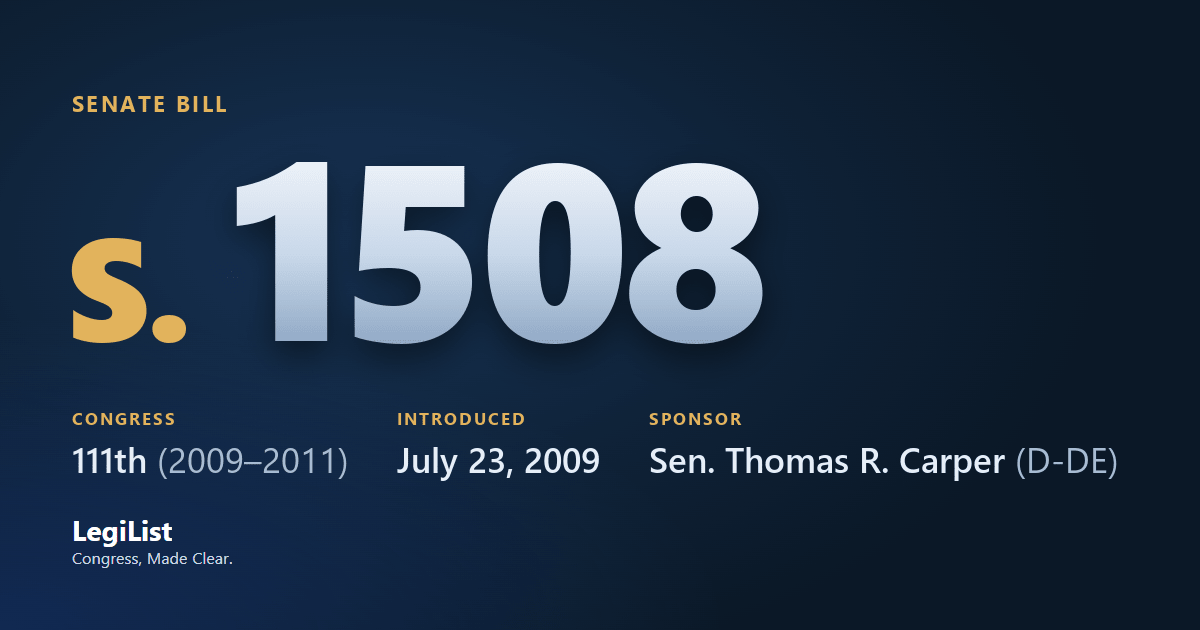
Improper Payments Elimination and Recovery Act of 2010
Latest action · Jul 22, 2010 Became Public Law No: 111-204.
Progress
Where this bill reached, and when. A stage with no date was not reached; one that failed a vote and later carried shows the date it carried.
- IntroducedJul 23, 2009
- Passed SenateJun 23, 2010
- Passed HouseJul 14, 2010
- To the PresidentJul 20, 2010
- Became lawJul 22, 2010Public Law 111-204
Summary
(This measure has not been amended since it was passed by the Senate on June 23, 2010. The summary of that version is repeated here.)
Improper Payments Elimination and Recovery Act of 2010 - (Sec. 2) Amends the Improper Payments Information Act of 2002 to expand requirements for identifying programs and activities susceptible to improper payments by requiring the head of each federal agency, during the year after the enactment of this Act and at least once every three fiscal years thereafter, to review and identify agency programs and activities that may be susceptible to significant improper payments. Defines "significant" to mean: (1) improper payments in the preceding fiscal year that may have exceeded $100 million or $10 million of all program and activity payments and 2.5% of program outlays; and (2) for fiscal years prior to FY2013, improper payments that may have exceeded $100 million or $10 million of all program and activity payments and 1.5% of program outlays.
Sets forth risk factors to be considered in conducting improper payment reviews, including: (1) whether the program or activity reviewed is new to the agency; (2) the complexity of the program or activity; (3) the volume of payments made; (4) whether payment or payment eligibility decisions are made outside of the agency; (5) recent major changes in program funding, authorities, practices, or procedures; (6) the level, experience, and quality of personnel training; and (7) significant deficiencies in auditing practices.
Revises requirements for estimating improper payments to require agency heads to: (1) produce a statistically valid estimate of the improper payments in their agencies; and (2) include such estimates in their annual financial statements.
Expands agency reporting requirements on actions to reduce improper payments to require a statement of whether the agency has sufficient resources with respect to internal controls, human capital, and information systems and other infrastructure to prevent improper payments. Requires reports on actions to recover improper payments.
Requires the Director of the Office of Management and Budget (OMB) to: (1) report each fiscal year to the House Committee on Oversight and Government Reform and the Senate Committee on Homeland Security and Governmental Affairs on actions agencies have taken to report information relating to improper payments and to recover such payments; (2) prescribe guidance to agencies to implement requirements of this Act; and (3) develop specific criteria as to when an agency should be required to obtain an opinion on internal control over mproper payments.
Requires agency heads to: (1) conduct recovery audits for agency programs that expend $1 million or more annually if such audits would be cost-effective; (2) conduct financial management improvement programs that address problems that contribute directly to agency improper payments; and (3) impose certain requirements upon contractors performing recovery audits, including a requirement to report to the agency credible evidence of fraud or vulnerabilities to fraud, and conduct appropriate training of personnel on identification of fraud. Requires the Chief Financial Officers Council to conduct a study of the implementation and cost effectiveness of recovery audits and report on such study to the House Committee on Oversight and Government Reform, the Senate Committee on Homeland Security and Governmental Affairs, and the Comptroller General.
(Sec. 3) Requires the Inspector General of each federal agency in each fiscal year to determine whether such agency is in compliance with the requirements of this Act and submit a report on that determination to the head of the agency, the House Committee on Oversight and Government Reform, the Senate Committee on Homeland Security and Governmental Affairs, and the Comptroller General. Deems an agency to be in compliance if such agency has conducted a program specific risk assessment and has published specified information, including improper payment estimates for all programs and activities, a corrective action plan, and improper payment reduction targets. Sets forth requirements for bringing noncompliant agencies into compliance.
Authorizes the OMB Director to establish one or more pilot programs for testing accountability mechanisms for compliance with this Act and report to Congress on such programs.
Requires the Chief Financial Officers Council and the Council of Inspectors General on Integrity and Efficiency to: (1) jointly examine the lessons learned in implementing the Chief Financial Officers Act of 1990 and identify reforms or improvements in federal financial management; and (2) report on such examination to the House Committee on Oversight and Government Reform, the Senate Committee on Homeland Security and Governmental Affairs, and the Comptroller General.
Recorded votes 1
Newest first. Open one to see how every member voted.
| Roll call | Question | Result | Date |
|---|---|---|---|
| House 442 | On Motion to Suspend the Rules and Pass | Passed414–0 | Jul 14, 2010 |
Cosponsors 5
Members who signed on, in the order they did. Signatures ran from Jul 23, 2009 to Jul 29, 2009; 4 are original cosponsors, there from the day it was introduced.
| Seat | Cosponsor | Signed on | |
|---|---|---|---|
| D-MO | Claire McCaskill | Original | Jul 23, 2009 |
| R-AZ | John McCain | Original | Jul 23, 2009 |
| R-ME | Susan M. Collins | Original | Jul 23, 2009 |
| R-OK | Tom Coburn | Original | Jul 23, 2009 |
| I-CT | Joseph I. Lieberman | Jul 29, 2009 |
Committees 1
Where it was sent and what each committee and subcommittee did with it, in order.
| Chamber | Committee | What it did |
|---|---|---|
| Senate | Homeland Security and Governmental Affairs Committee | Referred Jul 23, 2009Markup Jul 29, 2009Reported Jun 15, 2010 |
Actions 22
Everything that happened, newest first.
- Jul 22, 2010Signed by President.
- Jul 22, 2010Became Public Law No: 111-204.
- Jul 20, 2010Presented to President.
- Jul 14, 2010Mr. Davis (IL) moved to suspend the rules and pass the bill.
- Jul 14, 2010Considered under suspension of the rules. (consideration: CR H5553-5558)
In the Congressional Record 4
Days the Record’s own index lists this bill, newest first, with the pages and the members it names. Pages starting H are the House, S the Senate, E Extensions of Remarks.
| Where | In the Record | Members | Date |
|---|---|---|---|
| House | Debate and remarks H5619 | Kathleen A. Dahlkemper D-PA | Jul 15, 2010 |
| House · Senate | Debate and remarks H5550, H5553–H5558, S5798, S5799, S5809–S5811Text printed H5553–H5556Recorded votes H5590enact | Brian P. Bilbray R-CA, Danny K. Davis D-IL, Jason Chaffetz R-UT, Kurt Schrader D-OR, Patrick J. Murphy D-PA, Thomas R. Carper D-DE | Jul 14, 2010 |
| Senate | Debate and remarks S5306–S5309Text printed S5306–S5309Amendments S5376 | Richard J. Durbin D-IL, Thomas R. Carper D-DE (amendment) | Jun 23, 2010 |
| Senate | Hearings S3504 | Richard C. Shelby R-AL | May 11, 2010 |
Research
What has been written about this bill: committee reports, cost estimates, the sponsor’s authority statement, printed hearings and the Congressional Research Service’s work.
Printed hearings 2
Hearings whose printed record names this bill, newest first: hearings on it, and wider hearings where it came up.
| Number | Hearing | Committee | Held |
|---|---|---|---|
| S. Hrg. 111-1059 | PREVENTING AND RECOVERING MEDICARE PAYMENT ERRORS172 pages | Homeland Security and Governmental Affairs Committee | Jul 15, 2010 |
| S. Hrg. 111-575 | NOMINATION OF DANIEL I. WERFEL77 pages | Homeland Security and Governmental Affairs Committee | Sep 16, 2009 |
CRS reports 11
Congressional Research Service work that CRS links to this bill or the law it became, newest first.
Cite it 11
Products on other subjects that cite it, usually among other measures.
Amendments 1
Amendments offered to this bill.
| Amendment | Description | Offered by | Status |
|---|---|---|---|
| SA 4392 | In the nature of a substitute. | Thomas R. Carper D-DE | Amendment SA 4392 agreed to in Senate by Unanimous Consent. |
Related bills 1
Companion bills and other measures the record links to this one.
| Bill | Title | Relationship | Latest action |
|---|---|---|---|
| HR 3393 | Improper Payments Elimination and Recovery Act of 2010 | Related bill | Apr 29, 2010 |
Titles 6
Every title it has carried, official and short, at each stage.
- Official Title as Introduced
- A bill to amend the Improper Payments Information Act of 2002 (31 U.S.C. 3321 note) in order to prevent the loss of billions in taxpayer dollars.
- Short Titles as Introduced
- Improper Payments Elimination and Recovery Act of 2009
- Short Titles as Reported to Senate
- Improper Payments Elimination and Recovery Act of 2009
- Short Titles as Passed House
- Improper Payments Elimination and Recovery Act of 2010
- Short Titles as Passed Senate
- Improper Payments Elimination and Recovery Act of 2010
- Short Titles as Enacted
- Improper Payments Elimination and Recovery Act of 2010
Subjects
Assigned by the Library of Congress. Policy area: Government Operations and Politics.
Text 4
Each version as it was printed, newest first.
- —Enrolled Bill
- Jun 23, 2010Engrossed in Senate
- Jun 15, 2010Reported to Senate
- Jul 23, 2009Introduced in Senate
Support LegiList
This page is free, carries no paywall, and is built and maintained by one person. If the record here is useful to you, a few dollars keeps it going.
Everything here is as published by Congress: the summary is the Congressional Research Service's, the action wording is the clerks', and the subjects are the Library of Congress's. How far it got is read from the actions themselves, taking the most recent one of each kind, so a bill that failed a vote and later passed is shown as having passed. Records come from this bill on Congress.gov and govinfo.gov; cost estimates are the Congressional Budget Office's, and the hearings are the printed hearings GovInfo publishes, which can appear months after the hearing.