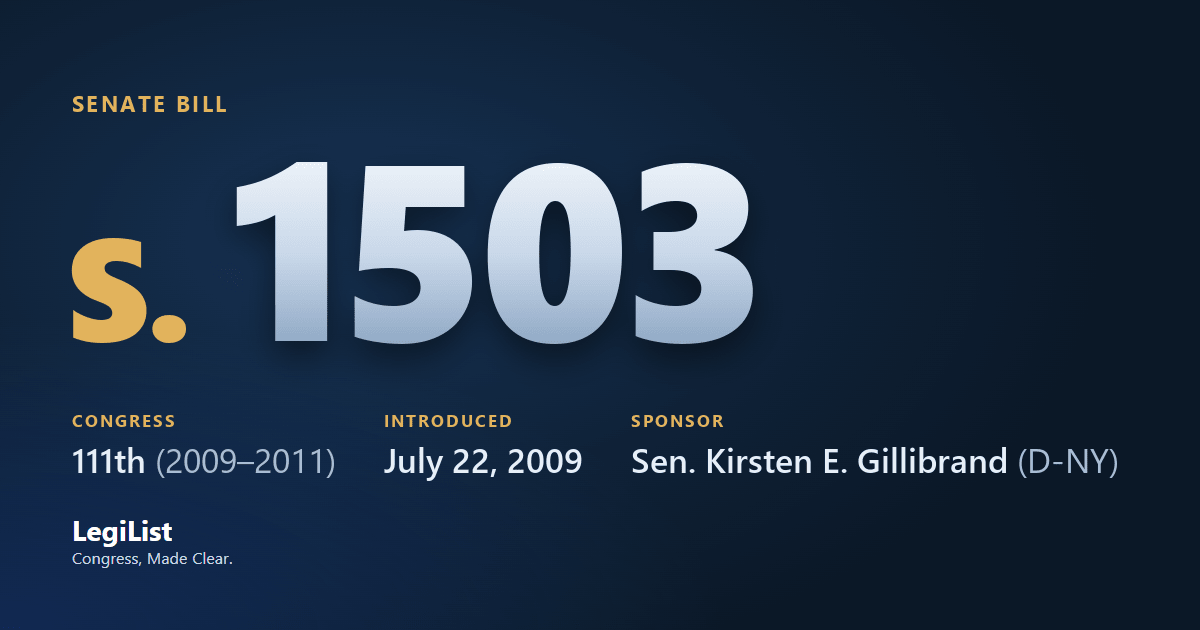
IMPACT Act
Latest action · Jul 22, 2009 Read twice and referred to the Committee on Health, Education, Labor, and Pensions.
Progress
Where this bill reached, and when. A stage with no date was not reached; one that failed a vote and later carried shows the date it carried.
- IntroducedJul 22, 2009
- Passed SenateNot reached
- Passed HouseNot reached
- To the PresidentNot reached
- Became lawNot reached
Summary
Improved Nutrition and Physical Activity Act or the IMPACT Act - Amends the Public Health Service Act to expand an existing grant program for training for health profession students to include training on the treatment of individuals who are overweight, obese, or have eating disorders.
Allows the Secretary of Health and Human Services (HHS) to award grants for the training of primary care physicians and other health professions on how to identify, properly refer, treat, and prevent obesity or eating disorders and aid individuals who are overweight or obese or who suffer from eating disorders.
Requires the Secretary, acting through the Director of the Centers for Disease Control and Prevention (CDC), to award grants for programs to: (1) promote healthy eating behaviors, physical activity, emotional wellness, and healthy living; and (2) prevent eating disorders, obesity, being overweight, and related serious and chronic medical conditions.
Allows the Secretary, acting through the National Center for Health Statistics, to provide for: (1) data collection of fitness levels and physical activity and nutritional behaviors of students from grades 1-12; (2) collection and analysis of data determining the connection between children's and youth's physical and emotional health; and (3) analysis of data collected as part of the National Health and Nutrition Examination Survey.
Requires the Director of the Agency for Healthcare Research and Quality to review research under this Act to determine if particular information may be important for the health disparities report.
Permits states to use preventive health and health services block grants for activities and community education programs designed to address and prevent overweight, obesity, and eating disorders through programs to promote healthy eating, exercise habits, and behaviors and emotional and social wellness.
Cosponsors
Members who signed on, in the order they did.
Committees 1
Where it was sent and what each committee and subcommittee did with it, in order.
| Chamber | Committee | What it did |
|---|---|---|
| Senate | Health, Education, Labor, and Pensions Committee | Referred Jul 22, 2009 |
Actions 2
Everything that happened, newest first.
- Jul 22, 2009Introduced in Senate
- Jul 22, 2009Read twice and referred to the Committee on Health, Education, Labor, and Pensions.
Related bills 1
Companion bills and other measures the record links to this one.
| Bill | Title | Relationship | Latest action |
|---|---|---|---|
| HR 2276 | IMPACT Act | Identical bill | May 7, 2009 |
Titles 3
Every title it has carried, official and short, at each stage.
- Official Title as Introduced
- A bill to establish grants to provide health services for improved nutrition, increased physical activity, obesity and eating disorder prevention, and for other purposes.
- Short Titles as Introduced
- IMPACT Act
- Improved Nutrition and Physical Activity Act
Subjects
Assigned by the Library of Congress. Policy area: Health.
- Child health
- Education programs funding
- Elementary and secondary education
- Government studies and investigations
- Health
- Health information and medical records
- Health programs administration and funding
- Health promotion and preventive care
- Medical education
- Medical research
- Mental health
- Nutrition and diet
- Pedestrians and bicycling
- Physical fitness and lifestyle
- Teaching, teachers, curricula
Text 1
Each version as it was printed, newest first.
- Jul 22, 2009Introduced in Senate
Everything here is as published by Congress: the summary is the Congressional Research Service's, the action wording is the clerks', and the subjects are the Library of Congress's. How far it got is read from the actions themselves, taking the most recent one of each kind, so a bill that failed a vote and later passed is shown as having passed. Records come from this bill on Congress.gov and govinfo.gov; cost estimates are the Congressional Budget Office's, and the hearings are the printed hearings GovInfo publishes, which can appear months after the hearing.