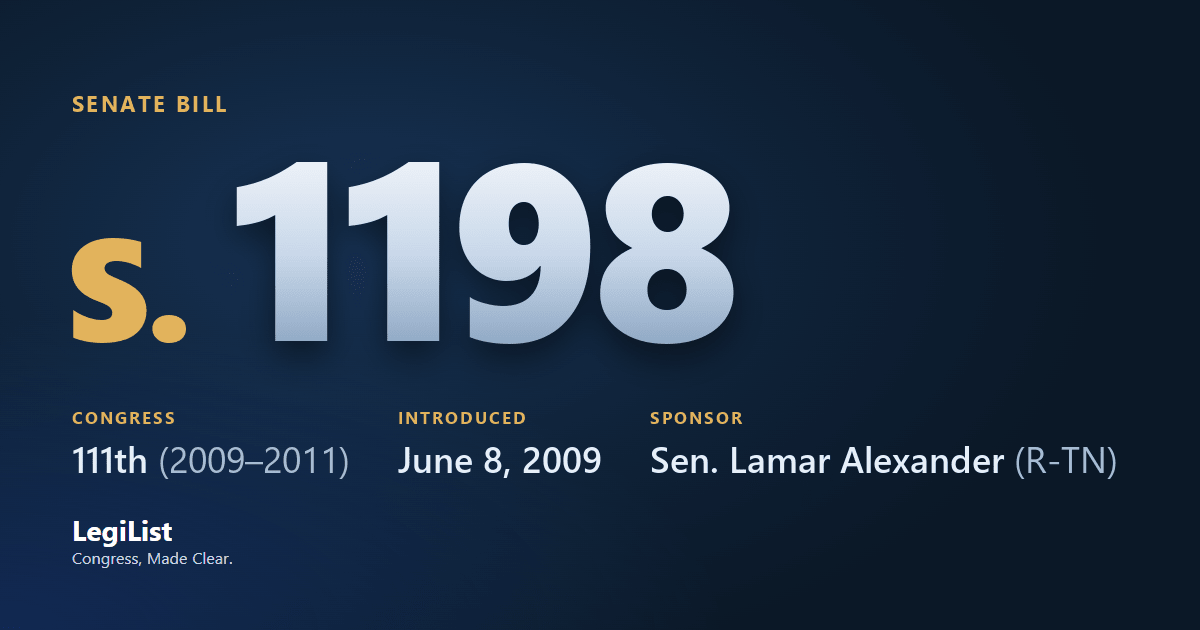
Auto Stock for Every Taxpayer Act
Latest action · Jun 8, 2009 Read twice and referred to the Committee on Banking, Housing, and Urban Affairs.
Progress
Where this bill reached, and when. A stage with no date was not reached; one that failed a vote and later carried shows the date it carried.
- IntroducedJun 8, 2009
- Passed SenateNot reached
- Passed HouseNot reached
- To the PresidentNot reached
- Became lawNot reached
Summary
Auto Stock for Every Taxpayer Act - Prohibits the Secretary of the Treasury from expending or obligating any more Troubled Asset Relief Program (TARP) funds for automobile manufacturers that have been participating in the program and have filed for bankruptcy protection.
Imposes on the Secretary the fiduciary duty to maximize the return on the taxpayers' investment in such manufacturers under TARP.
Authorizes persons aggrieved by violations of such fiduciary duty to bring civil actions for equitable relief.
Requires the Secretary, after the emergence of such an automobile manufacturer from bankruptcy, to provide taxpayers with common stock certificates representing their shares in the aggregate common stock holdings of the federal government in such manufacturer.
Cosponsors 10
Members who signed on, in the order they did. Signatures ran from Jun 8, 2009 to Jun 11, 2009; 9 are original cosponsors, there from the day it was introduced.
| Seat | Cosponsor | Signed on | |
|---|---|---|---|
| R-LA | David Vitter | Original | Jun 8, 2009 |
| R-TX | John Cornyn | Original | Jun 8, 2009 |
| R-GA | Johnny Isakson | Original | Jun 8, 2009 |
| R-AZ | Jon Kyl | Original | Jun 8, 2009 |
| R-NH | Judd Gregg | Original | Jun 8, 2009 |
| R-KY | Mitch McConnell | Original | Jun 8, 2009 |
| R-KS | Pat Roberts | Original | Jun 8, 2009 |
| R-UT | Robert F. Bennett | Original | Jun 8, 2009 |
| R-MS | Roger F. Wicker | Original | Jun 8, 2009 |
| R-NC | Richard Burr | Jun 11, 2009 |
Committees 1
Where it was sent and what each committee and subcommittee did with it, in order.
| Chamber | Committee | What it did |
|---|---|---|
| Senate | Banking, Housing, and Urban Affairs Committee | Referred Jun 8, 2009 |
Actions 2
Everything that happened, newest first.
- Jun 8, 2009Introduced in Senate
- Jun 8, 2009Read twice and referred to the Committee on Banking, Housing, and Urban Affairs.
In the Congressional Record 6
Days the Record’s own index lists this bill, newest first, with the pages and the members it names. Pages starting H are the House, S the Senate, E Extensions of Remarks.
| Where | In the Record | Members | Date |
|---|---|---|---|
| Senate | Debate and remarks S7348 | Lamar Alexander R-TN | Jul 10, 2009 |
| Senate | Debate and remarks S7229 | Lamar Alexander R-TN | Jul 8, 2009 |
| Senate | Debate and remarks S7159 | Lamar Alexander R-TN | Jul 7, 2009 |
| Senate | Debate and remarks S6755 | Lamar Alexander R-TN | Jun 18, 2009 |
| Senate | Debate and remarks S6418 | Lamar Alexander R-TN | Jun 10, 2009 |
| Senate | Debate and remarks S6240 | Lamar Alexander R-TN | Jun 8, 2009 |
Titles 2
Every title it has carried, official and short, at each stage.
- Official Title as Introduced
- A bill to limit disbursement of additional funds under the Troubled Asset Relief Program to certain automobile manufacturers, to impose fiduciary duties on the Secretary of the Treasury with respect to shareholders of such automobile manufacturers, to require the issuance of shares of common stock to eligible taxpayers which represent the common stock holdings of the United States Government in such automobile manufacturers, and for other purposes.
- Short Titles as Introduced
- Auto Stock for Every Taxpayer Act
Subjects
Assigned by the Library of Congress. Policy area: Finance and Financial Sector.
Text 1
Each version as it was printed, newest first.
- Jun 8, 2009Introduced in Senate
Everything here is as published by Congress: the summary is the Congressional Research Service's, the action wording is the clerks', and the subjects are the Library of Congress's. How far it got is read from the actions themselves, taking the most recent one of each kind, so a bill that failed a vote and later passed is shown as having passed. Records come from this bill on Congress.gov and govinfo.gov; cost estimates are the Congressional Budget Office's, and the hearings are the printed hearings GovInfo publishes, which can appear months after the hearing.