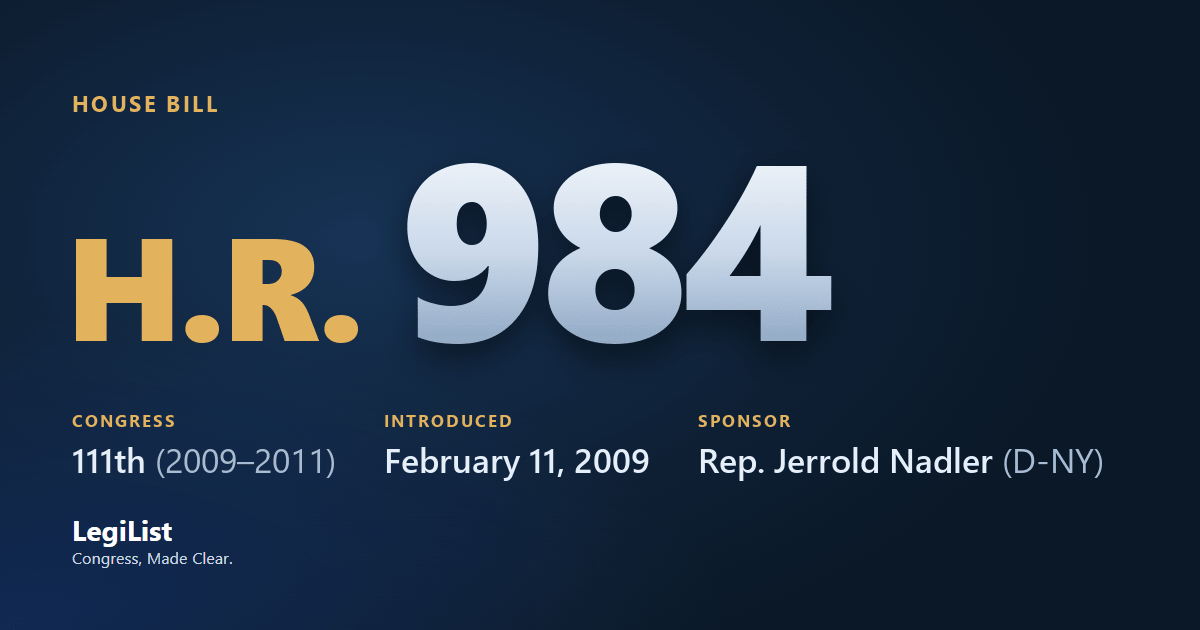
State Secret Protection Act of 2009
Latest action · Nov 5, 2009 Ordered to be Reported (Amended) by the Yeas and Nays: 18 - 12.
Progress
Where this bill reached, and when. A stage with no date was not reached; one that failed a vote and later carried shows the date it carried.
- IntroducedFeb 11, 2009
- Passed HouseNot reached
- Passed SenateNot reached
- To the PresidentNot reached
- Became lawNot reached
Summary
State Secret Protection Act of 2009 - Declares that in any civil action brought in federal or state court the government has a privilege to refuse to give information and to prevent any person from giving information only if the government shows that public disclosure of the information that the government seeks to protect would be reasonably likely to cause significant harm to the national defense or the diplomatic relations of the United States.
Requires the court to take steps, including in camera hearings and other proceedings, to protect sensitive information that comes before it.
Sets forth rules regarding the participation of counsel or the disclosure of information when it presents a risk of harm. Provides for court-ordered presentation of adequate or nonprivileged substitutes for privileged information.
Allows the government to: (1) assert the privilege in connection with any claim in a civil action to which it is a party; or (2) intervene in a civil action to which it is not a party in order to do so.
Provides that once the government has asserted the privilege, and before the court makes any determinations, the court shall: (1) undertake a preliminary review of the information in question; and (2) provide the government an opportunity to seek protective measures under this Act.
Establishes procedures and a standard for assessing the privilege claim.
Allows disclosure of information to a nongovernmental party, or admission at trial under the rules of evidence, if the court determines that the privilege is not validly asserted. Prohibits such disclosure or admission if the privilege is determined valid.
Grants the courts of appeal jurisdiction of an appeal by any party from any interlocutory decision or order of a U.S. district court.
Cosponsors 27
Members who signed on, in the order they did. Signatures ran from Feb 11, 2009 to Nov 16, 2010; 6 are original cosponsors, there from the day it was introduced.
| Seat | Cosponsor | Signed on | |
|---|---|---|---|
| D-MA | Barney Frank | Original | Feb 11, 2009 |
| D-MA | Bill Delahunt | Original | Feb 11, 2009 |
| D-MI | John Conyers, Jr. | Original | Feb 11, 2009 |
| D-TX | Lloyd Doggett | Original | Feb 11, 2009 |
| R-WI | Thomas E. Petri | Original | Feb 11, 2009 |
| D-CA | Zoe Lofgren | Original | Feb 11, 2009 |
| D-MD | Chris Van Hollen | Feb 23, 2009 | |
| D-PA | Robert A. Brady | Feb 23, 2009 | |
| D-CA | Barbara Lee | Mar 3, 2009 | |
| D-AZ | Ed Pastor | Mar 3, 2009 | |
| D-IL | Janice D. Schakowsky | Mar 3, 2009 | |
| D-NH | Paul W. Hodes | Mar 3, 2009 | |
| D-OR | Peter A. DeFazio | Mar 3, 2009 | |
| D-WI | Tammy Baldwin | Mar 3, 2009 | |
| D-NJ | Rush Holt | Mar 12, 2009 | |
| D-NC | David E. Price | Mar 19, 2009 | |
| D-CA | Bob Filner | Apr 2, 2009 | |
| D-VA | Rick Boucher | Apr 2, 2009 | |
| D-NY | Maurice D. Hinchey | Apr 23, 2009 | |
| D-WA | Jim McDermott | May 18, 2009 | |
| D-MA | Michael E. Capuano | May 21, 2009 | |
| D-NY | Carolyn B. Maloney | Jun 11, 2009 | |
| D-IL | Mike Quigley | Jul 22, 2009 | |
| D-CA | Judy Chu | Feb 22, 2010 | |
| D-NC | Melvin L. Watt | Feb 22, 2010 | |
| D-TN | Steve Cohen | Feb 22, 2010 | |
| D-CA | Fortney Pete Stark | Nov 16, 2010 |
Committees 1
Where it was sent and what each committee and subcommittee did with it, in order.
| Chamber | Committee | What it did |
|---|---|---|
| House | Judiciary Committee | Referred Feb 11, 2009Markup Nov 5, 2009 |
| Constitution and Limited Government Subcommittee | Referred May 29, 2009Hearings Jun 4, 2009Markup Jun 11, 2009Reported Jun 11, 2009 |
Actions 8
Everything that happened, newest first.
- Nov 5, 2009Committee Consideration and Mark-up Session Held.
- Nov 5, 2009Ordered to be Reported (Amended) by the Yeas and Nays: 18 - 12.
- Jun 11, 2009Subcommittee Consideration and Mark-up Session Held.
- Jun 11, 2009Forwarded by Subcommittee to Full Committee (Amended) by Voice Vote .
- Jun 4, 2009Subcommittee Hearings Held.
Research
What has been written about this bill: committee reports, cost estimates, the sponsor’s authority statement, printed hearings and the Congressional Research Service’s work.
Congressional Budget Office cost estimates 2
- Dec 4, 2009H.R. 984, State Secret Protection Act of 2009<p>Cost estimate for the bill as ordered reported by the House Committee on the Judiciary on November 5, 2009</p>
- Dec 4, 2009H.R. 984, State Secret Protection Act of 2009Cost estimate for the bill as ordered reported by the House Committee on the Judiciary on November 5, 2009
Printed hearings 2
Hearings whose printed record names this bill, newest first: hearings on it, and wider hearings where it came up.
| Number | Hearing | Committee | Held |
|---|---|---|---|
| Serial No. 111-132 | CIVIL DIVISION OF THE UNITED STATES DEPARTMENT OF JUSTICE41 pages | Judiciary Committee | Jun 24, 2010 |
| Serial No. 111-14 | STATE SECRET PROTECTION ACT OF 2009234 pages | Judiciary Committee | Jun 4, 2009 |
Titles 2
Every title it has carried, official and short, at each stage.
- Official Title as Introduced
- To provide safe, fair, and responsible procedures and standards for resolving claims of state secret privilege.
- Short Titles as Introduced
- State Secret Protection Act of 2009
Subjects
Assigned by the Library of Congress. Policy area: Law.
Text 1
Each version as it was printed, newest first.
- Feb 11, 2009Introduced in House
Support LegiList
This page is free, carries no paywall, and is built and maintained by one person. If the record here is useful to you, a few dollars keeps it going.
Everything here is as published by Congress: the summary is the Congressional Research Service's, the action wording is the clerks', and the subjects are the Library of Congress's. How far it got is read from the actions themselves, taking the most recent one of each kind, so a bill that failed a vote and later passed is shown as having passed. Records come from this bill on Congress.gov and govinfo.gov; cost estimates are the Congressional Budget Office's, and the hearings are the printed hearings GovInfo publishes, which can appear months after the hearing.