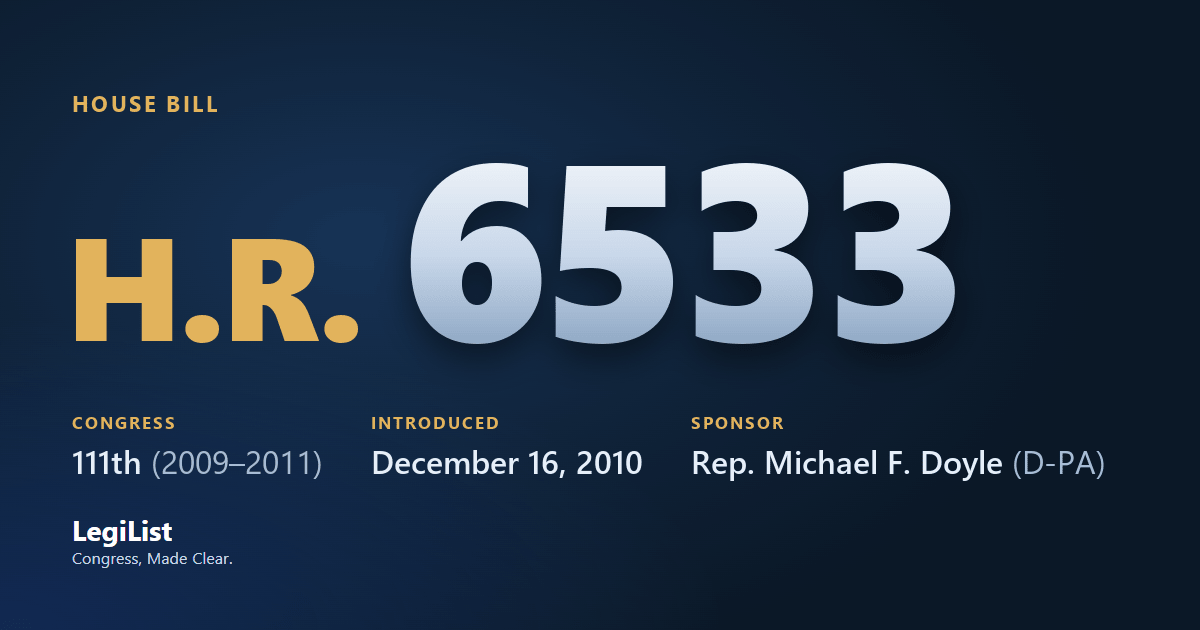
Local Community Radio Act of 2010
Latest action · Jan 4, 2011 Became Public Law No: 111-371.
Progress
Where this bill reached, and when. A stage with no date was not reached; one that failed a vote and later carried shows the date it carried.
- IntroducedDec 16, 2010
- Passed HouseDec 17, 2010
- Passed SenateDec 18, 2010
- To the PresidentDec 28, 2010
- Became lawJan 4, 2011Public Law 111-371
Summary
(This measure has not been amended since it was introduced. The expanded summary of the House passed version is repeated here.)
Local Community Radio Act of 2010 - (Sec. 2) Amends the Departments of Commerce, Justice, and State, the Judiciary, and Related Agencies Appropriations Act, 2001 to require the Federal Communications Commission (FCC) to modify the rules authorizing the operation of low-power FM radio stations, as proposed in MM Docket No. 99-25, to: (1) prescribe protection for co-channels and first- and second-adjacent channels; and (2) prohibit any applicant from obtaining a low-power FM license if the applicant has engaged in any manner in the unlicensed operation of any station in violation of the Communications Act of 1934. (Current law is the same, except that clause (1) instead requires prescribing minimum distance separations for third-adjacent channels, as well as for co-channels and first- and second-adjacent channels.)
States that any license that was issued by the FCC to a low-power FM station prior to April 2, 2001, and that does not comply with the modifications adopted by the Commission in the above docket on April 2, 2001, shall remain invalid.
Eliminates provisions prohibiting the FCC from extending the eligibility for application for low-power FM stations beyond the organizations and entities as proposed in the above docket.
(Sec. 3) Requires the FCC to eliminate third-adjacent minimum distance separation requirements between: (1) low-power FM stations; and (2) full-service FM stations, FM translator stations, and FM booster stations. Prohibits the FCC from reducing the minimum co-channel and first- and second-adjacent channel distance separation requirements in effect on the date of enactment of this Act between: (1) low-power FM stations; and (2) full-service FM stations.
Authorizes a waiver of the second-adjacent channel distance separation requirement to any low-power FM station that establishes that its proposed operations will not interfere with any authorized radio service, provided that, upon notification by the FCC that it is causing certain interference, such station must: (1) suspend operation; and (2) resume operation only after interference has been eliminated or it demonstrates that such interference was not due to the low-power FM station's emissions.
(Sec. 4) Requires the FCC to comply with its existing minimum distance separation requirements for full-service FM stations, FM translator stations, and FM booster stations that broadcast radio reading services via an analog subcarrier frequency to avoid potential interference by low-power FM stations.
(Sec. 5) Requires the FCC, when licensing new FM translator stations, FM booster stations, and low-power FM stations, to ensure that: (1) licenses are available to FM translator stations, FM booster stations, and low-power FM stations; (2) such decisions are made based on the needs of the local community; and (3) FM translator stations, FM booster stations, and low-power FM stations remain equal in status and secondary to existing and modified full-service FM stations.
(Sec. 6) Requires the FCC to modify its rules to address the potential for predicted interference to FM translator input signals on third-adjacent channels set forth in a specified technical report.
(Sec. 7) Requires the FCC to modify the interference complaint process in specified ways.
(Sec. 8) Requires the FCC to study and report to Congress on the impact that low-power FM stations will have on full-service commercial FM stations.
Cosponsors 1
Members who signed on, in the order they did. All signed on Dec 16, 2010.
| Seat | Cosponsor | Signed on | |
|---|---|---|---|
| R-NE | Lee Terry | Original | Dec 16, 2010 |
Committees 1
Where it was sent and what each committee and subcommittee did with it, in order.
| Chamber | Committee | What it did |
|---|---|---|
| House | Energy and Commerce Committee | Referred Dec 16, 2010 |
Actions 14
Everything that happened, newest first.
- Jan 4, 2011Signed by President.
- Jan 4, 2011Became Public Law No: 111-371.
- Dec 28, 2010Presented to President.
- Dec 20, 2010Message on Senate action sent to the House.
- Dec 18, 2010Passed/agreed to in Senate: Passed Senate without amendment by Unanimous Consent. (consideration: CR S10696)
- Dec 18, 2010Cleared for White House.
- Dec 17, 2010Mr. Doyle moved to suspend the rules and pass the bill.
- Dec 17, 2010Considered under suspension of the rules. (consideration: CR H8619-8623)
- Dec 17, 2010DEBATE - The House proceeded with forty minutes of debate on H.R. 6533.
- Dec 17, 2010Passed/agreed to in House: On motion to suspend the rules and pass the bill Agreed to by voice vote. (text: CR H8620-8621)
- Dec 17, 2010Motion to reconsider laid on the table Agreed to without objection.
- Dec 17, 2010Received in the Senate, read twice.
- Dec 16, 2010Introduced in House
- Dec 16, 2010Referred to the House Committee on Energy and Commerce.
In the Congressional Record 2
Days the Record’s own index lists this bill, newest first, with the pages and the members it names. Pages starting H are the House, S the Senate, E Extensions of Remarks.
| Where | In the Record | Members | Date |
|---|---|---|---|
| Senate | Debate and remarks S10696 | Patrick J. Leahy D-VT, Sherrod Brown D-OH | Dec 18, 2010 |
| House | Debate and remarks H8619–H8623Text printed H8620Lists H8621Organizations supporting H.R. 6533, Local Community Radio Act | Cliff Stearns R-FL, Henry A. Waxman D-CA, Lee Terry R-NE, Michael F. Doyle D-PA | Dec 17, 2010 |
Research
What has been written about this bill: committee reports, cost estimates, the sponsor’s authority statement, printed hearings and the Congressional Research Service’s work.
CRS reports 1
Congressional Research Service work that CRS links to this bill or the law it became, newest first.
Cite it 1
Products on other subjects that cite it, usually among other measures.
| Product | Title | Kind | Published |
|---|---|---|---|
| R40559 | S.Con.Res. 13: The Budget Resolution for FY2010 Archived | Report | Jun 8, 2009 |
Related bills 2
Companion bills and other measures the record links to this one.
| Bill | Title | Relationship | Latest action |
|---|---|---|---|
| S 592 | Local Community Radio Act of 2009 | Related bill | Mar 9, 2010 |
| HR 1147 | Local Community Radio Act of 2009 | Related bill | Dec 24, 2009 |
Titles 5
Every title it has carried, official and short, at each stage.
- Official Title as Introduced
- To implement the recommendations of the Federal Communications Commission report to the Congress regarding low-power FM service, and for other purposes.
- Short Titles as Introduced
- Local Community Radio Act of 2010
- Short Titles as Passed House
- Local Community Radio Act of 2010
- Short Titles as Passed Senate
- Local Community Radio Act of 2010
- Short Titles as Enacted
- Local Community Radio Act of 2010
Subjects
Assigned by the Library of Congress. Policy area: Science, Technology, Communications.
Text 4
Each version as it was printed, newest first.
- —Enrolled Bill
- Dec 17, 2010Received in Senate
- Dec 17, 2010Engrossed in House
- Dec 16, 2010Introduced in House
Everything here is as published by Congress: the summary is the Congressional Research Service's, the action wording is the clerks', and the subjects are the Library of Congress's. How far it got is read from the actions themselves, taking the most recent one of each kind, so a bill that failed a vote and later passed is shown as having passed. Records come from this bill on Congress.gov and govinfo.gov; cost estimates are the Congressional Budget Office's, and the hearings are the printed hearings GovInfo publishes, which can appear months after the hearing.