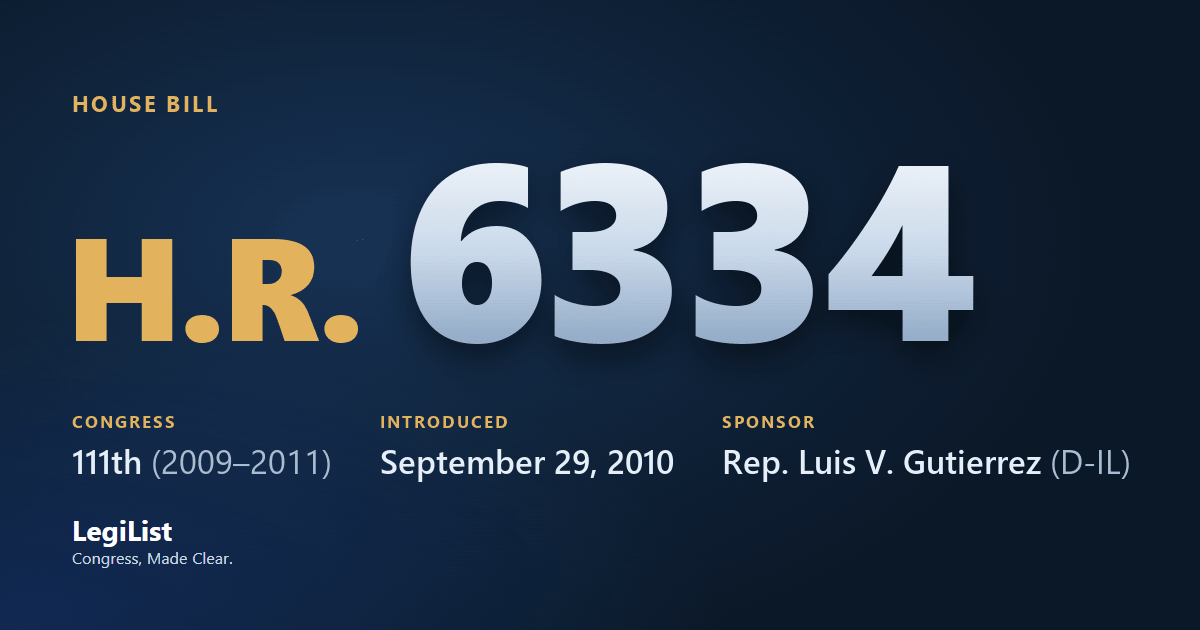
American Community Investment Reform Act of 2010
Latest action · Sep 29, 2010 Referred to the House Committee on Financial Services.
Progress
Where this bill reached, and when. A stage with no date was not reached; one that failed a vote and later carried shows the date it carried.
- IntroducedSep 29, 2010
- Passed HouseNot reached
- Passed SenateNot reached
- To the PresidentNot reached
- Became lawNot reached
Summary
American Community Investment Reform Act of 2010 - Revises the Community Reinvestment Act of 1977 with regard to assessments of regulated financial institutions.
Revises the list of appropriate federal financial supervisory agencies to include: (1) the Bureau of Consumer Financial Protection (established by the Dodd-Frank Wall Street Reform and Consumer Protection Act); and (2) the Securities and Exchange Commission (SEC) with regard to any U.S. nonbank financial company for which the SEC acts as the primary financial regulatory agency, and any broker or dealer that is a member of the Securities Investor Protection Corporation. Specifies the Board of Governors of the Federal Reserve System as the appropriate federal financial supervisory agency for securities holding companies, and, in consultation with its primary financial regulatory agency, any regulated financial institution not otherwise indicated.
Specifies the community development and other related activities of a regulated financial institution or a U.S. nonbank financial company, including lending and investment in low- and moderate-income and other traditionally underserved neighborhoods, which the appropriate federal financial supervisory agency is required to assess.
Requires the examination of a regulated financial institution to: (1) take into consideration public comments on its record of meeting the credit or other financial needs of its entire community; and (2) require an improvement plan for an institution that receives certain low ratings. Prescribes requirements for an improvement plan, including availability for public comment.
Revises requirements for assessment of the record of a regulated financial institution that is a nonminority-owned, nonwomen-owned institution and that is not a certified community development financial institution.
Requires the appropriate federal financial supervisory agency, in assessing the record of a regulated financial institution, to consider the complexity, innovativeness, effectiveness of its efforts in meeting particularly difficult community needs, or any significant effort extended in specific loans, investments, or services.
Requires the evaluation of a depository institution holding company to incorporate evaluations of its subsidiary regulated financial institutions.
Requires the public section of the written evaluation of a regulated financial institution to disclose whether it provided, or offered to provide, a consumer financial product that the Bureau of Consumer Financial Protection has determined is unfair, deceptive, or abusive.
Replaces the top rank "outstanding record of meeting community credit needs" rating for an institution with the current second rank rating of "satisfactory record." Makes the second rank rating now "sufficient record of meeting community credit or other financial needs." Requires the appropriate federal financial supervisory agencies to develop and implement a process to permit a regulated financial institution to apply for a rating of "outstanding record of meeting community credit or other financial needs." Reserves an "outstanding" rating to an applicant that significantly exceeds the requirements for receiving a "satisfactory" rating and meets other specified criteria. Allows the supervisory agency to consider community development activities and investments made outside the institution's service area if the financial institution has adequately met the needs of its local assessment area.
Requires the recipient of an "outstanding rating" to be given preference over lower-rated regulated financial institutions in connection with the award of government contracts. Specifies the effect of a "satisfactory" rating.
Prohibits the award of government contracts to, and certain other actions by, any regulated financial institution that receives a rating of: (1) "needs to improve record of meeting community credit or other financial needs" or lower on its two most recent performance evaluations; or (2) "substantial noncompliance in meeting community credit or other financial needs" on its most recent performance evaluations.
Cosponsors 14
Members who signed on, in the order they did. Signatures ran from Sep 29, 2010 to Dec 21, 2010; 3 are original cosponsors, there from the day it was introduced.
| Seat | Cosponsor | Signed on | |
|---|---|---|---|
| D-TX | Al Green | Original | Sep 29, 2010 |
| D-TX | Eddie Bernice Johnson | Original | Sep 29, 2010 |
| D-CA | Maxine Waters | Original | Sep 29, 2010 |
| D-CA | Barbara Lee | Dec 2, 2010 | |
| D-MA | Bill Delahunt | Dec 2, 2010 | |
| D-VI | Donna M. Christensen | Dec 2, 2010 | |
| D-DC | Eleanor Holmes Norton | Dec 2, 2010 | |
| D-OH | Marcia L. Fudge | Dec 2, 2010 | |
| D-CA | Michael M. Honda | Dec 2, 2010 | |
| D-AZ | Raúl M. Grijalva | Dec 2, 2010 | |
| D-PA | Chaka Fattah | Dec 9, 2010 | |
| D-IL | Bobby L. Rush | Dec 21, 2010 | |
| D-OH | Dennis J. Kucinich | Dec 21, 2010 | |
| D-CA | Lynn C. Woolsey | Dec 21, 2010 |
Committees 1
Where it was sent and what each committee and subcommittee did with it, in order.
| Chamber | Committee | What it did |
|---|---|---|
| House | Financial Services Committee | Referred Sep 29, 2010 |
Actions 2
Everything that happened, newest first.
- Sep 29, 2010Introduced in House
- Sep 29, 2010Referred to the House Committee on Financial Services.
Titles 2
Every title it has carried, official and short, at each stage.
- Official Title as Introduced
- To amend the Community Reinvestment Act of 1977 to improve the assessments of regulated financial institutions, and for other purposes.
- Short Titles as Introduced
- American Community Investment Reform Act of 2010
Subjects
Assigned by the Library of Congress. Policy area: Finance and Financial Sector.
- Administrative law and regulatory procedures
- Bank accounts, deposits, capital
- Banking and financial institutions regulation
- Corporate finance and management
- Credit and credit markets
- Department of Commerce
- Department of the Treasury
- Federal Deposit Insurance Corporation (FDIC)
- Federal Reserve System
- Finance and Financial Sector
- Financial services and investments
- Housing and community development funding
- Housing finance and home ownership
- Interest, dividends, interest rates
- Public contracts and procurement
- Securities and Exchange Commission (SEC)
- Wages and earnings
Text 1
Each version as it was printed, newest first.
- Sep 29, 2010Introduced in House
Everything here is as published by Congress: the summary is the Congressional Research Service's, the action wording is the clerks', and the subjects are the Library of Congress's. How far it got is read from the actions themselves, taking the most recent one of each kind, so a bill that failed a vote and later passed is shown as having passed. Records come from this bill on Congress.gov and govinfo.gov; cost estimates are the Congressional Budget Office's, and the hearings are the printed hearings GovInfo publishes, which can appear months after the hearing.