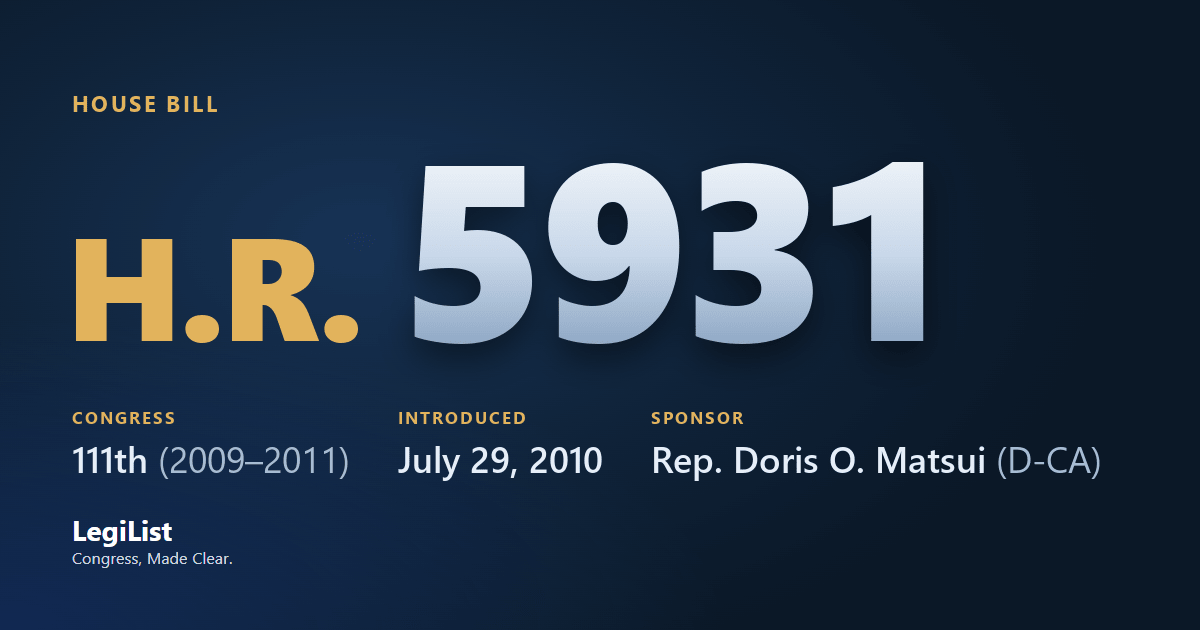
Renewable Energy Incentive Act
Latest action · Jul 29, 2010 Referred to House Energy and Commerce
Progress
Where this bill reached, and when. A stage with no date was not reached; one that failed a vote and later carried shows the date it carried.
- IntroducedJul 29, 2010
- Passed HouseNot reached
- Passed SenateNot reached
- To the PresidentNot reached
- Became lawNot reached
Summary
Renewable Energy Incentive Act - Amends the American Recovery and Reinvestment Act of 2009 to: (1) extend the grant program for investment in renewable energy property, including renewable resources used to produce electricity, and fuel cell, solar, wind, geothermal, and microturbine property, in lieu of tax credits, by extending the placed-in-service deadline for such property through 2012; and (2) expand eligibility for such grants to certain state power utilities and tax-exempt mutual or cooperative electric companies.
Amends the Internal Revenue Code to: (1) allow an energy tax credit for investment in qualified solar manufacturing project property; (2) allow a tax credit for the purchase, consolidation, and use of contiguous high solarity disturbed private land to produce solar energy for use in a trade or business; and (3) limit the energy tax credit for solar energy equipment used to generate electricity or heat or cool a structure, as applied to swimming pools, to exclude those located at single-family residences. Defines "qualified solar manufacturing project property" as any tangible personal property purchased to re-equip, expand, or establish a manufacturing facility for producing solar energy equipment to generate electricity.
Cosponsors 10
Members who signed on, in the order they did. Signatures ran from Jul 29, 2010 to Nov 15, 2010; 2 are original cosponsors, there from the day it was introduced.
| Seat | Cosponsor | Signed on | |
|---|---|---|---|
| D-AZ | Gabrielle Giffords | Original | Jul 29, 2010 |
| D-WA | Jay Inslee | Original | Jul 29, 2010 |
| D-PA | Joe Sestak | Sep 14, 2010 | |
| D-CA | Lynn C. Woolsey | Sep 14, 2010 | |
| D-AZ | Harry E. Mitchell | Sep 20, 2010 | |
| D-CA | Lois Capps | Sep 22, 2010 | |
| D-NJ | Rush Holt | Sep 22, 2010 | |
| D-CA | Michael M. Honda | Sep 28, 2010 | |
| D-NM | Ben Ray Luján | Sep 29, 2010 | |
| D-CA | Jackie Speier | Nov 15, 2010 |
Committees 2
Where it was sent and what each committee and subcommittee did with it, in order.
| Chamber | Committee | What it did |
|---|---|---|
| House | Ways and Means Committee | Referred Jul 29, 2010 |
| House | Energy and Commerce Committee | Referred Jul 29, 2010 |
Actions 4
Everything that happened, newest first.
- Jul 29, 2010Introduced in House
- Jul 29, 2010Referred to House Ways and Means
- Jul 29, 2010Referred to the Committee on Ways and Means, and in addition to the Committee on Energy and Commerce, for a period to be subsequently determined by the Speaker, in each case for consideration of such provisions as fall within the jurisdiction of the committee concerned.
- Jul 29, 2010Referred to House Energy and Commerce
Related bills 3
Companion bills and other measures the record links to this one.
| Bill | Title | Relationship | Latest action |
|---|---|---|---|
| S 2899 | Renewable Energy Incentive Act | Related bill | Dec 17, 2009 |
| HR 3136 | To extend the program to provide grants for specified energy property in lieu of tax credits. | Related bill | Jul 9, 2009 |
| HR 5252 | Renewable Energy Tax Incentives Extension Act | Related bill | May 6, 2010 |
Titles 2
Every title it has carried, official and short, at each stage.
- Official Title as Introduced
- To amend the American Recovery and Reinvestment Act of 2009 and the Internal Revenue Code of 1986 to provide incentives for the development of solar energy.
- Short Titles as Introduced
- Renewable Energy Incentive Act
Subjects
Assigned by the Library of Congress. Policy area: Taxation.
Text 1
Each version as it was printed, newest first.
- Jul 29, 2010Introduced in House
Everything here is as published by Congress: the summary is the Congressional Research Service's, the action wording is the clerks', and the subjects are the Library of Congress's. How far it got is read from the actions themselves, taking the most recent one of each kind, so a bill that failed a vote and later passed is shown as having passed. Records come from this bill on Congress.gov and govinfo.gov; cost estimates are the Congressional Budget Office's, and the hearings are the printed hearings GovInfo publishes, which can appear months after the hearing.