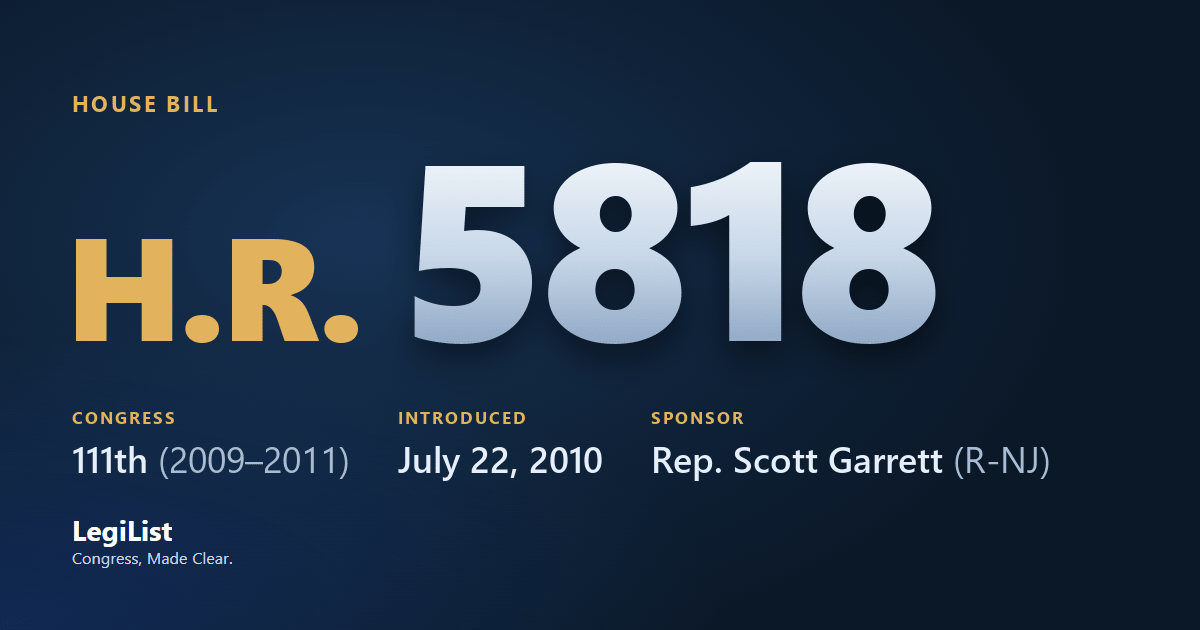
Mandate Prevention Act of 2010
Latest action · Jul 22, 2010 Referred to House Budget
Progress
Where this bill reached, and when. A stage with no date was not reached; one that failed a vote and later carried shows the date it carried.
- IntroducedJul 22, 2010
- Passed HouseNot reached
- Passed SenateNot reached
- To the PresidentNot reached
- Became lawNot reached
Summary
Mandate Prevention Act of 2010 - Amends the Congressional Budget Act of 1974 (CBA) to make it out of order to consider in either chamber of Congress any legislation that would increase the direct costs of federal private sector mandates by an amount that causes the applicable thresholds to be exceeded, unless the legislation: (1) provides new budget or entitlement authority in the House of Representatives or direct spending authority in the Senate for each fiscal year for such mandates in an amount equal to or exceeding the direct costs of each such mandate; or (2) includes an authorization of appropriations in an amount equal to or exceeding the direct costs of such mandates and makes other specified arrangements for up to 10 years during which each mandate shall be in effect under the legislation.
Applies such prohibition to any legislative provision increasing direct costs of a federal private sector mandate (currently, federal intergovernmental mandate only) in any legislation reported by a congressional appropriations committee.
Amends Rule XVIII (The Committee of the Whole House on the state of the Union) of the Rules of the House to state that the Committee of the Whole may be precluded from considering an amendment proposing only to strike an unfunded federal private sector mandate from the portion of the bill then open to amendment only by specific terms of a special order of the House.
Amends the CBA to equalize the threshold between private sector and intergovernmental mandates.
Cosponsors 16
Members who signed on, in the order they did. All signed on Jul 30, 2010.
| Seat | Cosponsor | Signed on | |
|---|---|---|---|
| R-CA | Darrell Issa | Jul 30, 2010 | |
| R-CO | Doug Lamborn | Jul 30, 2010 | |
| R-SC | Henry E. Brown, Jr. | Jul 30, 2010 | |
| R-TX | Jeb Hensarling | Jul 30, 2010 | |
| R-PA | Joseph R. Pitts | Jul 30, 2010 | |
| R-TX | Kevin Brady | Jul 30, 2010 | |
| R-TX | Louie Gohmert | Jul 30, 2010 | |
| R-IN | Mike Pence | Jul 30, 2010 | |
| R-GA | Phil Gingrey | Jul 30, 2010 | |
| R-TX | Ralph M. Hall | Jul 30, 2010 | |
| R-UT | Rob Bishop | Jul 30, 2010 | |
| R-OH | Robert E. Latta | Jul 30, 2010 | |
| R-MD | Roscoe G. Bartlett | Jul 30, 2010 | |
| R-GA | Tom Graves | Jul 30, 2010 | |
| R-GA | Tom Price | Jul 30, 2010 | |
| R-AZ | Trent Franks | Jul 30, 2010 |
Committees 2
Where it was sent and what each committee and subcommittee did with it, in order.
| Chamber | Committee | What it did |
|---|---|---|
| House | Rules Committee | Referred Jul 22, 2010 |
| House | Budget Committee | Referred Jul 22, 2010 |
Actions 4
Everything that happened, newest first.
- Jul 22, 2010Introduced in House
- Jul 22, 2010Referred to House Rules
- Jul 22, 2010Referred to the Committee on Rules, and in addition to the Committee on the Budget, for a period to be subsequently determined by the Speaker, in each case for consideration of such provisions as fall within the jurisdiction of the committee concerned.
- Jul 22, 2010Referred to House Budget
Titles 2
Every title it has carried, official and short, at each stage.
- Official Title as Introduced
- To amend title IV of the Congressional Budget Act of 1974 and the Rules of the House of Representatives to make Federal private sector mandates subject to a point of order, and for other purposes.
- Short Titles as Introduced
- Mandate Prevention Act of 2010
Subjects
Assigned by the Library of Congress. Policy area: Congress.
Text 1
Each version as it was printed, newest first.
- Jul 22, 2010Introduced in House
Support LegiList
This page is free, carries no paywall, and is built and maintained by one person. If the record here is useful to you, a few dollars keeps it going.
Everything here is as published by Congress: the summary is the Congressional Research Service's, the action wording is the clerks', and the subjects are the Library of Congress's. How far it got is read from the actions themselves, taking the most recent one of each kind, so a bill that failed a vote and later passed is shown as having passed. Records come from this bill on Congress.gov and govinfo.gov; cost estimates are the Congressional Budget Office's, and the hearings are the printed hearings GovInfo publishes, which can appear months after the hearing.