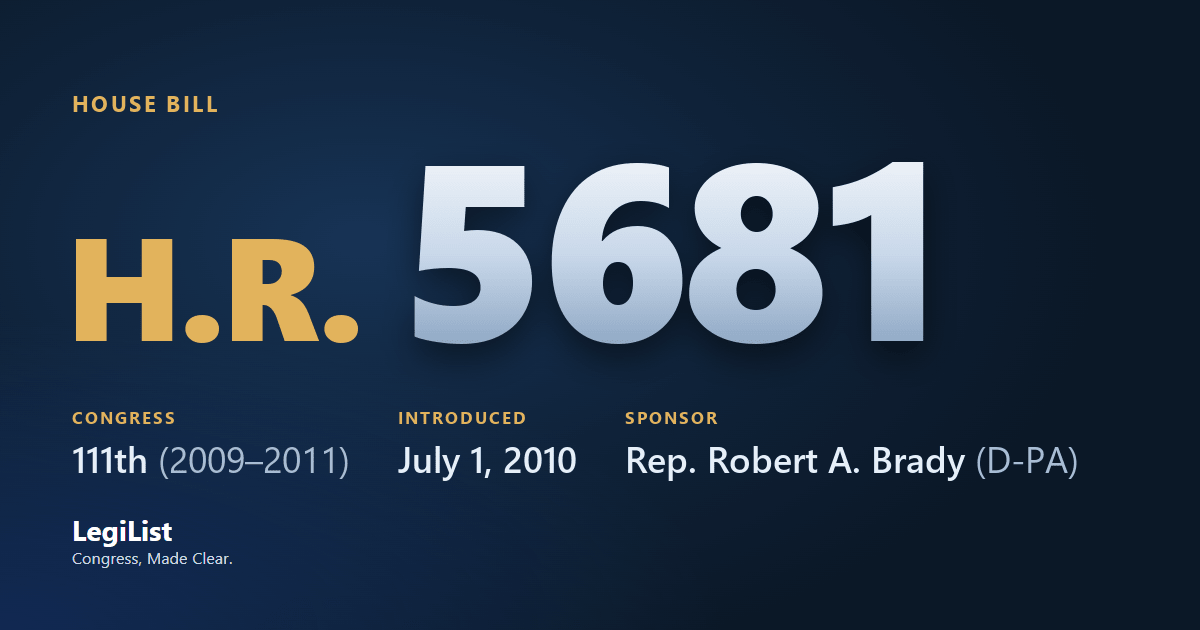
To improve certain administrative operations of the Library of Congress, and for other purposes.
Latest action · Jul 28, 2010 Received in the Senate and Read twice and referred to the Committee on Rules and Administration.
Progress
Where this bill reached, and when. A stage with no date was not reached; one that failed a vote and later carried shows the date it carried.
- IntroducedJul 1, 2010
- Passed HouseJul 27, 2010
- Passed SenateNot reached
- To the PresidentNot reached
- Became lawNot reached
Summary
Authorizes the Librarian of Congress to dispose of surplus or obsolete personal property of the Library of Congress by interagency transfer, donation, sale, trade-in, or other appropriate method.
Requires proceeds from such disposition to be: (1) credited to the funds available for the Library's operations; and (2) made available to acquire the same or similar property during the fiscal year in which the amounts are received, including the following fiscal year.
States that amounts appropriated or otherwise made available to the Librarian for a fiscal year for salaries and expenses of Library employees may be used by the Librarian to make payments under the student loan repayment program, on behalf of a Library employee, without regard to the source of the funds used to pay the employee's salary.
Makes unobligated balances of expired appropriations made to the Library for fiscal years beginning with FY2011 available to the Librarian to make a specified mandatory deposit to the credit of the Employees' Compensation Fund.
Declares that the budgetary effects of this Act, in order to comply with the Statutory Pay-As-You-Go Act of 2010, shall be determined by reference to the latest statement titled "Budgetary Effects of PAYGO Legislation" for this Act, provided that such statement has been submitted before the vote on passage.
Cosponsors
Members who signed on, in the order they did.
Committees 2
Where it was sent and what each committee and subcommittee did with it, in order.
| Chamber | Committee | What it did |
|---|---|---|
| House | Committee on House Administration | Referred Jul 1, 2010Markup Jul 14, 2010Reported Jul 22, 2010 |
| Senate | Rules and Administration Committee | Referred Jul 28, 2010 |
Actions 12
Everything that happened, newest first.
- Jul 28, 2010Received in the Senate and Read twice and referred to the Committee on Rules and Administration.
- Jul 27, 2010Mr. Brady (PA) moved to suspend the rules and pass the bill, as amended.
- Jul 27, 2010Considered under suspension of the rules. (consideration: CR H6097-6098)
- Jul 27, 2010DEBATE - The House proceeded with forty minutes of debate on H.R. 5681.
- Jul 27, 2010Passed/agreed to in House: On motion to suspend the rules and pass the bill, as amended Agreed to by voice vote. (text: CR H6097-6098)
- Jul 27, 2010Motion to reconsider laid on the table Agreed to without objection.
- Jul 22, 2010Reported by the Committee on House Administration. H. Rept. 111-557.
- Jul 22, 2010Placed on the Union Calendar, Calendar No. 318.
- Jul 14, 2010Committee Consideration and Mark-up Session Held.
- Jul 14, 2010Ordered to be Reported by Voice Vote.
- Jul 1, 2010Introduced in House
- Jul 1, 2010Referred to the House Committee on House Administration.
In the Congressional Record 1
Days the Record’s own index lists this bill, newest first, with the pages and the members it names. Pages starting H are the House, S the Senate, E Extensions of Remarks.
| Where | In the Record | Members | Date |
|---|---|---|---|
| House | Debate and remarks H6097, H6098Text printed H6097Tables H6160Pay-as-you-go effects of H.R. 5681, Library of Congress administrative operations improvement | Daniel E. Lungren R-CA, John M. Spratt, Jr. D-SC, Robert A. Brady D-PA | Jul 27, 2010 |
Research
What has been written about this bill: committee reports, cost estimates, the sponsor’s authority statement, printed hearings and the Congressional Research Service’s work.
Committee report
Congressional Budget Office cost estimates 4
- Jul 26, 2010H.R. 5681, A bill to improve certain administrative operations at the Library of Congress, and for other purposes<p>Pay-as-you-go table for the bill as amended</p>
- Jul 26, 2010H.R. 5681, A bill to improve certain administrative operations at the Library of Congress, and for other purposesPay-as-you-go table for the bill as amended
- Jul 21, 2010H.R. 5681, A bill to improve certain administrative operations of the Library of Congress, and for other purposes<p>Cost estimate for the bill as ordered reported by the Committee on House Administration on July 14, 2010</p>
- Jul 21, 2010H.R. 5681, A bill to improve certain administrative operations of the Library of Congress, and for other purposesCost estimate for the bill as ordered reported by the Committee on House Administration on July 14, 2010
Printed hearings 1
Hearings whose printed record names this bill, newest first: hearings on it, and wider hearings where it came up.
| Number | Hearing | Committee | Held |
|---|---|---|---|
| — | MARKUP OF H.R. 5493, H.R. 5711, H.R. 5681, H.R. 5682, H.R. 5717, AND TWO COMMITTEE RESOLUTIONS50 pages | Committee on House Administration | Jul 14, 2010 |
Titles 1
Every title it has carried, official and short, at each stage.
- Official Title as Introduced
- To improve certain administrative operations of the Library of Congress, and for other purposes.
Subjects
Assigned by the Library of Congress. Policy area: Congress.
- Appropriations
- Budget deficits and national debt
- Congress
- Congressional agencies
- Education programs funding
- Government buildings, facilities, and property
- Government employee pay, benefits, personnel management
- Higher education
- Humanities programs funding
- Libraries and archives
- Library of Congress
- Student aid and college costs
Text 4
Each version as it was printed, newest first.
- Jul 28, 2010Referred in Senate
- Jul 27, 2010Engrossed in House
- Jul 22, 2010Reported in House
- Jul 1, 2010Introduced in House
Everything here is as published by Congress: the summary is the Congressional Research Service's, the action wording is the clerks', and the subjects are the Library of Congress's. How far it got is read from the actions themselves, taking the most recent one of each kind, so a bill that failed a vote and later passed is shown as having passed. Records come from this bill on Congress.gov and govinfo.gov; cost estimates are the Congressional Budget Office's, and the hearings are the printed hearings GovInfo publishes, which can appear months after the hearing.