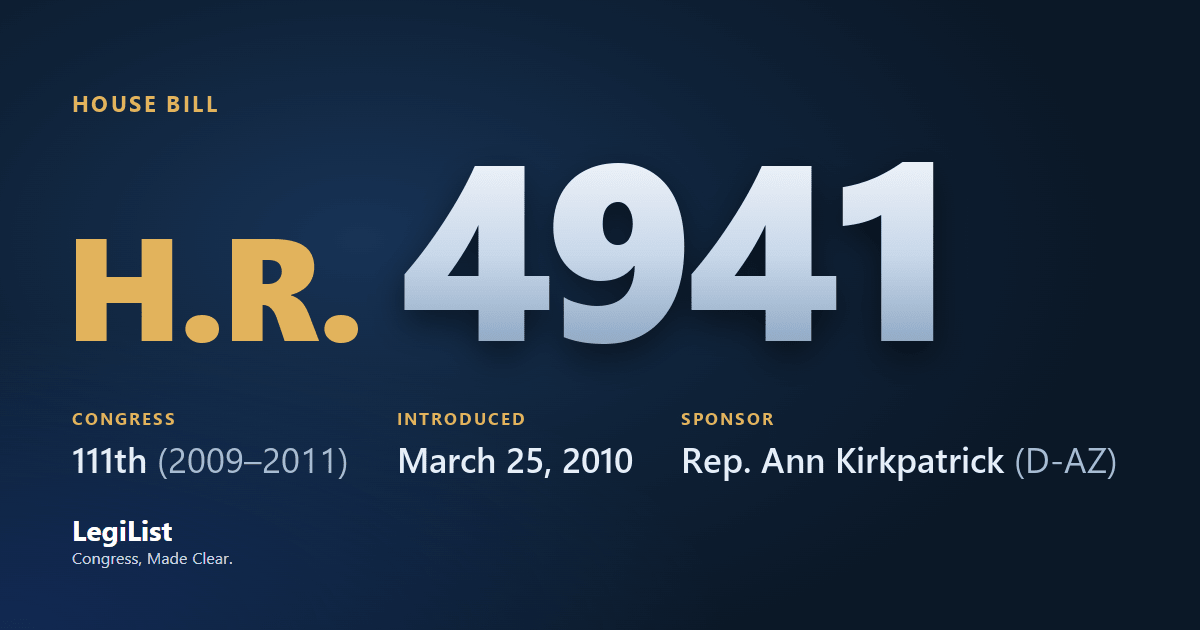
Anti-Cash Smuggling Act of 2010
Latest action · Mar 25, 2010 Referred to the House Committee on Financial Services.
Progress
Where this bill reached, and when. A stage with no date was not reached; one that failed a vote and later carried shows the date it carried.
- IntroducedMar 25, 2010
- Passed HouseNot reached
- Passed SenateNot reached
- To the PresidentNot reached
- Became lawNot reached
Summary
Anti-Cash Smuggling Act of 2010 - Directs the Secretary of the Treasury to require reports concerning means of access to funds or the value of funds belonging or credited to a person, including electronic means and prepaid or stored cards (but not debit or credit cards).
Requires such reports to be filed when a person: (1) transports, is about to transport, or has transported a means of access to funds or the value of funds from a place in the United States to or through a place outside the United States, or to a place in the United States from or through a place outside the United States; or (2) receives a means of access to funds or the value of funds transported into the United States from or through a place outside the United States.
Authorizes either the Secretary of the Treasury or the Secretary of Homeland Security (DHS) to apply to a court for a search warrant upon a reasonable belief that: (1) a monetary instrument or a tangible mechanism that constitutes a means of access to funds or the value of funds is being transported; and (2) a required report has not been filed or contains a material omission or misstatement.
Authorizes a customs officer to stop and search, at the border and without a search warrant, any vehicle, vessel, aircraft, or other conveyance, any envelope or other container, and any person entering or departing from the United States.
Subjects violations of this Act to criminal and civil forfeiture.
Revises penalties and procedures regarding smuggling of cash, monetary instruments, and means of access to funds or the value of funds into or out of the United States.
Cosponsors 9
Members who signed on, in the order they did. Signatures ran from Mar 25, 2010 to Aug 10, 2010; 4 are original cosponsors, there from the day it was introduced.
| Seat | Cosponsor | Signed on | |
|---|---|---|---|
| D-CA | Bob Filner | Original | Mar 25, 2010 |
| D-TX | Ciro D. Rodriguez | Original | Mar 25, 2010 |
| R-WY | Cynthia M. Lummis | Original | Mar 25, 2010 |
| D-NV | Dina Titus | Original | Mar 25, 2010 |
| R-CA | Brian P. Bilbray | Apr 29, 2010 | |
| D-NM | Harry Teague | Apr 29, 2010 | |
| D-CA | Loretta Sanchez | May 19, 2010 | |
| D-NY | William L. Owens | May 19, 2010 | |
| R-MI | Candice S. Miller | Aug 10, 2010 |
Committees 1
Where it was sent and what each committee and subcommittee did with it, in order.
| Chamber | Committee | What it did |
|---|---|---|
| House | Financial Services Committee | Referred Mar 25, 2010 |
Actions 2
Everything that happened, newest first.
- Mar 25, 2010Introduced in House
- Mar 25, 2010Referred to the House Committee on Financial Services.
Titles 2
Every title it has carried, official and short, at each stage.
- Official Title as Introduced
- To amend title 31, United States Code, to include means of access to funds or the value of funds in certain records and reports on monetary instrument transactions, and for other purposes.
- Short Titles as Introduced
- Anti-Cash Smuggling Act of 2010
Subjects
Assigned by the Library of Congress. Policy area: Finance and Financial Sector.
Text 1
Each version as it was printed, newest first.
- Mar 25, 2010Introduced in House
Everything here is as published by Congress: the summary is the Congressional Research Service's, the action wording is the clerks', and the subjects are the Library of Congress's. How far it got is read from the actions themselves, taking the most recent one of each kind, so a bill that failed a vote and later passed is shown as having passed. Records come from this bill on Congress.gov and govinfo.gov; cost estimates are the Congressional Budget Office's, and the hearings are the printed hearings GovInfo publishes, which can appear months after the hearing.