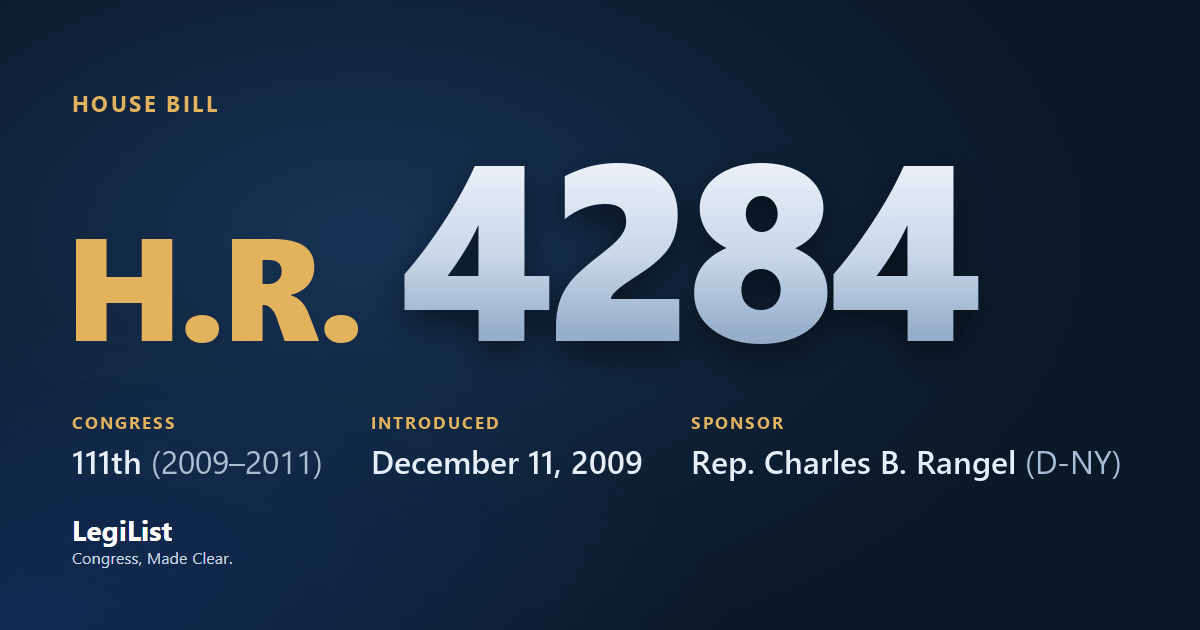
To extend the Generalized System of Preferences and the Andean Trade Preference Act, and for other purposes.
Latest action · Dec 28, 2009 Became Public Law No: 111-124.
Progress
Where this bill reached, and when. A stage with no date was not reached; one that failed a vote and later carried shows the date it carried.
- IntroducedDec 11, 2009
- Passed HouseDec 14, 2009
- Passed SenateDec 22, 2009
- To the PresidentDec 23, 2009
- Became lawDec 28, 2009Public Law 111-124
Summary
(This measure has not been amended since it was introduced. The summary of that version is repeated here.)
Amends the Trade Act of 1974 to extend duty-free treatment under the Generalized System of Preferences from December 31, 2009, through December 31, 2010.
Amends the Andean Trade Preference Act (ATPA) to extend the ATPA program through December 31, 2010.
Extends through FY2010 preferential treatment for apparel articles assembled in one or more beneficiary countries from regional fabrics or regional components, and specified other type apparel (brassieres).
Advances from April 30, 2003, to June 30, 2010, the base scheduling date for biennial reports to Congress of the United States Trade Representative (USTR) on the operation of ATPA.
Amends the Consolidated Omnibus Budget Reconciliation Act of 1985 to extend customs fees for the processing of specified different kinds of merchandise entered into the United States: (1) from February 14, 2018, through May 14, 2018; and (2) from February 7, 2018, through June 7, 2018.
Amends the Tax Increase Prevention and Reconciliation Act of 2005 to increase by 1.5% (to 101.75% of such amount) the amount in effect on the date of enactment of this Act of any corporate estimated tax installment otherwise due by a corporation with assets of not less than $1 billion in July, August, or September 2014.
Cosponsors 1
Members who signed on, in the order they did. All signed on Dec 11, 2009.
| Seat | Cosponsor | Signed on | |
|---|---|---|---|
| D-MI | Sander M. Levin | Original | Dec 11, 2009 |
Committees 1
Where it was sent and what each committee and subcommittee did with it, in order.
| Chamber | Committee | What it did |
|---|---|---|
| House | Ways and Means Committee | Referred Dec 11, 2009 |
Actions 14
Everything that happened, newest first.
- Dec 28, 2009Signed by President.
- Dec 28, 2009Became Public Law No: 111-124.
- Dec 23, 2009Message on Senate action sent to the House.
- Dec 23, 2009Presented to President.
- Dec 22, 2009Passed/agreed to in Senate: Passed Senate without amendment by Unanimous Consent. (consideration: CR S13792)
- Dec 22, 2009Cleared for White House.
- Dec 14, 2009Mr. Levin moved to suspend the rules and pass the bill.
- Dec 14, 2009Considered under suspension of the rules. (consideration: CR H14831-14835)
- Dec 14, 2009DEBATE - The House proceeded with forty minutes of debate on H.R. 4284.
- Dec 14, 2009Passed/agreed to in House: On motion to suspend the rules and pass the bill Agreed to by voice vote. (text: CR H14831)
- Dec 14, 2009Motion to reconsider laid on the table Agreed to without objection.
- Dec 14, 2009Received in the Senate, read twice.
- Dec 11, 2009Introduced in House
- Dec 11, 2009Referred to the House Committee on Ways and Means.
In the Congressional Record 3
Days the Record’s own index lists this bill, newest first, with the pages and the members it names. Pages starting H are the House, S the Senate, E Extensions of Remarks.
| Where | In the Record | Members | Date |
|---|---|---|---|
| Senate | Debate and remarks S13792 | Christopher J. Dodd D-CT | Dec 22, 2009 |
| Extensions | Debate and remarks E3005, E3006 | Bart Stupak D-MI, David Dreier R-CA | Dec 15, 2009 |
| House | Debate and remarks H14831–H14835Text printed H14831 | Dave Camp R-MI, David G. Reichert R-WA, Earl Blumenauer D-OR, Edward R. Royce R-CA, Jim McDermott D-WA, Kevin Brady R-TX, Laura Richardson D-CA, Linda T. Sánchez D-CA, Lloyd Doggett D-TX, Sander M. Levin D-MI | Dec 14, 2009 |
Research
What has been written about this bill: committee reports, cost estimates, the sponsor’s authority statement, printed hearings and the Congressional Research Service’s work.
Congressional Budget Office cost estimates 2
- Jan 13, 2010H.R. 4284, An act to extend the Generalized System of Preferences and the Andean Trade Preference Act, and for other purposes<p>Direct spending and revenues effects estimate for the bill as cleared by the Congress on December 22, 2009, and signed by the President on December 28, 2009</p>
- Jan 13, 2010H.R. 4284, An act to extend the Generalized System of Preferences and the Andean Trade Preference Act, and for other purposesDirect spending and revenues effects estimate for the bill as cleared by the Congress on December 22, 2009, and signed by the President on December 28, 2009
CRS reports 3
Congressional Research Service work that CRS links to this bill or the law it became, newest first.
Cite it 3
Products on other subjects that cite it, usually among other measures.
| Product | Title | Kind | Published |
|---|---|---|---|
| RL33663 | Generalized System of Preferences (GSP): Overview and Issues for Congress | Report | Nov 22, 2023 |
| R46553 | International Parental Child Abduction (IPCA): Foreign Policy Responses and Implications Archived | Report | Sep 29, 2020 |
| R40755 | U.S.-Vietnam Economic and Trade Relations: Issues for the 111th Congress Archived | Report | May 3, 2010 |
Titles 1
Every title it has carried, official and short, at each stage.
- Official Title as Introduced
- To extend the Generalized System of Preferences and the Andean Trade Preference Act, and for other purposes.
Subjects
Assigned by the Library of Congress. Policy area: Foreign Trade and International Finance.
Text 4
Each version as it was printed, newest first.
- —Enrolled Bill
- Dec 14, 2009Engrossed in House
- Dec 14, 2009Received in Senate
- Dec 11, 2009Introduced in House
Everything here is as published by Congress: the summary is the Congressional Research Service's, the action wording is the clerks', and the subjects are the Library of Congress's. How far it got is read from the actions themselves, taking the most recent one of each kind, so a bill that failed a vote and later passed is shown as having passed. Records come from this bill on Congress.gov and govinfo.gov; cost estimates are the Congressional Budget Office's, and the hearings are the printed hearings GovInfo publishes, which can appear months after the hearing.