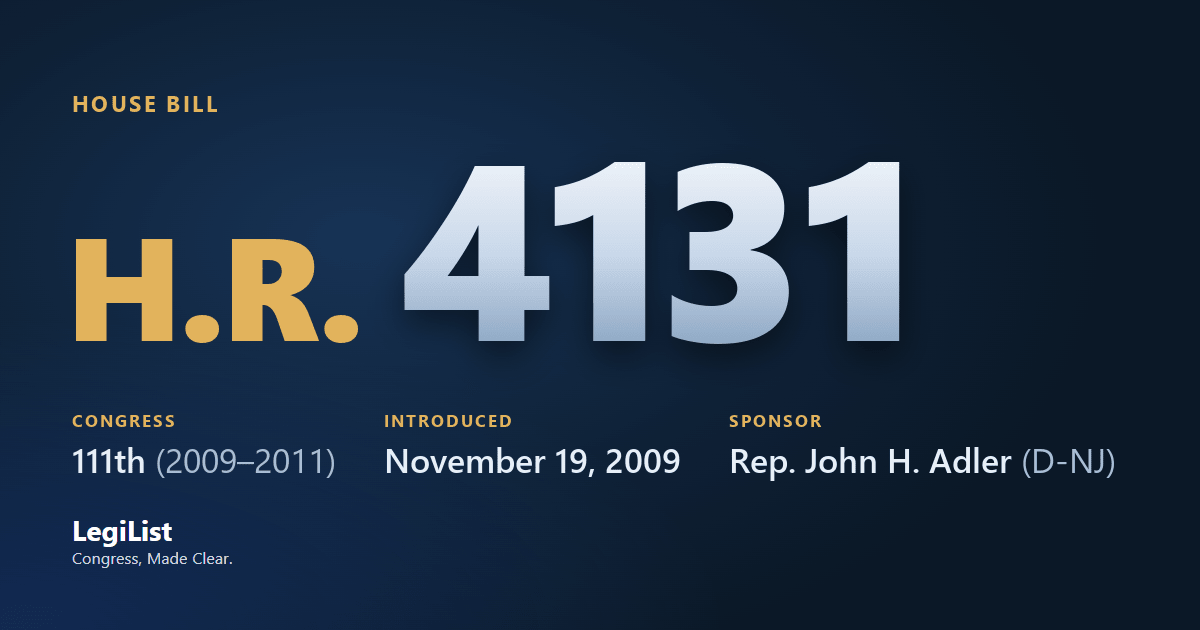
Smoke-Free Federal Workplace Act
Latest action · Jan 4, 2010 Referred to the Subcommittee on Courts and Competition Policy.
Progress
Where this bill reached, and when. A stage with no date was not reached; one that failed a vote and later carried shows the date it carried.
- IntroducedNov 19, 2009
- Passed HouseNot reached
- Passed SenateNot reached
- To the PresidentNot reached
- Became lawNot reached
Summary
Smoke-Free Federal Workplace Act - Prohibits smoking in federal buildings.
Defines "federal building" to: (1) include any building, any area within 25 feet of such building, any courtyard, any areas used for children's playgrounds, or any structure owned, leased, or leased for use by a federal agency; and (2) exclude any building or other structure on a military installation, any health care facility under the jurisdiction of the Secretary of Veterans Affairs (VA), or any area of a building that is used primarily as living quarters.
Requires the head of each executive agency, the Director of the Administrative Office of the United States Courts, the House Office Building Commission and the Senate Committee on Rules and Administration, and the Architect of the Capitol to: (1) take such actions as necessary to institute and enforce the prohibition as it applies to all federal buildings; and (2) implement an enforcement process to impose a fine on an individual who fails to comply with the prohibition ($250 fine for a first offense, $500 for a second offense, and $1,000 for any subsequent offense).
Permits a state or local government or a federal agency, including a military installation or VA facility, to implement more protective smoke-free or tobacco-free laws.
Cosponsors 13
Members who signed on, in the order they did. Signatures ran from Nov 19, 2009 to Feb 24, 2010; 1 is an original cosponsor, there from the day it was introduced.
| Seat | Cosponsor | Signed on | |
|---|---|---|---|
| D-CO | Diana DeGette | Original | Nov 19, 2009 |
| D-NY | Eric J. J. Massa | Dec 2, 2009 | |
| D-CA | Lois Capps | Dec 2, 2009 | |
| D-TX | Sheila Jackson Lee | Dec 2, 2009 | |
| D-AS | Eni F. H. Faleomavaega | Dec 3, 2009 | |
| D-MA | James P. McGovern | Dec 3, 2009 | |
| D-AZ | Raúl M. Grijalva | Dec 3, 2009 | |
| D-WI | Steve Kagen | Dec 3, 2009 | |
| D-CA | George Miller | Dec 16, 2009 | |
| D-KS | Dennis Moore | Jan 12, 2010 | |
| D-MD | Elijah E. Cummings | Jan 12, 2010 | |
| D-IL | Janice D. Schakowsky | Jan 12, 2010 | |
| D-NJ | Rush Holt | Feb 24, 2010 |
Committees 3
Where it was sent and what each committee and subcommittee did with it, in order.
| Chamber | Committee | What it did |
|---|---|---|
| House | Transportation and Infrastructure Committee | Referred Nov 19, 2009 |
| Economic Development, Public Buildings, and Emergency Management Subcommittee | Referred Nov 20, 2009 | |
| House | Committee on House Administration | Referred Nov 19, 2009 |
| House | Judiciary Committee | Referred Nov 19, 2009 |
| Courts, Intellectual Property, Artificial Intelligence, and the Internet Subcommittee | Referred Jan 4, 2010 |
Actions 7
Everything that happened, newest first.
- Jan 4, 2010Referred to the Subcommittee on Courts and Competition Policy.
- Nov 20, 2009Referred to the Subcommittee on Economic Development, Public Buildings and Emergency Management.
- Nov 19, 2009Introduced in House
- Nov 19, 2009Referred to House Transportation and Infrastructure
- Nov 19, 2009Referred to the Committee on Transportation and Infrastructure, and in addition to the Committees on House Administration, and the Judiciary, for a period to be subsequently determined by the Speaker, in each case for consideration of such provisions as fall within the jurisdiction of the committee concerned.
- Nov 19, 2009Referred to House Administration
- Nov 19, 2009Referred to House Judiciary
Titles 2
Every title it has carried, official and short, at each stage.
- Official Title as Introduced
- To prohibit smoking in and around Federal buildings.
- Short Titles as Introduced
- Smoke-Free Federal Workplace Act
Subjects
Assigned by the Library of Congress. Policy area: Government Operations and Politics.
Text 1
Each version as it was printed, newest first.
- Nov 19, 2009Introduced in House
Everything here is as published by Congress: the summary is the Congressional Research Service's, the action wording is the clerks', and the subjects are the Library of Congress's. How far it got is read from the actions themselves, taking the most recent one of each kind, so a bill that failed a vote and later passed is shown as having passed. Records come from this bill on Congress.gov and govinfo.gov; cost estimates are the Congressional Budget Office's, and the hearings are the printed hearings GovInfo publishes, which can appear months after the hearing.