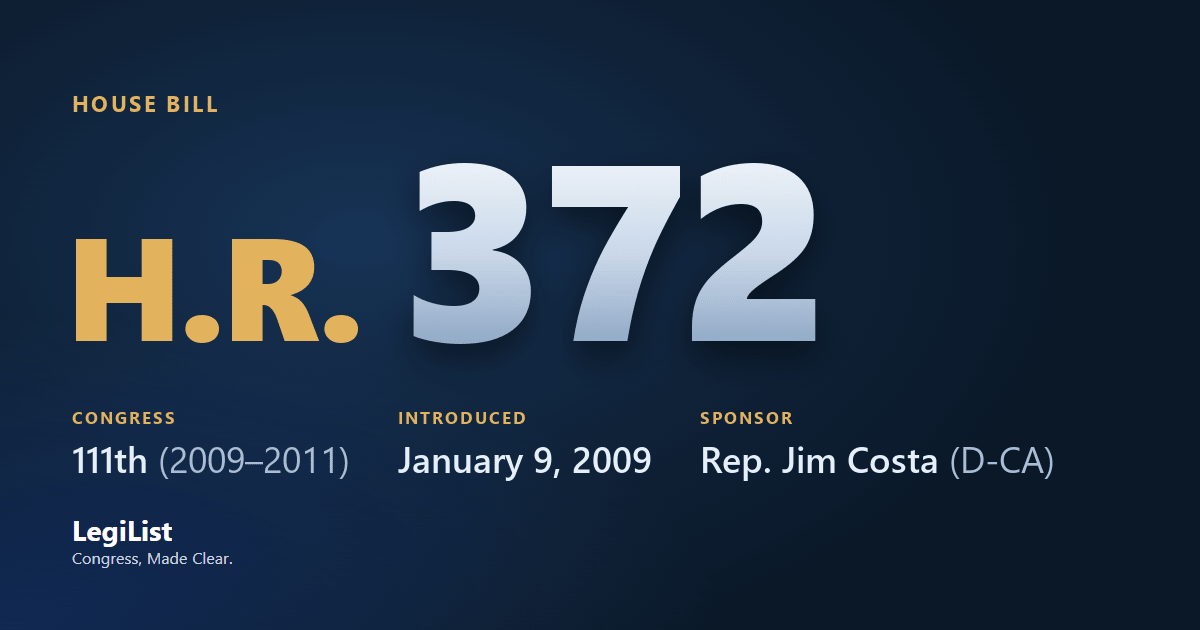
To authorize implementation of the San Joaquin River Restoration Settlement, and for other purposes.
Latest action · Feb 4, 2009 Referred to the Subcommittee on Water and Power.
Progress
Where this bill reached, and when. A stage with no date was not reached; one that failed a vote and later carried shows the date it carried.
- IntroducedJan 9, 2009
- Passed HouseNot reached
- Passed SenateNot reached
- To the PresidentNot reached
- Became lawNot reached
Summary
San Joaquin River Restoration Settlement Act - Directs the Secretary of the Interior (the Secretary), in cooperation with the state of California, to implement the Stipulation of Settlement dated September 13, 2006, in Natural Resources Defense Council, et al. v. Kirk Rodgers, et al., United States District Court, Eastern District of California. Directs the Secretary to: (1) enter into agreements with California to facilitate or expedite Settlement implementation; and (2) identify impacts of facilities construction or operation decisions and measures to mitigate such impacts on adjacent and downstream water users and landowners before implementing such decisions. Provides that Settlement implementation and the reintroduction of Chinook salmon shall not result in the involuntary reduction in contract water allocations to Central Valley Project long-term contractors other than Friant Division contractors.
Requires the Secretary to prepare an environmental analysis prior to releasing Interim Flows. Authorizes the Secretary to release such flows to the extent that they would not impede or delay completion of specified measures in the Settlement or exceed existing downstream channel capacities.
Authorizes the Secretary to: (1) purchase property needed to implement the Settlement; and (2) dispose of such property and deposit proceeds into the San Joaquin River Restoration Fund established in the Treasury.
Declares that the Settlement satisfies and discharges the Secretary's obligations under the Reclamation Projects Authorization and Adjustment Act of 1992. Provides for the reintroduction of California Central Valley Spring Run Chinook salmon into the San Joaquin River.
Directs the Secretary, acting through the Bureau of Reclamation, to provide direct financial assistance to the California Water Institute to study coordination and integration of sub-regional integrated regional water management plans into a unified plan.
Directs the Secretary to conduct feasibility studies on: (1) restoration of the capacity of the Friant-Kern Canal and Madera Canal; and (2) reverse flow pump-back facilities on the Friant-Kern Canal.
Authorizes the Secretary to provide financial assistance to local agencies within the Central Valley Project for facilities to bank water underground or to recharge groundwater and to recover such water.
Cosponsors 3
Members who signed on, in the order they did. All signed on Jan 9, 2009.
| Seat | Cosponsor | Signed on | |
|---|---|---|---|
| D-CA | Dennis A. Cardoza | Original | Jan 9, 2009 |
| R-CA | George Radanovich | Original | Jan 9, 2009 |
| D-CA | Jerry McNerney | Original | Jan 9, 2009 |
Actions 3
Everything that happened, newest first.
- Feb 4, 2009Referred to the Subcommittee on Water and Power.
- Jan 9, 2009Introduced in House
- Jan 9, 2009Referred to the House Committee on Natural Resources.
Related bills 1
Companion bills and other measures the record links to this one.
| Bill | Title | Relationship | Latest action |
|---|---|---|---|
| S 161 | A bill to authorize implementation of the San Joaquin River Restoration Settlement, and for other purposes. | Identical bill | Jan 6, 2009 |
Subjects
Assigned by the Library of Congress. Policy area: Water Resources Development.
Text 1
Each version as it was printed, newest first.
- Jan 9, 2009Introduced in House
Everything here is as published by Congress: the summary is the Congressional Research Service's, the action wording is the clerks', and the subjects are the Library of Congress's. How far it got is read from the actions themselves, taking the most recent one of each kind, so a bill that failed a vote and later passed is shown as having passed. Records come from this bill on Congress.gov and govinfo.gov.