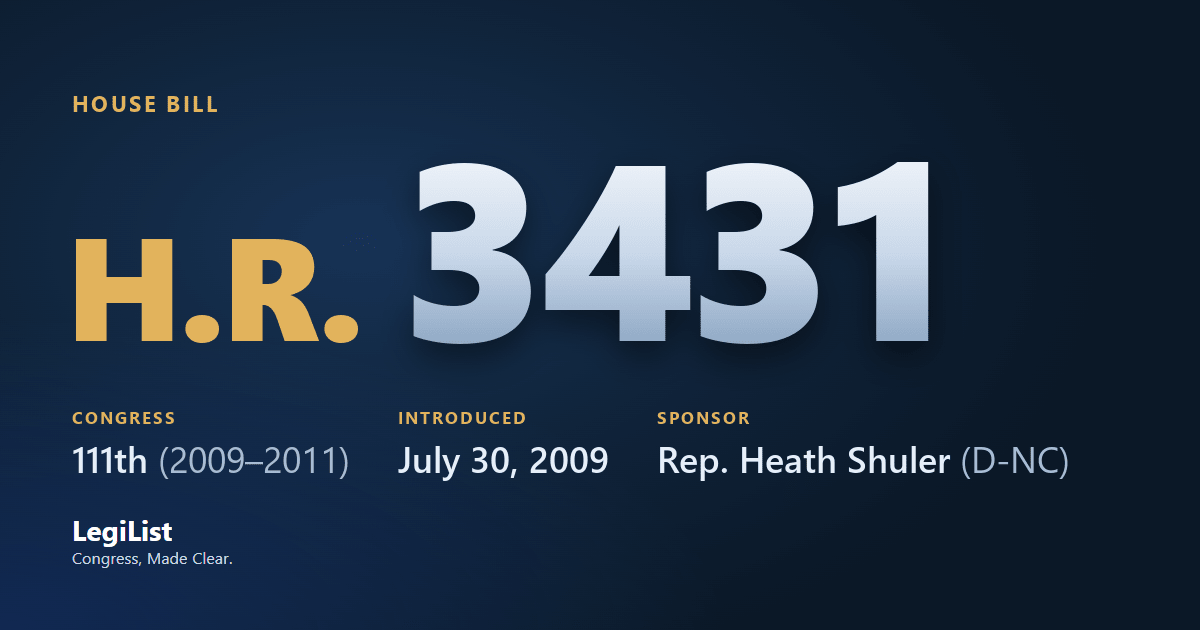
Streamline Vehicle Conversions Act
Latest action · Jul 31, 2009 Referred to the Subcommittee on Energy and Environment.
Progress
Where this bill reached, and when. A stage with no date was not reached; one that failed a vote and later carried shows the date it carried.
- IntroducedJul 30, 2009
- Passed HouseNot reached
- Passed SenateNot reached
- To the PresidentNot reached
- Became lawNot reached
Summary
Streamline Vehicle Conversions Act - Amends the Clean Air Act to provide that a certificate of conformity issued by the Administrator of the Environmental Protection Agency (EPA) for one or more aftermarket conversion test groups with respect to an aftermarket conversion system (i.e., hardware installed on a light-duty or heavy-duty vehicle, light-duty truck, or heavy-duty engine that allows the vehicle or engine to operate on a fuel other than that which it was originally certified to use) shall not expire, shall continue to apply in subsequent calendar years, and shall not require recertification.
Requires the Administrator to: (1) establish criteria for use in identifying similar vehicle makes, models, original equipment manufacturers, emission standards, and different model years that may be used under a single test group; (2) accept such an established test group on an aftermarket conversion system manufacturer application for a certificate of conformity; and (3) allow the submission of previous vehicle emission test data for the certification of additional model year vehicles if the aftermarket conversion system manufacturer is able to demonstrate that neither the aftermarket conversion system nor the design and specifications of the applicable vehicle model are substantially different.
Directs the Administrator to promulgate regulations regarding on-board diagnostic systems for aftermarket conversion systems that: (1) ensure that such conversion systems that are equipped with on-board diagnostic systems are effective at monitoring critical emission components; (2) take into account the inability of an aftermarket conversion system manufacturer to access proprietary on-board diagnostic technology of an original equipment manufacturer; and (3) are sufficiently flexible to encourage the increased use of alternative fueled vehicles.
Sets forth provisions regarding the conversion of a vehicle outside of its useful life cycle.
Cosponsors 7
Members who signed on, in the order they did. Signatures ran from Jul 30, 2009 to Sep 22, 2010; 1 is an original cosponsor, there from the day it was introduced.
| Seat | Cosponsor | Signed on | |
|---|---|---|---|
| D-OK | Dan Boren | Original | Jul 30, 2009 |
| R-PA | Tim Murphy | Nov 17, 2009 | |
| D-MS | Gene Taylor | Dec 8, 2009 | |
| R-LA | Bill Cassidy | Feb 2, 2010 | |
| R-OK | Tom Cole | Mar 12, 2010 | |
| R-IN | Dan Burton | Sep 16, 2010 | |
| D-PA | Mark S. Critz | Sep 22, 2010 |
Committees 1
Where it was sent and what each committee and subcommittee did with it, in order.
| Chamber | Committee | What it did |
|---|---|---|
| House | Energy and Commerce Committee | Referred Jul 30, 2009 |
| Energy Subcommittee | Referred Jul 31, 2009 |
Actions 3
Everything that happened, newest first.
- Jul 31, 2009Referred to the Subcommittee on Energy and Environment.
- Jul 30, 2009Introduced in House
- Jul 30, 2009Referred to the House Committee on Energy and Commerce.
Related bills 1
Companion bills and other measures the record links to this one.
| Bill | Title | Relationship | Latest action |
|---|---|---|---|
| S 1809 | Streamline Vehicle Conversions Act | Identical bill | Oct 20, 2009 |
Titles 2
Every title it has carried, official and short, at each stage.
- Official Title as Introduced
- To amend the Clean Air Act to promote the certification of aftermarket conversion systems and thereby encourage the increased use of alternative fueled vehicles.
- Short Titles as Introduced
- Streamline Vehicle Conversions Act
Subjects
Assigned by the Library of Congress. Policy area: Environmental Protection.
Text 1
Each version as it was printed, newest first.
- Jul 30, 2009Introduced in House
Support LegiList
This page is free, carries no paywall, and is built and maintained by one person. If the record here is useful to you, a few dollars keeps it going.
Everything here is as published by Congress: the summary is the Congressional Research Service's, the action wording is the clerks', and the subjects are the Library of Congress's. How far it got is read from the actions themselves, taking the most recent one of each kind, so a bill that failed a vote and later passed is shown as having passed. Records come from this bill on Congress.gov and govinfo.gov; cost estimates are the Congressional Budget Office's, and the hearings are the printed hearings GovInfo publishes, which can appear months after the hearing.