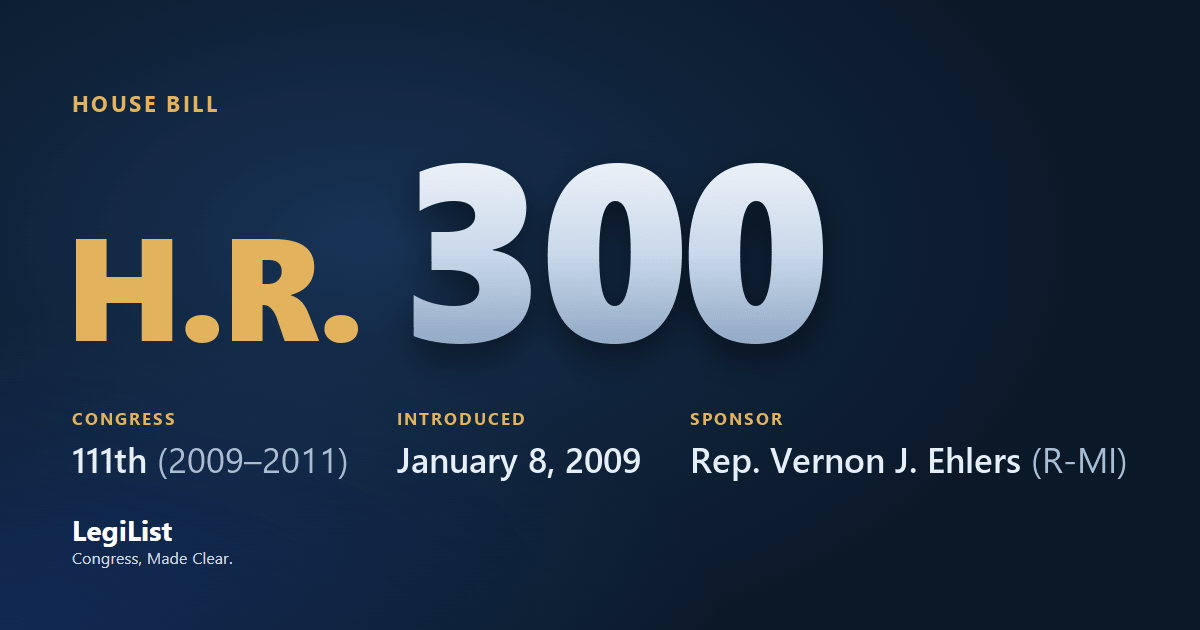
National Oceanic and Atmospheric Administration Act
Latest action · Feb 4, 2009 Referred to the Subcommittee on Insular Affairs, Oceans and Wildlife.
Progress
Where this bill reached, and when. A stage with no date was not reached; one that failed a vote and later carried shows the date it carried.
- IntroducedJan 8, 2009
- Passed HouseNot reached
- Passed SenateNot reached
- To the PresidentNot reached
- Became lawNot reached
Summary
National Oceanic and Atmospheric Administration Act - Reestablishes in the Department of Commerce the National Oceanic and Atmospheric Administration (NOAA), headed by an Under Secretary of Commerce for Oceans and Atmosphere, who shall serve as the Administrator of NOAA.
Maintains within NOAA: (1) the National Weather Service; (2) programs to support efforts, on a continuing basis, to collect data and provide information and products regarding satellites, observations, and coastal, ocean, and Great Lakes information; and (3) programs to conduct and support research and education and the development of technologies relating to weather, climate, and the coasts, oceans, and Great Lakes.
Establishes a Science Advisory Board within NOAA.
Terminates the Reorganization Plan No. 4 of 1970 (the executive order that established NOAA).
Requires the Administrator to develop and submit to Congress a NOAA reorganization plan.
Prohibits the Administrator from closing, consolidating, relocating, subdividing, or establishing a facility of NOAA unless there has been specified prior public and congressional notification, and an assessment, of any proposed changes.
Prohibits, except as provided, a NOAA activity or function that is converted to contractor performance under Office of Management and Budget Circular A-76 from being performed by the contractor or any subcontractor at a location outside of the United States.
Cosponsors
Members who signed on, in the order they did.
Committees 2
Where it was sent and what each committee and subcommittee did with it, in order.
| Chamber | Committee | What it did |
|---|---|---|
| House | Science, Space, and Technology Committee | Referred Jan 8, 2009 |
| Energy Subcommittee | Referred Jan 8, 2009 | |
| House | Natural Resources Committee | Referred Jan 8, 2009 |
| Fisheries, Wildlife, Oceans, and Insular Affairs Subcommittee | Referred Feb 4, 2009 |
Actions 6
Everything that happened, newest first.
- Feb 4, 2009Referred to the Subcommittee on Insular Affairs, Oceans and Wildlife.
- Jan 8, 2009Introduced in House
- Jan 8, 2009Referred to House Science and Technology
- Jan 8, 2009Referred to the Committee on Science and Technology, and in addition to the Committee on Natural Resources, for a period to be subsequently determined by the Speaker, in each case for consideration of such provisions as fall within the jurisdiction of the committee concerned.
- Jan 8, 2009Referred to House Natural Resources
Research
What has been written about this bill: committee reports, cost estimates, the sponsor’s authority statement, printed hearings and the Congressional Research Service’s work.
CRS reports 1
Congressional Research Service work that CRS links to this bill or the law it became, newest first.
Cite it 1
Products on other subjects that cite it, usually among other measures.
| Product | Title | Kind | Published |
|---|---|---|---|
| R47636 | National Oceanic and Atmospheric Administration (NOAA): Organization Overview and Issues for Congress | Report | Mar 4, 2025 |
Titles 2
Every title it has carried, official and short, at each stage.
- Official Title as Introduced
- To provide for the National Oceanic and Atmospheric Administration, and for other purposes.
- Short Titles as Introduced
- National Oceanic and Atmospheric Administration Act
Subjects
Assigned by the Library of Congress. Policy area: Science, Technology, Communications.
- Advanced technology and technological innovations
- Advisory bodies
- Aquatic ecology
- Atmospheric science and weather
- Climate change and greenhouse gases
- Congressional oversight
- Department of Commerce
- Earth sciences
- Environmental assessment, monitoring, research
- Executive agency funding and structure
- Government buildings, facilities, and property
- Government information and archives
- Great Lakes
- Higher education
- Marine and coastal resources, fisheries
- Navigation, waterways, harbors
- Public contracts and procurement
- Public-private cooperation
- Research and development
- Science and engineering education
- Science, Technology, Communications
- Spacecraft and satellites
Text 1
Each version as it was printed, newest first.
- Jan 8, 2009Introduced in House
Everything here is as published by Congress: the summary is the Congressional Research Service's, the action wording is the clerks', and the subjects are the Library of Congress's. How far it got is read from the actions themselves, taking the most recent one of each kind, so a bill that failed a vote and later passed is shown as having passed. Records come from this bill on Congress.gov and govinfo.gov; cost estimates are the Congressional Budget Office's, and the hearings are the printed hearings GovInfo publishes, which can appear months after the hearing.