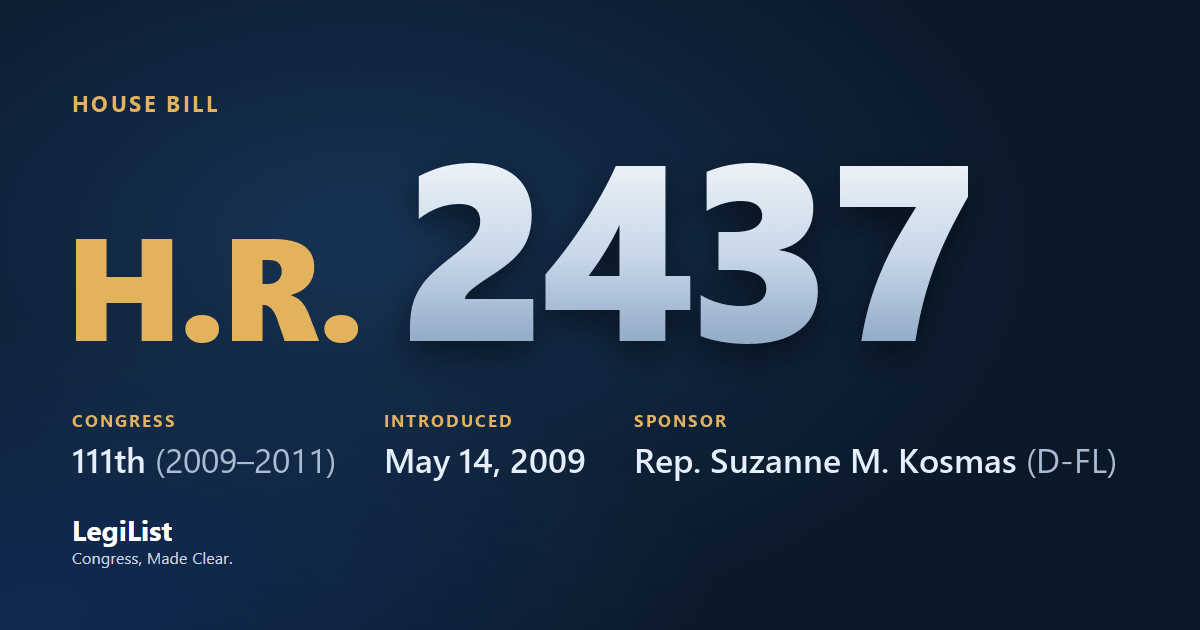
Employing America's Heroes Tax Relief Act
Latest action · May 14, 2009 Referred to the House Committee on Ways and Means.
Progress
Where this bill reached, and when. A stage with no date was not reached; one that failed a vote and later carried shows the date it carried.
- IntroducedMay 14, 2009
- Passed HouseNot reached
- Passed SenateNot reached
- To the PresidentNot reached
- Became lawNot reached
Summary
Employing America's Heroes Tax Relief Act - Amends the Internal Revenue Code to extend through 2010 the tax credit for differential wage payments made by a small business employer on behalf of employees who are active duty members of the uniformed services.
Cosponsors
Members who signed on, in the order they did.
Committees 1
Where it was sent and what each committee and subcommittee did with it, in order.
| Chamber | Committee | What it did |
|---|---|---|
| House | Ways and Means Committee | Referred May 14, 2009 |
Actions 2
Everything that happened, newest first.
- May 14, 2009Introduced in House
- May 14, 2009Referred to the House Committee on Ways and Means.
Related bills 1
Companion bills and other measures the record links to this one.
| Bill | Title | Relationship | Latest action |
|---|---|---|---|
| HR 2396 | Small Business Supporting our Troops Act of 2009 | Related bill | May 13, 2009 |
Titles 2
Every title it has carried, official and short, at each stage.
- Official Title as Introduced
- To amend the Internal Revenue Code of 1986 to extend the employer wage credit for employees who are active duty members of the uniformed services.
- Short Titles as Introduced
- Employing America's Heroes Tax Relief Act
Subjects
Assigned by the Library of Congress. Policy area: Taxation.
Text 1
Each version as it was printed, newest first.
- May 14, 2009Introduced in House
Everything here is as published by Congress: the summary is the Congressional Research Service's, the action wording is the clerks', and the subjects are the Library of Congress's. How far it got is read from the actions themselves, taking the most recent one of each kind, so a bill that failed a vote and later passed is shown as having passed. Records come from this bill on Congress.gov and govinfo.gov; cost estimates are the Congressional Budget Office's, and the hearings are the printed hearings GovInfo publishes, which can appear months after the hearing.