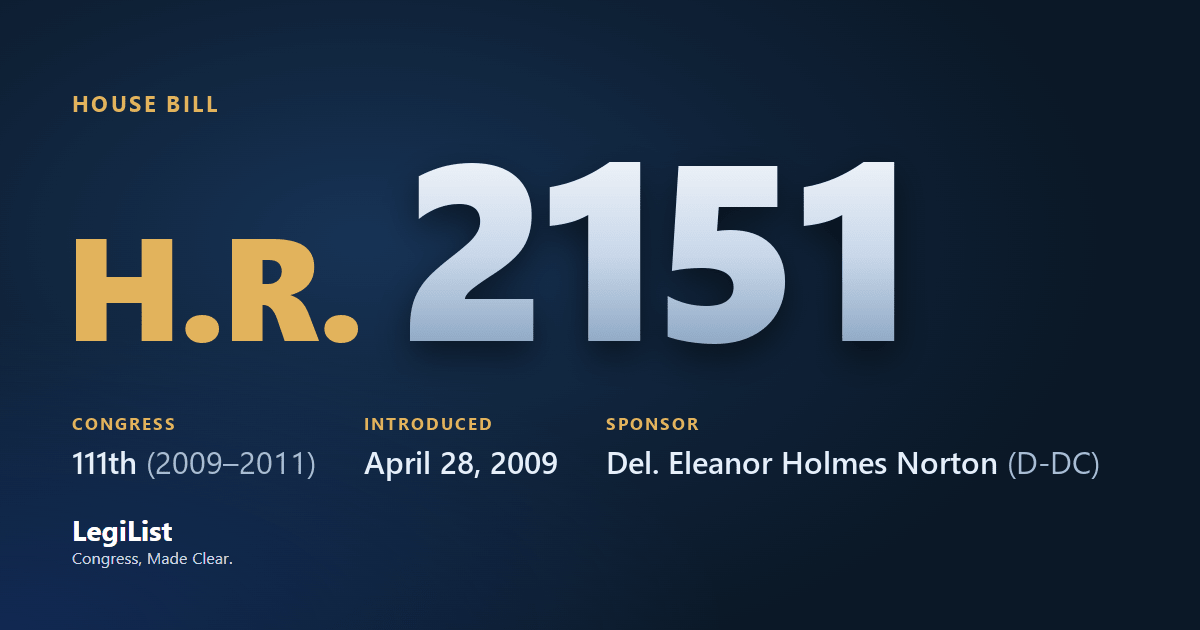
Fair Pay Act of 2009
Latest action · Jun 4, 2009 Referred to the Subcommittee on Workforce Protections.
Progress
Where this bill reached, and when. A stage with no date was not reached; one that failed a vote and later carried shows the date it carried.
- IntroducedApr 28, 2009
- Passed HouseNot reached
- Passed SenateNot reached
- To the PresidentNot reached
- Became lawNot reached
Summary
Fair Pay Act of 2009 - Amends the Fair Labor Standards Act of 1938 to prohibit discrimination in the payment of wages on account of sex, race, or national origin. (Allows payment of different wages under seniority systems, merit systems, systems that measure earnings by quantity or quality of production, or differentials based on bona fide factors that the employer demonstrates are job-related or further legitimate business interests.)
Prohibits the discharge of, or any other discrimination against, an individual for opposing any act or practice made unlawful by this Act, or for assisting in an investigation or proceeding under it.
Directs courts, in any action brought under this Act for violation of such prohibition, to allow expert fees as part of the costs awarded to prevailing plaintiffs. Allows any such action to be maintained as a class action.
Directs the Equal Employment Opportunity Commission (EEOC) to: (1) undertake studies and provide information and technical assistance to employers, labor organizations, and the general public concerning effective means available to implement this Act; and (2) carry on a continuing program of research, education, and technical assistance with specified components related to the purposes of this Act.
Makes conforming amendments relating to congressional and executive branch employees to the Congressional Accountability Act of 1995 and the Presidential and Executive Office Accountability Act.
Cosponsors
Members who signed on, in the order they did.
Committees 1
Where it was sent and what each committee and subcommittee did with it, in order.
| Chamber | Committee | What it did |
|---|---|---|
| House | Education and Workforce Committee | Referred Apr 28, 2009 |
| Workforce Protections Subcommittee | Referred Jun 4, 2009 |
Actions 4
Everything that happened, newest first.
- Jun 4, 2009Referred to the Subcommittee on Workforce Protections.
- Apr 28, 2009Introduced in House
- Apr 28, 2009Sponsor introductory remarks on measure. (CR E999)
- Apr 28, 2009Referred to the House Committee on Education and Labor.
In the Congressional Record 1
Days the Record’s own index lists this bill, newest first, with the pages and the members it names. Pages starting H are the House, S the Senate, E Extensions of Remarks.
| Where | In the Record | Members | Date |
|---|---|---|---|
| Extensions | Debate and remarks E999 | Eleanor Holmes Norton D-DC | Apr 28, 2009 |
Related bills 1
Companion bills and other measures the record links to this one.
| Bill | Title | Relationship | Latest action |
|---|---|---|---|
| S 904 | Fair Pay Act of 2009 | Identical bill | Mar 11, 2010 |
Titles 2
Every title it has carried, official and short, at each stage.
- Official Title as Introduced
- To amend the Fair Labor Standards Act of 1938 to prohibit discrimination in the payment of wages on account of sex, race, or national origin, and for other purposes.
- Short Titles as Introduced
- Fair Pay Act of 2009
Subjects
Assigned by the Library of Congress. Policy area: Labor and Employment.
Text 1
Each version as it was printed, newest first.
- Apr 28, 2009Introduced in House
Everything here is as published by Congress: the summary is the Congressional Research Service's, the action wording is the clerks', and the subjects are the Library of Congress's. How far it got is read from the actions themselves, taking the most recent one of each kind, so a bill that failed a vote and later passed is shown as having passed. Records come from this bill on Congress.gov and govinfo.gov; cost estimates are the Congressional Budget Office's, and the hearings are the printed hearings GovInfo publishes, which can appear months after the hearing.