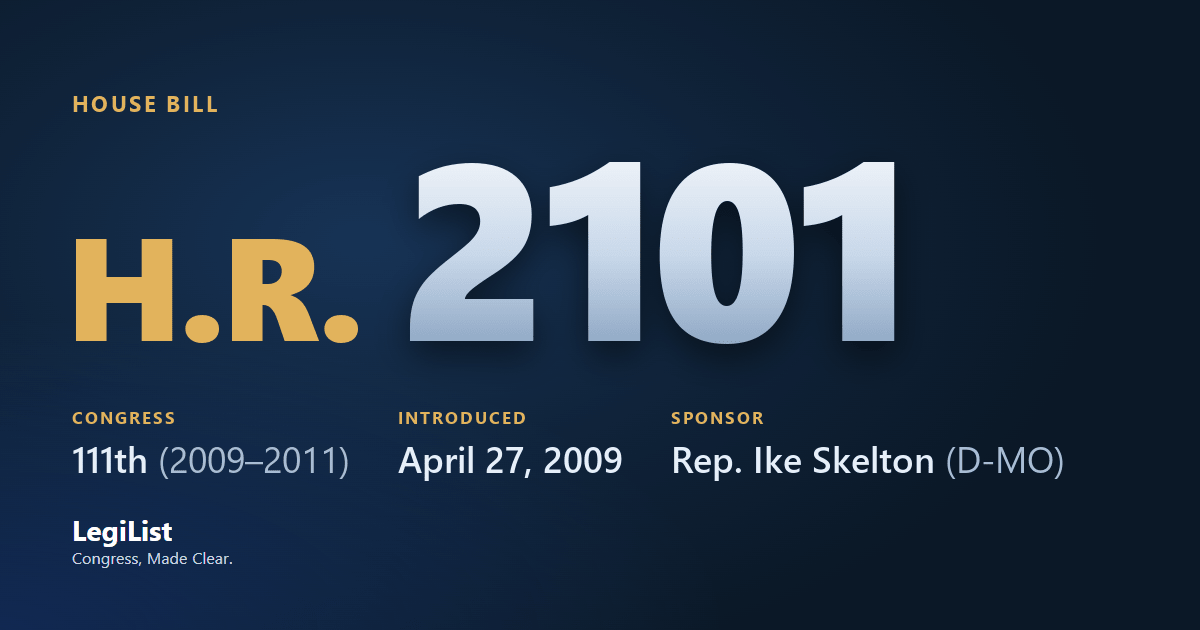
Weapons Acquisition System Reform Through Enhancing Technical Knowledge and Oversight Act of 2009
Latest action · May 13, 2009 Laid on the table. See S.454 for further action.
Progress
Where this bill reached, and when. A stage with no date was not reached; one that failed a vote and later carried shows the date it carried.
- IntroducedApr 27, 2009
- Passed HouseMay 13, 2009
- Passed SenateNot reached
- To the PresidentNot reached
- Became lawNot reached
Summary
Weapons Acquisition System Reform Through Enhancing Technical Knowledge and Oversight Act of 2009 - Title I: Acquisition Organization - (Sec. 101) Directs the Secretary of Defense to designate an official within the Office of the Secretary of Defense as the principal advisor to the Secretary for each of the following Department of Defense (DOD) acquisition oversight functions: (1) cost estimation; (2) systems engineering; (3) performance assessment; and (4) such other functions as considered appropriate by the Secretary.
(Sec. 102) Requires the official assigned oversight of cost estimation to issue policies, procedures, guidance, and cost estimates in connection with DOD acquisition programs and major defense acquisition programs (MDAPs). Directs the Secretary to ensure that the official so designated: (1) receives all cost estimates, analyses, and studies conducted by the military departments for MDAPs and major automated information systems; and (2) is involved in all discussions relating to cost estimation for MDAPs and major automated information systems at all stages of such programs. Requires such official to: (1) disclose the confidence level used in establishing a baseline estimate for an MDAP; and (2) report annually to the defense and appropriations committees on cost estimation activities.
(Sec. 103) Requires the official assigned oversight of systems engineering to: (1) issue policies, procedures, and guidance for DOD use of systems engineering; (2) provide input on the inclusion of systems engineering requirements in the process for consideration of joint military requirements by the Joint Requirements Oversight Council (JROC); (3) review and approve, with respect to each MDAP, the systems engineering master plan and the developmental test and evaluation plan; and (4) report annually to the defense and appropriations committees on systems engineering activities.
(Sec. 104) Requires the official assigned oversight of performance assessment to: (1) issue policies, procedures, and guidance governing the conduct of performance assessments for DOD acquisition programs; (2) periodically assess the suitability of MDAP baseline descriptions for providing a basis for performance assessment; (3) be responsible for management and oversight of records of the DOD earned value management system; (4) participate in certain MDAP program reviews; and (5) report annually to the defense and appropriations committees on performance assessment activities.
(Sec. 105) Requires the Director of Defense Research and Engineering to: (1) periodically review and assess the technological maturity and integration risk of MDAP critical technologies; (2) report annually to the Secretary and the defense and appropriations committees on such review and assessment; and (3) report to such committees on any additional resources that may be required to implement recommendations made after such reviews and assessments.
(Sec. 106) Directs the: (1) JROC to seek and consider input from commanders of combatant commands in identifying joint military requirements; and (2) Comptroller General (CG) to report to the defense committees on the implementation of such requirement.
Title II: Acquisition Policy - (Sec. 201) Directs the Secretary to ensure that the acquisition strategy for each MDAP includes: (1) measures to ensure competition at both the prime contract and subcontract level of the MDAP throughout its life-cycle as a means to improve contractor performance; and (2) adequate documentation of the rationale for selection of the subcontractor tier or tiers. Outlines measures to ensure such competition. Requires the Secretary to ensure that, with respect to maintenance of an MDAP, consideration is given to DOD capabilities to perform maintenance functions.
(Sec. 202) Directs the milestone decision authority (MDA) for an MDAP who waives certain program certification requirements normally necessary before Milestone B or Key Decision Point B approval to, at least annually, review that MDAP to determine its satisfaction with the waived requirements. Requires the current certification status of such MDAPs to be included in annual DOD budget justification documents.
Requires the MDA for an MDAP to have received a preliminary design review and conducted a formal post-preliminary design review assessment before an MDAP may receive Milestone B or Key Decision Point B approval.
Directs the MDA, for each MDAP that has not received Milestone C or Key Decision Point C approval, to: (1) determine whether or not the program satisfies specified certification components; and (2) annually review progress in satisfying such components. Requires the current certification status of such MDAPs to be included in annual DOD budget justification documents.
Directs the official assigned oversight of performance assessment, with respect to MDAPs that are restructured after experiencing critical cost growth and certified as necessary to continue, to annually review and assess the MDAP's success in achieving adequate program performance.
(Sec. 203) Requires certain MDA certification with respect to MDAPs that have not received Milestone B or Key Decision Point B approval, including that the program: (1) fulfills an approved initial capabilities document; and (2) is being executed by an entity with a relevant core competency identified by the Secretary. Directs the MDA to report to the defense and appropriations committees with respect to cost growth or schedule delays under such MDAPs.
(Sec. 204) Directs the Secretary, if the acquisition or procurement unit cost of an MDAP or designated major subprogram increases by a percentage equal to or greater than the critical cost growth threshold for the program or subprogram, to: (1) determine the root cause or causes for the cost growth; (2) determine whether to terminate or restructure the program or subprogram; and (3) submit such determinations to Congress. Allows a program or subprogram to be restructured only under limited conditions, including a certification that the program is essential to national security and that there are no alternatives which will provide acceptable military capability at less cost. Provides that when a program is restructured, the next Selected Acquisition Report for the program after the restructuring shall contain a description of all funding changes in the budget as a result of the program's cost growth.
(Sec. 205) Directs the Panel on Contracting Integrity (established under the John Warner National Defense Authorization Act for Fiscal Year 2007) to present recommendations to the Secretary on measures to eliminate or mitigate organizational conflicts of interest in the acquisition of major weapons systems. Requires the Secretary to revise the Defense Supplement to the Federal Acquisition Regulation to address such conflicts. Directs the Panel to continue to serve until at least the end of 2011.
(Sec. 206) Directs the Secretary to carry out a program to recognize excellent performance by individuals and teams of members of the Armed Forces and civilian DOD personnel in the acquisition of products and services for DOD. Authorizes cash bonuses as part of the program.
(Sec. 207) Requires the CG to: (1) review DOD use of certain mechanisms for considering tradeoffs among cost, schedule, and performance in the acquisition of major weapon systems; and (2) report review results to the defense and appropriations committees.
Cosponsors 23
Members who signed on, in the order they did. Signatures ran from Apr 27, 2009 to May 7, 2009; 12 are original cosponsors, there from the day it was introduced.
| Seat | Cosponsor | Signed on | |
|---|---|---|---|
| D-NH | Carol Shea-Porter | Original | Apr 27, 2009 |
| D-CA | Ellen O. Tauscher | Original | Apr 27, 2009 |
| D-NY | Eric J. J. Massa | Original | Apr 27, 2009 |
| R-VA | J. Randy Forbes | Original | Apr 27, 2009 |
| D-PA | Joe Sestak | Original | Apr 27, 2009 |
| R-NY | John M. McHugh | Original | Apr 27, 2009 |
| D-SC | John M. Spratt, Jr. | Original | Apr 27, 2009 |
| R-TX | K. Michael Conaway | Original | Apr 27, 2009 |
| R-CO | Mike Coffman | Original | Apr 27, 2009 |
| D-PA | Robert A. Brady | Original | Apr 27, 2009 |
| D-NJ | Robert E. Andrews | Original | Apr 27, 2009 |
| D-AR | Vic Snyder | Original | Apr 27, 2009 |
| D-MS | Gene Taylor | Apr 30, 2009 | |
| D-CT | Joe Courtney | Apr 30, 2009 | |
| R-VA | Robert J. Wittman | Apr 30, 2009 |
Committees 1
Where it was sent and what each committee and subcommittee did with it, in order.
| Chamber | Committee | What it did |
|---|---|---|
| House | Armed Services Committee | Referred Apr 27, 2009Markup May 7, 2009Reported May 12, 2009 |
Actions 8
Everything that happened, newest first.
- May 13, 2009Passed/agreed to in House: Pursuant to the provisions of H. Res. 432, H.R. 2101 is considered passed House as amended. (consideration: CR H5539)
- May 13, 2009Laid on the table. See S.454 for further action.
- May 12, 2009Reported (Amended) by the Committee on Armed Services. H. Rept. 111-101.
- May 12, 2009Placed on the Union Calendar, Calendar No. 47.
- May 7, 2009Committee Consideration and Mark-up Session Held.
In the Congressional Record 1
Days the Record’s own index lists this bill, newest first, with the pages and the members it names. Pages starting H are the House, S the Senate, E Extensions of Remarks.
| Where | In the Record | Members | Date |
|---|---|---|---|
| House | Debate and remarks H5524–H5530Text printed H5524Recorded votes H5538 | Brad Ellsworth D-IN, Carol Shea-Porter D-NH, Chris Van Hollen D-MD, Frank Kratovil, Jr. D-MD, Ike Skelton D-MO, James R. Langevin D-RI, John Fleming R-LA, John M. McHugh R-NY, K. Michael Conaway R-TX, Mike Coffman R-CO, Robert E. Andrews D-NJ, Roscoe G. Bartlett R-MD | May 13, 2009 |
Research
What has been written about this bill: committee reports, cost estimates, the sponsor’s authority statement, printed hearings and the Congressional Research Service’s work.
Committee report
Congressional Budget Office cost estimates 2
- May 11, 2009H.R. 2101, Weapons Acquisition System Reform Through Enhancing Technical Knowledge and Oversight Act of 2009<p>Cost estimate for the bill as ordered reported by the House Committee on Armed Services on May 7, 2009</p>
- May 11, 2009H.R. 2101, Weapons Acquisition System Reform Through Enhancing Technical Knowledge and Oversight Act of 2009Cost estimate for the bill as ordered reported by the House Committee on Armed Services on May 7, 2009
Printed hearings 2
Hearings whose printed record names this bill, newest first: hearings on it, and wider hearings where it came up.
| Number | Hearing | Committee | Held |
|---|---|---|---|
| H.A.S.C. No. 111-52 | THE DEPARTMENT OF DEFENSE AT HIGH RISK: THE CHIEF MANAGEMENT OFFICER'S RECOMMENDATIONS FOR ACQUISITION REFORM AND RELATED HIGH-RISK AREAS59 pages | Armed Services Committee | May 6, 2009 |
| H.A.S.C. No. 111-54 | REFORM OF MAJOR WEAPONS SYSTEM ACQUISITION AND RELATED LEGISLATIVE PROPOSALS86 pages | Armed Services Committee | Apr 30, 2009 |
Related bills 2
Companion bills and other measures the record links to this one.
| Bill | Title | Relationship | Latest action |
|---|---|---|---|
| HRES 432 | Providing for passage of the bill (H.R. 2101) to promote reform and independence in the oversight of weapons system acquisition by the Department of Defense, and for other purposes. | Procedurally related | May 13, 2009 |
| S 454 | Weapon Systems Acquisition Reform Act of 2009 | Related bill | May 22, 2009 |
Titles 4
Every title it has carried, official and short, at each stage.
- Official Title as Introduced
- To promote reform and independence in the oversight of weapons system acquisition by the Department of Defense.
- Short Titles as Introduced
- Weapons Acquisition System Reform Through Enhancing Technical Knowledge and Oversight Act of 2009
- Short Titles as Reported to House
- Weapons Acquisition System Reform Through Enhancing Technical Knowledge and Oversight Act of 2009
- Short Titles as Passed House
- Weapons Acquisition System Reform Through Enhancing Technical Knowledge and Oversight Act of 2009
Subjects
Assigned by the Library of Congress. Policy area: Armed Forces and National Security.
- Armed Forces and National Security
- Congressional oversight
- Department of Defense
- Executive agency funding and structure
- Government employee pay, benefits, personnel management
- Military procurement, research, weapons development
- Performance measurement
- Public contracts and procurement
- Technology assessment
Text 2
Each version as it was printed, newest first.
- May 12, 2009Reported in House
- Apr 27, 2009Introduced in House
Everything here is as published by Congress: the summary is the Congressional Research Service's, the action wording is the clerks', and the subjects are the Library of Congress's. How far it got is read from the actions themselves, taking the most recent one of each kind, so a bill that failed a vote and later passed is shown as having passed. Records come from this bill on Congress.gov and govinfo.gov; cost estimates are the Congressional Budget Office's, and the hearings are the printed hearings GovInfo publishes, which can appear months after the hearing.