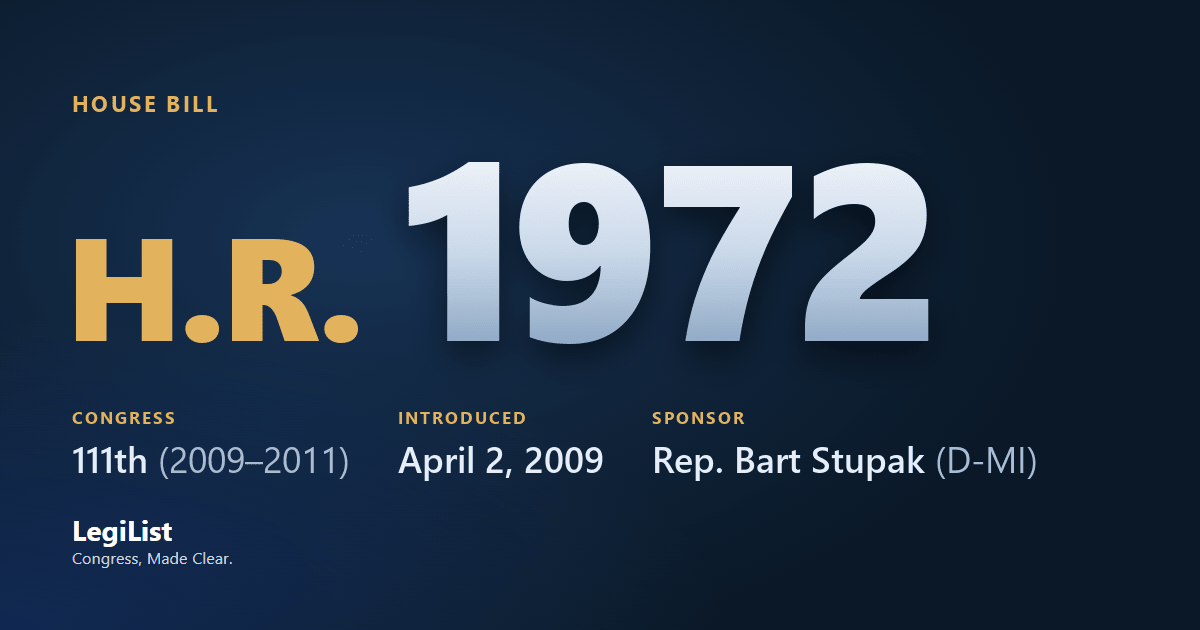
Law Enforcement Officer's Procedural Bill of Rights Act of 2009
Latest action · May 26, 2009 Referred to the Subcommittee on Crime, Terrorism, and Homeland Security.
Progress
Where this bill reached, and when. A stage with no date was not reached; one that failed a vote and later carried shows the date it carried.
- IntroducedApr 2, 2009
- Passed HouseNot reached
- Passed SenateNot reached
- To the PresidentNot reached
- Became lawNot reached
Summary
Law Enforcement Officer's Procedural Bill of Rights Act of 2009 - Amends the Omnibus Crime Control and Safe Streets Act of 1968 to set forth the due process rights, including procedures, that shall be afforded a law enforcement officer who is the subject of an investigation or disciplinary proceedings.
Requires a law enforcement agency that initiates investigations or disciplinary proceedings against an officer of that agency to adopt and thereafter comply with a written complaint procedure that meets specified requirements.
Grants certain procedural protections to law enforcement officers before and during any investigation that may result in disciplinary action, including: (1) the right to effective counsel; (2) the right to be interrogated at a reasonable hour; (3) written notice of investigative findings and disciplinary recommendations; (4) the right to submit a written response to such findings and recommendations; and (5) access to the complete file of the investigation and the right to examine physical evidence. Prohibits an officer from being compelled to submit to the use of a lie detector. Sets forth requirements and procedures for conducting disciplinary proceedings and for protecting the personal records and property of an officer.
Declares that nothing in this Act shall be construed to authorize federal control over any state or local police force or criminal justice agency.
Cosponsors 11
Members who signed on, in the order they did. Signatures ran from Apr 2, 2009 to Sep 29, 2010; 1 is an original cosponsor, there from the day it was introduced.
| Seat | Cosponsor | Signed on | |
|---|---|---|---|
| R-MN | Erik Paulsen | Original | Apr 2, 2009 |
| R-NC | Walter B. Jones | May 13, 2009 | |
| D-MN | Timothy J. Walz | Dec 16, 2009 | |
| D-PA | Patrick J. Murphy | May 4, 2010 | |
| D-NV | Shelley Berkley | May 4, 2010 | |
| D-PA | Tim Holden | May 4, 2010 | |
| D-OH | Betty Sutton | May 11, 2010 | |
| R-KY | Ed Whitfield | May 25, 2010 | |
| D-AZ | Harry E. Mitchell | May 25, 2010 | |
| D-NM | Martin Heinrich | Jul 27, 2010 | |
| D-NC | David E. Price | Sep 29, 2010 |
Committees 1
Where it was sent and what each committee and subcommittee did with it, in order.
| Chamber | Committee | What it did |
|---|---|---|
| House | Judiciary Committee | Referred Apr 2, 2009 |
| Crime and Federal Government Surveillance Subcommittee | Referred May 26, 2009 |
Actions 3
Everything that happened, newest first.
- May 26, 2009Referred to the Subcommittee on Crime, Terrorism, and Homeland Security.
- Apr 2, 2009Introduced in House
- Apr 2, 2009Referred to the House Committee on the Judiciary.
In the Congressional Record 1
Days the Record’s own index lists this bill, newest first, with the pages and the members it names. Pages starting H are the House, S the Senate, E Extensions of Remarks.
| Where | In the Record | Members | Date |
|---|---|---|---|
| House | Debate and remarks H5490 | Erik Paulsen R-MN | May 13, 2009 |
Titles 2
Every title it has carried, official and short, at each stage.
- Official Title as Introduced
- To amend the Omnibus Crime Control and Safe Streets Act of 1968 to provide standards and procedures to guide State and local law enforcement agencies and law enforcement officers during internal investigations, interrogation of law enforcement officers, and administrative disciplinary hearings, to ensure accountability of law enforcement officers, to guarantee the due process rights of law enforcement officers, and to require States to enact law enforcement discipline, accountability, and due process laws.
- Short Titles as Introduced
- Law Enforcement Officer's Procedural Bill of Rights Act of 2009
Subjects
Assigned by the Library of Congress. Policy area: Crime and Law Enforcement.
Text 1
Each version as it was printed, newest first.
- Apr 2, 2009Introduced in House
Everything here is as published by Congress: the summary is the Congressional Research Service's, the action wording is the clerks', and the subjects are the Library of Congress's. How far it got is read from the actions themselves, taking the most recent one of each kind, so a bill that failed a vote and later passed is shown as having passed. Records come from this bill on Congress.gov and govinfo.gov; cost estimates are the Congressional Budget Office's, and the hearings are the printed hearings GovInfo publishes, which can appear months after the hearing.