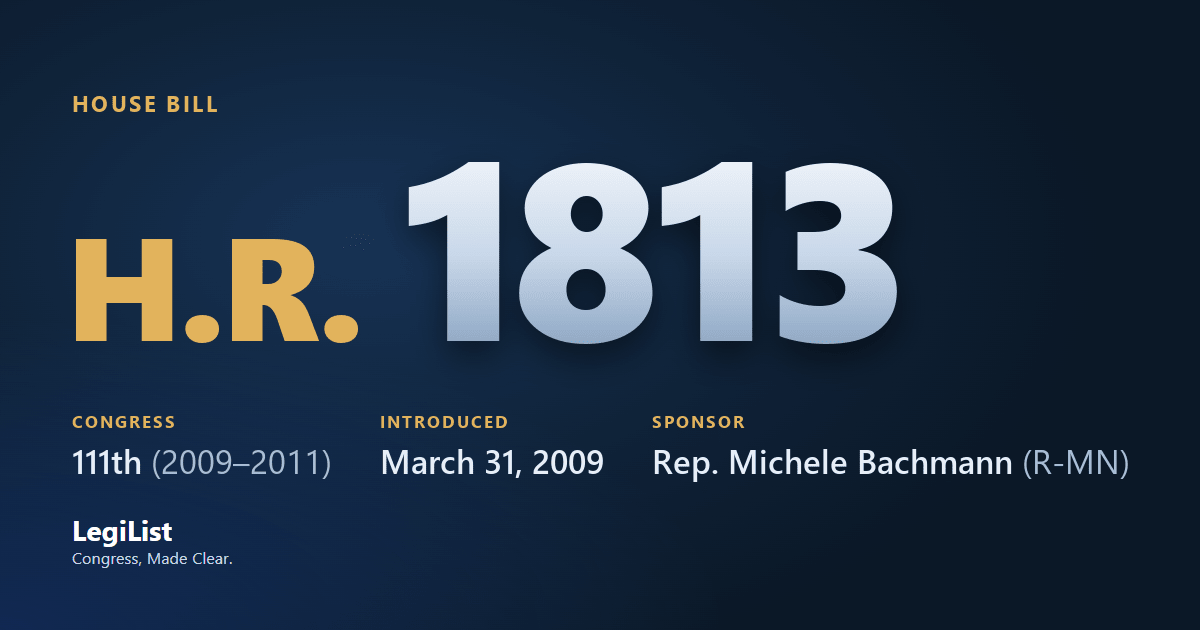
Emergency Energy Cut the Red Tape Now Act of 2009
Latest action · Apr 28, 2009 Referred to the Subcommittee on Department Operations, Oversight, Nutrition and Forestry.
Progress
Where this bill reached, and when. A stage with no date was not reached; one that failed a vote and later carried shows the date it carried.
- IntroducedMar 31, 2009
- Passed HouseNot reached
- Passed SenateNot reached
- To the PresidentNot reached
- Became lawNot reached
Summary
Emergency Energy Cut the Red Tape Now Act of 2009 - Declares without force or effect all: (1) federal prohibitions against the leasing of federal Outer Continental Shelf, Bureau of Land Management, or National Forest lands or federal submerged lands for exploration, development, or production of oil, gas, or oil shale; (2) federal withdrawals of such lands from such leasing; or (3) federal prohibitions against the expenditure of federal funds for such leasing.
Authorizes the Secretary of the Interior to waive the application of any federal law that requires a permit to engage in drilling for oil or gas under a lease of federal lands or federal submerged lands during any period in which the most recent spot market price for West Texas Intermediate crude oil at the domestic spot market at Cushing, Oklahoma, is less than $100 per barrel. Requires such a waiver during any period in which the most recent spot price is greater than $100 per barrel.
Requires the Department of Energy to act as the lead agency to coordinate all applicable federal refinery authorizations and related environmental reviews with respect to a designated refinery.
Requires each federal and state agency or official required to provide a federal refinery authorization to cooperate with the Secretary of Energy and comply with deadlines the Secretary establishes.
Requires the Secretary to establish a schedule for all federal refinery authorizations with respect to a designated refinery.
Requires the Secretary to approve an application for a federal refinery authorization within 30 days after any failure of a federal or state administrative agency or official to complete an approval proceeding in accordance with the schedule established by the Secretary.
Cosponsors 2
Members who signed on, in the order they did. Signatures ran from Mar 31, 2009 to Apr 29, 2009; 1 is an original cosponsor, there from the day it was introduced.
| Seat | Cosponsor | Signed on | |
|---|---|---|---|
| R-NC | Patrick T. McHenry | Original | Mar 31, 2009 |
| R-IN | Dan Burton | Apr 29, 2009 |
Committees 3
Where it was sent and what each committee and subcommittee did with it, in order.
| Chamber | Committee | What it did |
|---|---|---|
| House | Natural Resources Committee | Referred Mar 31, 2009 |
| Energy and Mineral Resources Subcommittee | Referred Apr 7, 2009 | |
| House | Energy and Commerce Committee | Referred Mar 31, 2009 |
| Energy Subcommittee | Referred Apr 1, 2009 | |
| House | Agriculture Committee | Referred Mar 31, 2009 |
| Commodity Markets, Digital Assets, and Rural Development Subcommittee | Referred Apr 28, 2009 |
Actions 8
Everything that happened, newest first.
- Apr 28, 2009Referred to the Subcommittee on Department Operations, Oversight, Nutrition and Forestry.
- Apr 7, 2009Referred to the Subcommittee on Energy and Mineral Resources.
- Apr 1, 2009Referred to the Subcommittee on Energy and Environment.
- Mar 31, 2009Introduced in House
- Mar 31, 2009Referred to House Natural Resources
Titles 2
Every title it has carried, official and short, at each stage.
- Official Title as Introduced
- To terminate or provide for suspension of the application of Federal laws that restrict exploration, development, or production of oil, gas, or oil shale, to facilitate the construction of new crude oil refineries, and for other purposes.
- Short Titles as Introduced
- Emergency Energy Cut the Red Tape Now Act of 2009
Subjects
Assigned by the Library of Congress. Policy area: Public Lands and Natural Resources.
- Administrative law and regulatory procedures
- Department of Energy
- Energy prices
- Environmental assessment, monitoring, research
- Forests, forestry, trees
- Intergovernmental relations
- Land transfers
- Licensing and registrations
- Marine and coastal resources, fisheries
- Oil and gas
- Public Lands and Natural Resources
- State and local government operations
Text 1
Each version as it was printed, newest first.
- Mar 31, 2009Introduced in House
Support LegiList
This page is free, carries no paywall, and is built and maintained by one person. If the record here is useful to you, a few dollars keeps it going.
Everything here is as published by Congress: the summary is the Congressional Research Service's, the action wording is the clerks', and the subjects are the Library of Congress's. How far it got is read from the actions themselves, taking the most recent one of each kind, so a bill that failed a vote and later passed is shown as having passed. Records come from this bill on Congress.gov and govinfo.gov; cost estimates are the Congressional Budget Office's, and the hearings are the printed hearings GovInfo publishes, which can appear months after the hearing.