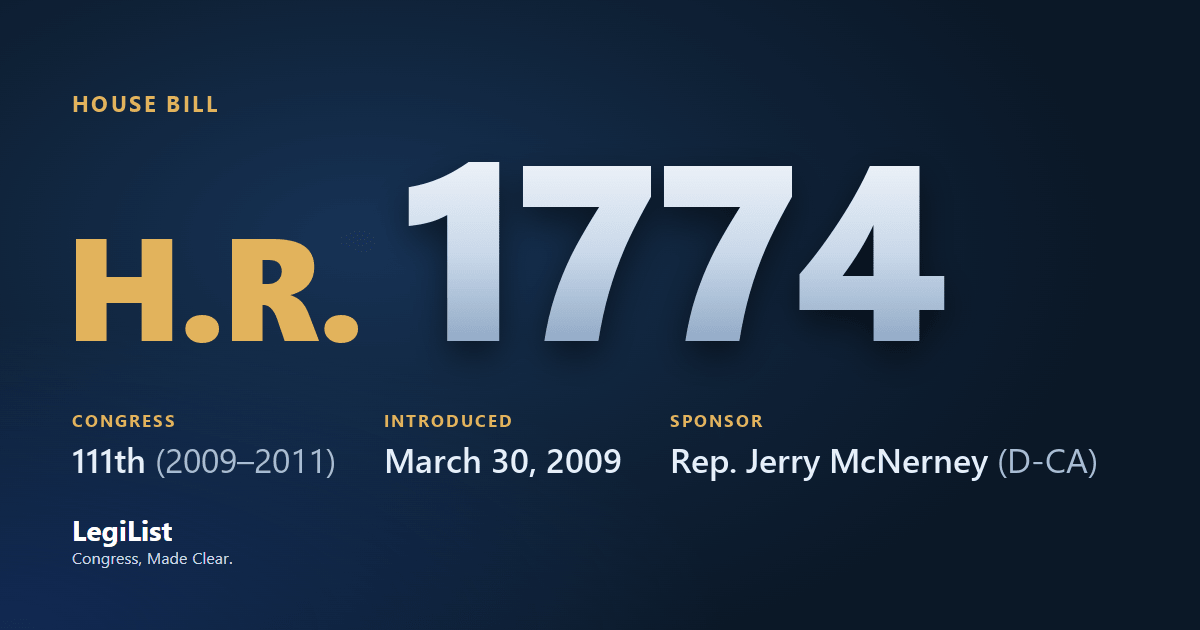
Smart Grid Advancement Act
Latest action · Mar 31, 2009 Referred to the Subcommittee on Energy and Environment.
Progress
Where this bill reached, and when. A stage with no date was not reached; one that failed a vote and later carried shows the date it carried.
- IntroducedMar 30, 2009
- Passed HouseNot reached
- Passed SenateNot reached
- To the PresidentNot reached
- Became lawNot reached
Summary
Smart Grid Advancement Act - Requires the Secretary of Energy and the Administrator of the Environmental Protection Agency (EPA) to: (1) assess the potential for cost-effective integration of Smart Grid technologies and capabilities in all products that are reviewed by the Department of Energy (DOE) and EPA for potential designation as Energy Star products; (2) conduct a best case smart grid analysis by analyzing the potential energy savings and electricity cost savings that could accrue for such products in specified circumstances; and (3) take specified actions when they find that including Smart Gird capability in products is cost effective in the best case.
Sets forth provisions concerning Smart Grid peak demand reduction goals, including requiring: (1) load serving entities or states to determine and publish demand reduction goals for such entities that have applicable baselines in excess of 250 megawatts; (2) the Federal Energy Regulatory Commission (FERC) to develop and publish a methodology to provide for adjustments or normalization to a load serving entity's applicable baseline over time to reflect changes in the number of customers served, weather conditions, general economic conditions, and other factors external to peak load management; (3) the Secretary to develop a system for measuring and verifying demand reductions; and (4) each load serving entity to prepare a peak load reduction plan.
Authorizes the Secretary to make grants to offset the costs of carrying out responsibilities to be implemented under this Act.
Amends the Energy Policy Act of 2005 to revise: (1) the Energy Efficiency Public Information Initiative, including by renaming the program as the Energy Efficiency and Smart Grid Public Information Initiative and authorizing appropriations through FY2020; and (2) the Energy Efficient Appliance Rebate Program, including by renaming the program as the Energy Efficient and Smart Appliance Rebate Program and authorizing appropriations through FY2015.
Cosponsors 6
Members who signed on, in the order they did. Signatures ran from Apr 30, 2009 to Jul 31, 2009.
| Seat | Cosponsor | Signed on | |
|---|---|---|---|
| D-CA | Anna G. Eshoo | Apr 30, 2009 | |
| D-WA | Jay Inslee | May 6, 2009 | |
| D-MD | John P. Sarbanes | May 7, 2009 | |
| D-CA | Lois Capps | May 14, 2009 | |
| D-AZ | Raúl M. Grijalva | Jun 8, 2009 | |
| D-FL | Robert Wexler | Jul 31, 2009 |
Committees 1
Where it was sent and what each committee and subcommittee did with it, in order.
| Chamber | Committee | What it did |
|---|---|---|
| House | Energy and Commerce Committee | Referred Mar 30, 2009 |
| Energy Subcommittee | Referred Mar 31, 2009 |
Actions 3
Everything that happened, newest first.
- Mar 31, 2009Referred to the Subcommittee on Energy and Environment.
- Mar 30, 2009Introduced in House
- Mar 30, 2009Referred to the House Committee on Energy and Commerce.
Titles 2
Every title it has carried, official and short, at each stage.
- Official Title as Introduced
- To incorporate smart grid capability into the Energy Star Program, to reduce peak electric demand, to reauthorize energy efficiency public information program to include Smart Grid information, and for other purposes.
- Short Titles as Introduced
- Smart Grid Advancement Act
Subjects
Assigned by the Library of Congress. Policy area: Energy.
- Administrative law and regulatory procedures
- Department of Energy
- Electric power generation and transmission
- Energy
- Energy efficiency and conservation
- Energy storage, supplies, demand
- Environmental technology
- Executive agency funding and structure
- Federal Energy Regulatory Commission (FERC)
- Government information and archives
- Public utilities and utility rates
Text 1
Each version as it was printed, newest first.
- Mar 30, 2009Introduced in House
Support LegiList
This page is free, carries no paywall, and is built and maintained by one person. If the record here is useful to you, a few dollars keeps it going.
Everything here is as published by Congress: the summary is the Congressional Research Service's, the action wording is the clerks', and the subjects are the Library of Congress's. How far it got is read from the actions themselves, taking the most recent one of each kind, so a bill that failed a vote and later passed is shown as having passed. Records come from this bill on Congress.gov and govinfo.gov; cost estimates are the Congressional Budget Office's, and the hearings are the printed hearings GovInfo publishes, which can appear months after the hearing.