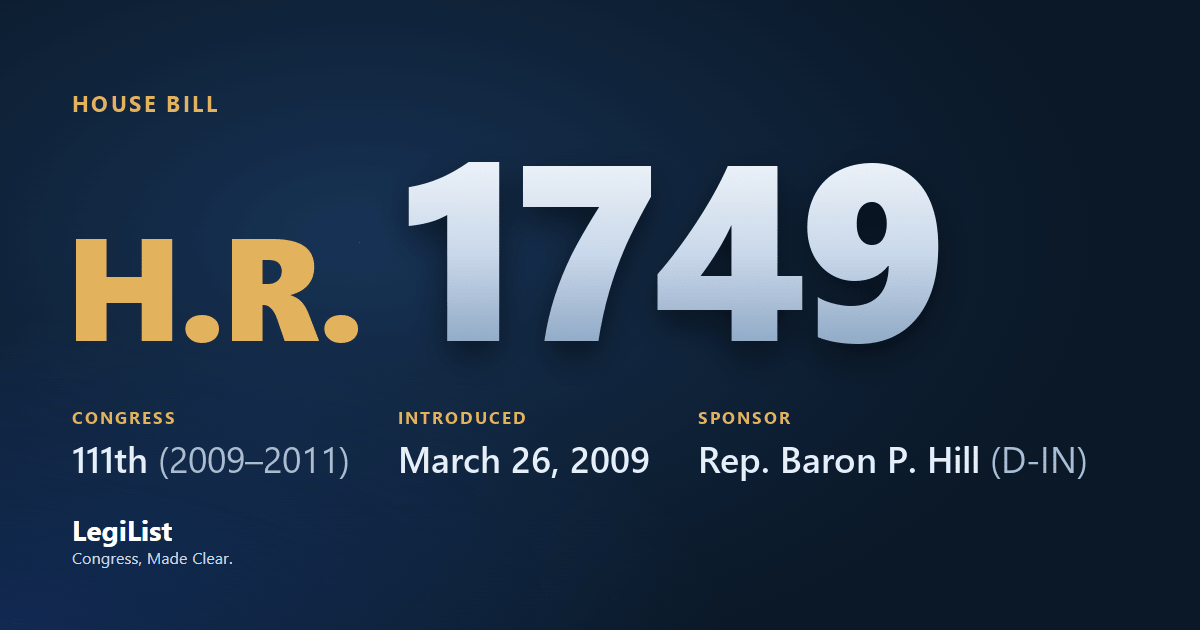
Energy Efficient Manufactured Housing Act of 2009
Latest action · Mar 30, 2009 Referred to the Subcommittee on Energy and Environment.
Progress
Where this bill reached, and when. A stage with no date was not reached; one that failed a vote and later carried shows the date it carried.
- IntroducedMar 26, 2009
- Passed HouseNot reached
- Passed SenateNot reached
- To the PresidentNot reached
- Became lawNot reached
Summary
Energy Efficient Manufactured Housing Act of 2009 - Authorizes the Secretary of Energy to make grants to state agencies responsible for developing state energy conservation plans under the Energy Policy and Conservation Act to provide owners of manufactured homes constructed prior to 1976 rebates to use toward purchases of new Energy Star qualified manufactured homes.
Restricts rebates to owners of manufactured homes that are used on a year-round basis as a primary residence and that will be destroyed (including appropriate recycling) and replaced, in the same general location, with an Energy Star qualified manufactured home. Limits rebates to: (1) one owner per household; (2) households with total incomes not exceeding 200% of the federal poverty level in the applicable area; and (3) $7,500 per manufactured home.
Directs the Secretary to seek to achieve the purpose of this Act through similar federal programs, including: (1) the Weatherization Assistance Program; and (2) the Department of Energy’s (DOE’s) State Energy Program.
Cosponsors 1
Members who signed on, in the order they did. All signed on Apr 2, 2009.
| Seat | Cosponsor | Signed on | |
|---|---|---|---|
| D-CA | Anna G. Eshoo | Apr 2, 2009 |
Committees 2
Where it was sent and what each committee and subcommittee did with it, in order.
| Chamber | Committee | What it did |
|---|---|---|
| House | Energy and Commerce Committee | Referred Mar 26, 2009 |
| Energy Subcommittee | Referred Mar 30, 2009 | |
| House | Financial Services Committee | Referred Mar 26, 2009 |
Actions 5
Everything that happened, newest first.
- Mar 30, 2009Referred to the Subcommittee on Energy and Environment.
- Mar 26, 2009Introduced in House
- Mar 26, 2009Referred to House Energy and Commerce
- Mar 26, 2009Referred to the Committee on Energy and Commerce, and in addition to the Committee on Financial Services, for a period to be subsequently determined by the Speaker, in each case for consideration of such provisions as fall within the jurisdiction of the committee concerned.
- Mar 26, 2009Referred to House Financial Services
Research
What has been written about this bill: committee reports, cost estimates, the sponsor’s authority statement, printed hearings and the Congressional Research Service’s work.
Printed hearings 1
Hearings whose printed record names this bill, newest first: hearings on it, and wider hearings where it came up.
| Number | Hearing | Committee | Held |
|---|---|---|---|
| 111-371 | PREDATORY LENDING AND REVERSE REDLINING: ARE LOW-INCOME, MINORITY AND SENIOR BORROWERS TARGETS FOR HIGHER-COST LOANS?55 pages | Joint Economic Committee | Jun 25, 2009 |
Related bills 1
Companion bills and other measures the record links to this one.
| Bill | Title | Relationship | Latest action |
|---|---|---|---|
| S 1320 | Energy-Efficient Manufactured Housing Act of 2010 | Related bill | Sep 27, 2010 |
Titles 2
Every title it has carried, official and short, at each stage.
- Official Title as Introduced
- To provide assistance to owners of manufactured homes constructed prior to 1976 to purchase Energy Star qualified manufactured homes.
- Short Titles as Introduced
- Energy Efficient Manufactured Housing Act of 2009
Subjects
Assigned by the Library of Congress. Policy area: Housing and Community Development.
Text 1
Each version as it was printed, newest first.
- Mar 26, 2009Introduced in House
Support LegiList
This page is free, carries no paywall, and is built and maintained by one person. If the record here is useful to you, a few dollars keeps it going.
Everything here is as published by Congress: the summary is the Congressional Research Service's, the action wording is the clerks', and the subjects are the Library of Congress's. How far it got is read from the actions themselves, taking the most recent one of each kind, so a bill that failed a vote and later passed is shown as having passed. Records come from this bill on Congress.gov and govinfo.gov; cost estimates are the Congressional Budget Office's, and the hearings are the printed hearings GovInfo publishes, which can appear months after the hearing.