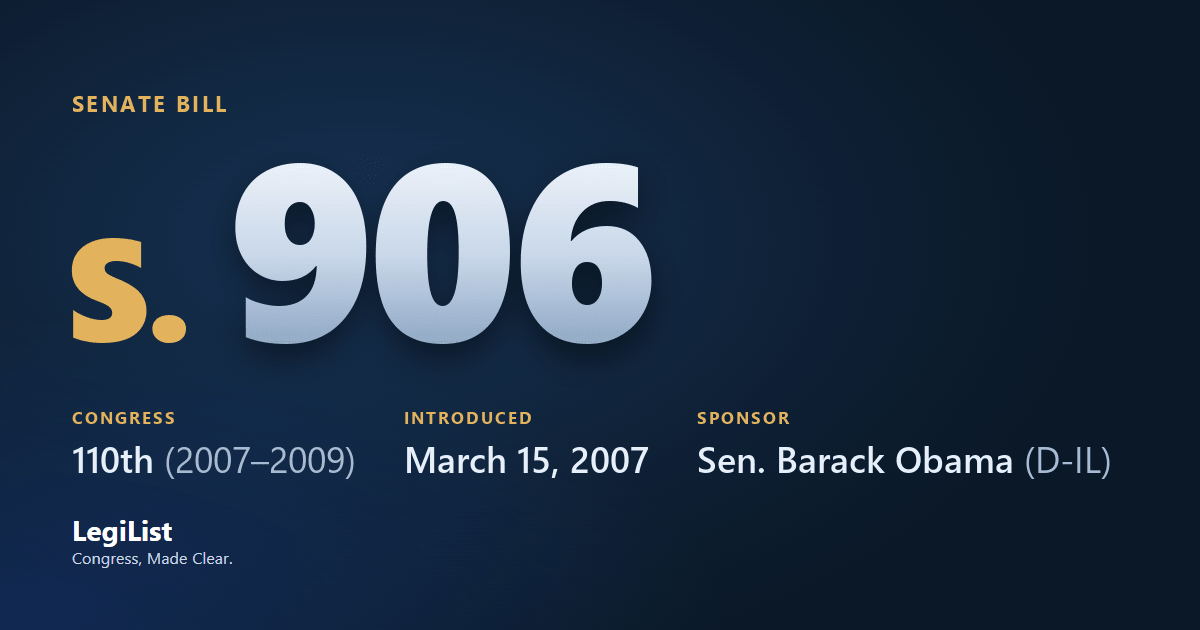
Mercury Export Ban Act of 2008
Latest action · Oct 14, 2008 Became Public Law No: 110-414.
Progress
Where this bill reached, and when. A stage with no date was not reached; one that failed a vote and later carried shows the date it carried.
- IntroducedMar 15, 2007
- Passed SenateSep 26, 2008
- Passed HouseSep 29, 2008
- To the PresidentOct 3, 2008
- Became lawOct 14, 2008Public Law 110-414
Summary
Mercury Export Ban Act of 2008- (Sec. 3) Amends the Toxic Substances Control Act to prohibit any federal agency from conveying, selling, or distributing elemental mercury to any other federal, state, or local agency or any private individual or entity. Exempts: (1) transfers between federal agencies for the sole purpose of facilitating storage of mercury to carry out this Act; and (2) conveyances, sales, distributions, or transfers of coal.
(Sec. 4) Prohibits the export of elemental mercury from the United States effective January 1, 2013.
Requires the Administrator of the Environmental Protection Agency (EPA) to report to Congress, within one year after the enactment of this Act, on mercuric chloride, mercurous chloride or calomel, mercuric oxide, and other mercury compounds used in significant quantities in products or processes. Requires such report to include an analysis of: (1) the sources and amounts of such compounds imported into, or manufactured in, the United States annually; (2) the purposes for which each of the compounds is used domestically, the amounts consumed annually for each purpose, and the amounts estimated to be consumed in 2010 and beyond; (3) the sources and amounts of each compound exported annually in the last three years; (4) the potential for the compounds to be processed into elemental mercury after export; and (5) other information relevant in determining whether to extend the export prohibition to include mercury compounds.
Authorizes any U.S. resident to petition the Administrator for an exemption from the export prohibition. Authorizes the Administrator to grant an exemption for a specified use at an identified foreign facility if: (1) nonmercury alternatives for the specified use are not available in the country where the facility is located; (2) there is no other source of elemental mercury available from domestic supplies (not including new mercury mines) in the country where the mercury will be used; (3) the country where the mercury will be used certifies its support for the exemption; (4) the export will be conducted in a manner that ensures the mercury will be used at the facility described and will not be diverted for other uses for any reason; (5) the mercury will be used in a manner that will protect human health and the environment; and (6) the export for the specified use is consistent with international obligations of the United States intended to reduce global mercury supply, use, and pollution. Disallows any exemption for a duration exceeding three years and involving more than 10 metric tons of mercury.
Authorizes the Administrator to suspend or cancel an exemption for specified violations or the submission of false information. Subjects violators to penalties, injunctive relief, and citizen suits.
Declares that nothing in this Act: (1) affects, replaces, or amends prior law relating to the need for consistency with international trade obligations; or (2) prohibits the export of coal.
(Sec. 5) Requires the Secretary of Energy, not later than January 1, 2010, to designate a facility of the Department of Energy (DOE) for the long-term management and storage of elemental mercury generated within the United States. Excludes from such designation the Y-12 National Security Complex or any other portion or facility of the Oak Ridge Reservation. Requires such facility to be operational by January 1, 2013.
Requires the Secretary to: (1) assess and collect a fee for management and storage of elemental mercury; and (2) report annually to specified congressional committees on the costs of such long-term management and storage. Requires the amount of such fees to be made publicly available by October 1, 2012.
Requires the Secretary, not later than October 1, 2009, to establish procedures and standards for the receipt, management, and long-term storage of elemental mercury at designated facilities that are protective of human health and the environmental and that ensure that the elementary mercury is stored in a safe, secure, and effective manner.
Subjects such stored mercury to the requirements of the Solid Waste Disposal Act (SWDA). Sets forth provisions concerning permit applications under SWDA.
Requires the Secretary to: (1) conduct training for elemental mercury management, transfer, storage, monitoring or response; (2) ensure that each designated facility has all equipment necessary for routine operations, emergencies, monitoring, checking inventory, loading, and storing mercury; and (3) ensure the installation of specified fire detection systems. Provides for indemnification of persons delivering elemental mercury to a designated facility.
Declares that elemental mercury that the Secretary is storing on a long-term basis is not subject to a specified SWDA storage prohibition. Deems a generator accumulating elemental mercury destined for a facility for 90 days or less to be accumulating the mercury to facilitate proper treatment, recovery, or disposal for purposes of SWDA standards applicable to owners and operators of hazardous waste treatment, storage, and disposal facilities.
Exempts elemental mercury that is stored at a facility with an SWDA hazardous waste permit from the SWDA prohibition of hazardous waste storage if: (1) the Secretary is unable to accept the mercury at a designated facility for reasons beyond the control of the owner or operator of the permitted facility; and (2) such owner/operator certifies that the owner/operator will ship the mercury to the designated facility when the Secretary is able to accept it, and will not sell it or otherwise place it into commerce.
Requires the Secretary to report to Congress by July 1, 2014, on a study that: (1) determines the impact of the long-term storage program on mercury recycling; and (2) includes proposals to mitigate any negative impact.
(Sec. 6) Requires the Administrator, at least three years after the effective date of the export prohibition, but not later than January 1, 2017, to report to specified congressional committees on the global supply and trade of elemental mercury.
Recorded votes 1
Newest first. Open one to see how every member voted.
| Roll call | Question | Result | Date |
|---|---|---|---|
| House 669 | On Motion to Suspend the Rules and Pass | Passed393–5 | Sep 29, 2008 |
Cosponsors 5
Members who signed on, in the order they did. Signatures ran from Mar 15, 2007 to Sep 15, 2008; 1 is an original cosponsor, there from the day it was introduced.
| Seat | Cosponsor | Signed on | |
|---|---|---|---|
| R-AK | Lisa Murkowski | Original | Mar 15, 2007 |
| D-DE | Joseph R. Biden Jr. | Jun 5, 2007 | |
| D-CO | Ken Salazar | Oct 25, 2007 | |
| D-CA | Barbara Boxer | Apr 1, 2008 | |
| D-MI | Carl Levin | Sep 15, 2008 |
Committees 1
Where it was sent and what each committee and subcommittee did with it, in order.
| Chamber | Committee | What it did |
|---|---|---|
| Senate | Environment and Public Works Committee | Referred Mar 15, 2007Hearings May 13, 2008Markup Jul 31, 2008Reported Sep 22, 2008 |
Actions 24
Everything that happened, newest first.
- Oct 14, 2008Signed by President.
- Oct 14, 2008Became Public Law No: 110-414.
- Oct 3, 2008Presented to President.
- Sep 29, 2008Considered as unfinished business. (consideration: CR H10333-10334)
- Sep 29, 2008Passed/agreed to in House: On motion to suspend the rules and pass the bill Agreed to by the Yeas and Nays: (2/3 required): 393 - 5, 6 Present (Roll no. 669). (text: CR 9/27/2008 H10178-10179)
In the Congressional Record 5
Days the Record’s own index lists this bill, newest first, with the pages and the members it names. Pages starting H are the House, S the Senate, E Extensions of Remarks.
| Where | In the Record | Members | Date |
|---|---|---|---|
| Extensions | Debate and remarks E2217 | Thomas H. Allen D-ME | Oct 3, 2008 |
| House | Debate and remarks H10333Recorded votes H10333enact | — | Sep 29, 2008 |
| House | Debate and remarks H10177–H10181Text printed H10178 | Christopher H. Smith R-NJ, John Sullivan R-OK, Thomas H. Allen D-ME | Sep 27, 2008 |
| Senate | Debate and remarks S9874Text printed S9874–S9876Amendments S9848 | Barbara Boxer D-CA (amendment), Sheldon Whitehouse D-RI | Sep 26, 2008 |
| Senate | Debate and remarks S3213Text printed S3213–S3215 | Barack Obama D-IL (text) | Mar 15, 2007 |
Research
What has been written about this bill: committee reports, cost estimates, the sponsor’s authority statement, printed hearings and the Congressional Research Service’s work.
Committee report
Congressional Budget Office cost estimates 2
- Sep 10, 2008S. 906, Mercury Export Ban Act of 2008<p>Cost estimate for the bill as ordered reported by the Senate Committee on Environment and Public Workds on July 31, 2008</p>
- Sep 10, 2008S. 906, Mercury Export Ban Act of 2008Cost estimate for the bill as ordered reported by the Senate Committee on Environment and Public Workds on July 31, 2008
Printed hearings 1
Hearings whose printed record names this bill, newest first: hearings on it, and wider hearings where it came up.
| Number | Hearing | Committee | Held |
|---|---|---|---|
| S. Hrg. 110-1249 | HEARING ON MERCURY LEGISLATION229 pages | Environment and Public Works Committee | May 13, 2008 |
CRS reports 5
Congressional Research Service work that CRS links to this bill or the law it became, newest first.
Cite it 5
Products on other subjects that cite it, usually among other measures.
| Product | Title | Kind | Published |
|---|---|---|---|
| R45149 | Title I of the Toxic Substances Control Act (TSCA): A Summary of the Statute | Report | Jul 20, 2021 |
| RL31905 | The Toxic Substances Control Act (TSCA): A Summary of the Act and Its Major Requirements Archived | Report | Sep 14, 2015 |
| RL30798 | Environmental Laws: Summaries of Major Statutes Administered by the Environmental Protection Agency Archived | Report | Dec 20, 2013 |
| R43136 | Proposed Reform of the Toxic Substances Control Act (TSCA) in the 113th Congress: S. 1009 Compared with S. 696 and Current Statute Archived | Report | Oct 23, 2013 |
| RL33334 | Biotechnology in Animal Agriculture: Status and Current Issues Archived | Report | May 19, 2011 |
Amendments 1
Amendments offered to this bill.
| Amendment | Description | Offered by | Status |
|---|---|---|---|
| SA 5673 | In the nature of a substitute. | Barbara Boxer D-CA | Amendment SA 5673 agreed to in Senate by Unanimous Consent. |
Related bills 1
Companion bills and other measures the record links to this one.
| Bill | Title | Relationship | Latest action |
|---|---|---|---|
| HR 1534 | Mercury Export Ban Act of 2007 | Related bill | May 13, 2008 |
Titles 3
Every title it has carried, official and short, at each stage.
- Official Title as Introduced
- A bill to prohibit the sale, distribution, transfer, and export of elemental mercury, and for other purposes.
- Short Titles as Introduced
- Mercury Market Minimization Act of 2007
- Short Titles as Enacted
- Mercury Export Ban Act of 2008
Subjects
Assigned by the Library of Congress. Policy area: Environmental Protection.
- Congress
- Congressional oversight
- Congressional reporting requirements
- Environmental health
- Environmental Protection
- Environmental research
- Export controls
- Federal advisory bodies
- Foreign Trade and International Finance
- Government Operations and Politics
- Health
- Imports
- Labor and Employment
- Mercury
- Occupational health and safety
- Science, Technology, Communications
- Storage
- Transportation and Public Works
- Transportation of hazardous substances
Text 4
Each version as it was printed, newest first.
- Sep 30, 2008Enrolled Bill
- Sep 27, 2008Engrossed in Senate
- Sep 22, 2008Reported to Senate
- Mar 15, 2007Introduced in Senate
Support LegiList
This page is free, carries no paywall, and is built and maintained by one person. If the record here is useful to you, a few dollars keeps it going.
Everything here is as published by Congress: the summary is the Congressional Research Service's, the action wording is the clerks', and the subjects are the Library of Congress's. How far it got is read from the actions themselves, taking the most recent one of each kind, so a bill that failed a vote and later passed is shown as having passed. Records come from this bill on Congress.gov and govinfo.gov; cost estimates are the Congressional Budget Office's, and the hearings are the printed hearings GovInfo publishes, which can appear months after the hearing.