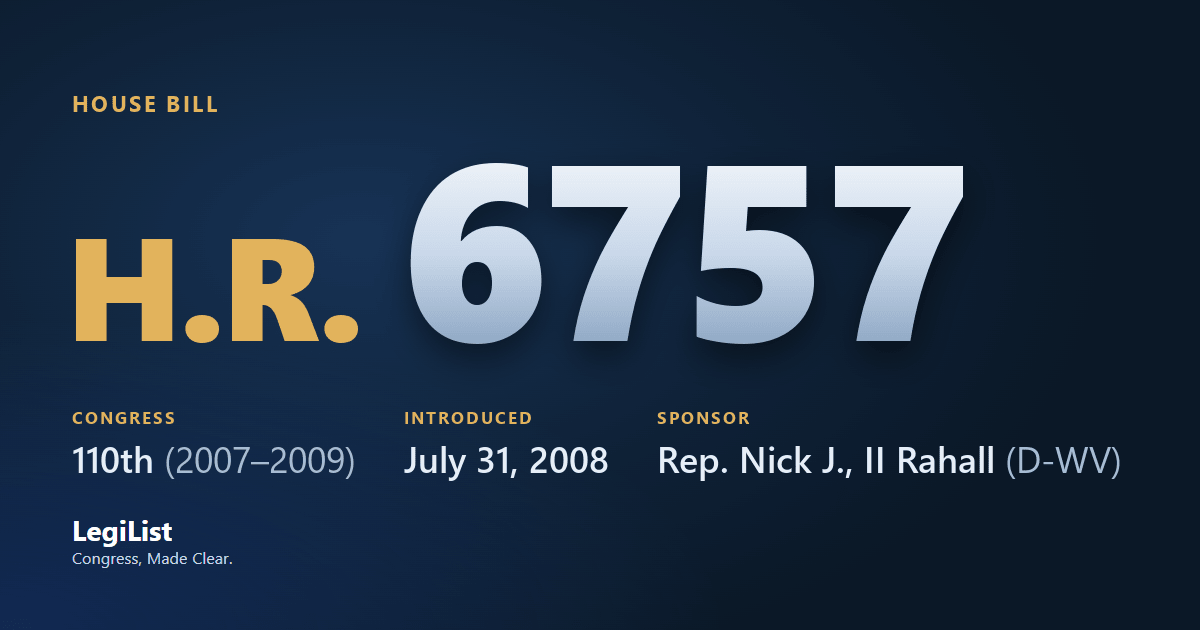
Surface Transportation Safety Act of 2008
Latest action · Aug 1, 2008 Referred to the Subcommittee on Highways and Transit.
Progress
Where this bill reached, and when. A stage with no date was not reached; one that failed a vote and later carried shows the date it carried.
- IntroducedJul 31, 2008
- Passed HouseNot reached
- Passed SenateNot reached
- To the PresidentNot reached
- Became lawNot reached
Summary
Surface Transportation Safety Act of 2008 - Directs the Secretary of Transportation to modify certain federal regulations to: (1) allow fire services personnel to wear high visibility apparel meeting certain requirements; and (2) ensure that positive protective measures (including temporary longitudinal traffic barriers) are used to separate workers on highway construction projects from motorized traffic.
Directs the Secretary to approve the use of federal-aid highway funds for patented or proprietary items that further the goals of state strategic highway safety plans.
Directs the Secretary of Transportation to revise the Manual on Uniform Traffic Control Devices to include a standard for a minimum level of retroreflectivity that must be maintained for pavement markings, which shall apply to all roads open to public travel.
Revises requirements for the highway safety improvement program to count installation, replacement, and upgrade of highway signs and pavement markings as a highway safety improvement project. Directs the Secretary to: (1) require each state to assess local government financial obligations to maintain minimum levels of retroreflectivity in traffic signs and pavement markings; and (2) provide local governments funding for at least 90% of such obligations.
Directs the Secretary to: (1) carry out a program to improve traffic signs and pavement markings for older drivers and pedestrians in all states; (2) review the safety of all highway-rail grade crossings in the United States and, based on such review, compile a list of the ten highway-rail grade crossings having the greatest need for safety improvements; and (3) establish a national database of information on the safety of highway-rail grade crossings in the United States.
Cosponsors 2
Members who signed on, in the order they did. All signed on Jul 31, 2008.
| Seat | Cosponsor | Signed on | |
|---|---|---|---|
| R-PA | Bill Shuster | Original | Jul 31, 2008 |
| D-FL | Corrine Brown | Original | Jul 31, 2008 |
Committees 1
Where it was sent and what each committee and subcommittee did with it, in order.
| Chamber | Committee | What it did |
|---|---|---|
| House | Transportation and Infrastructure Committee | Referred Jul 31, 2008 |
| Highways and Transit Subcommittee | Referred Aug 1, 2008 |
Actions 3
Everything that happened, newest first.
- Aug 1, 2008Referred to the Subcommittee on Highways and Transit.
- Jul 31, 2008Introduced in House
- Jul 31, 2008Referred to the House Committee on Transportation and Infrastructure.
Titles 2
Every title it has carried, official and short, at each stage.
- Official Title as Introduced
- To direct the Secretary of Transportation to carry out programs and activities to improve highway safety.
- Short Titles as Introduced
- Surface Transportation Safety Act of 2008
Subjects
Assigned by the Library of Congress. Policy area: Transportation and Public Works.
- Administrative law and regulatory procedures
- Aging
- Department of Transportation
- Fires
- First responders and emergency personnel
- Government information and archives
- Pedestrians and bicycling
- Railroads
- Roads and highways
- State and local finance
- Transportation and Public Works
- Transportation programs funding
- Transportation safety and security
- Worker safety and health
Text 1
Each version as it was printed, newest first.
- Jul 31, 2008Introduced in House
Support LegiList
This page is free, carries no paywall, and is built and maintained by one person. If the record here is useful to you, a few dollars keeps it going.
Everything here is as published by Congress: the summary is the Congressional Research Service's, the action wording is the clerks', and the subjects are the Library of Congress's. How far it got is read from the actions themselves, taking the most recent one of each kind, so a bill that failed a vote and later passed is shown as having passed. Records come from this bill on Congress.gov and govinfo.gov; cost estimates are the Congressional Budget Office's, and the hearings are the printed hearings GovInfo publishes, which can appear months after the hearing.