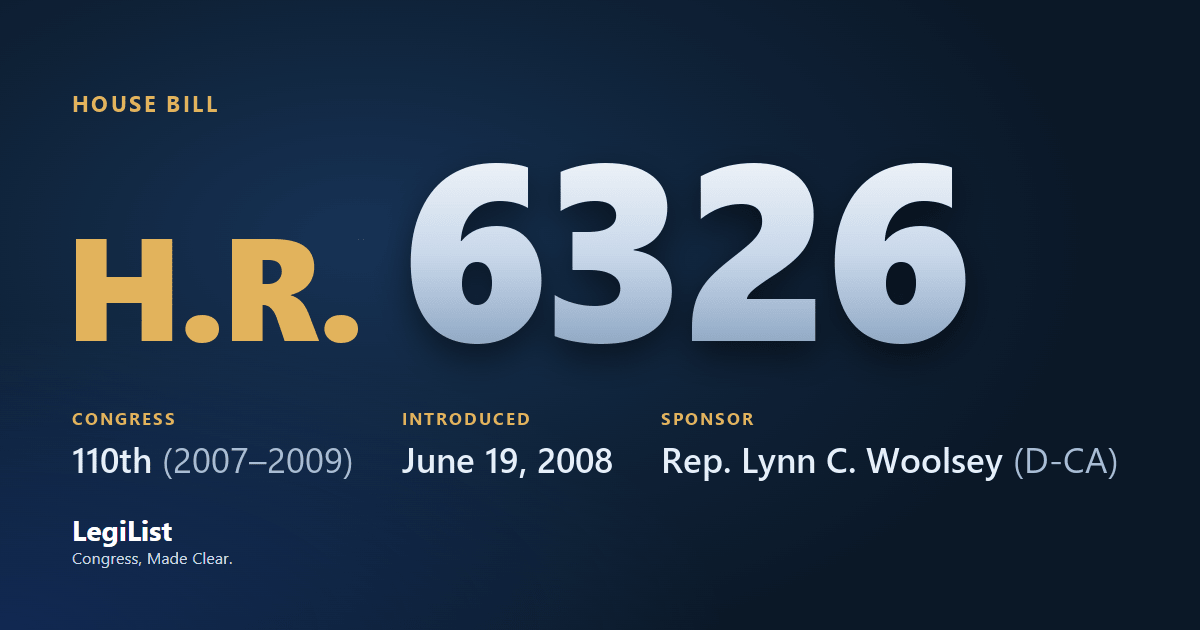
Military Family Support Act of 2008
Latest action · Jul 16, 2008 Referred to the Subcommittee on Military Personnel.
Progress
Where this bill reached, and when. A stage with no date was not reached; one that failed a vote and later carried shows the date it carried.
- IntroducedJun 19, 2008
- Passed HouseNot reached
- Passed SenateNot reached
- To the PresidentNot reached
- Became lawNot reached
Summary
Military Family Support Act of 2008 - Directs the Office of Personnel Management (OPM) to establish a program to authorize a caregiver (a federal employee at least 18 years of age capable of providing care to a child or other dependent family member of a member of the Armed Forces) to use: (1) any available sick leave for the provision of such care in the same manner as annual leave is used; and (2) any federal leave available to that caregiver as though that period of caregiving is a medical emergency.
Requires the program to: (1) provide a process for reasonable notice of the need for leave; and (2) protect employees from discrimination or retaliation for the use of leave under this Act and provide the opportunity to appeal a denial of its use. Requires the service member for whom the caregiving is provided to be performing service in support of a contingency operation or in situations for which hostile fire or imminent danger pay is authorized and to designate the caregiver for his or her family.
Terminates the program on December 31, 2012.
Provides for an offsetting reduction in FY2008 appropriations for the Department of Defense for research, development, test and evaluation.
Cosponsors 16
Members who signed on, in the order they did. Signatures ran from Jul 8, 2008 to Jul 24, 2008.
| Seat | Cosponsor | Signed on | |
|---|---|---|---|
| D-CA | Barbara Lee | Jul 8, 2008 | |
| D-CA | Bob Filner | Jul 8, 2008 | |
| D-NY | Carolyn B. Maloney | Jul 8, 2008 | |
| D-CA | Fortney Pete Stark | Jul 8, 2008 | |
| D-WI | Gwen Moore | Jul 8, 2008 | |
| D-CA | Joe Baca | Jul 8, 2008 | |
| D-OH | Marcy Kaptur | Jul 8, 2008 | |
| D-CA | Michael M. Honda | Jul 8, 2008 | |
| D-AZ | Raúl M. Grijalva | Jul 8, 2008 | |
| D-PA | Robert A. Brady | Jul 8, 2008 | |
| D-IL | Janice D. Schakowsky | Jul 10, 2008 | |
| D-CA | Linda T. Sánchez | Jul 10, 2008 | |
| D-HI | Mazie K. Hirono | Jul 10, 2008 | |
| D-NY | Timothy H. Bishop | Jul 10, 2008 | |
| D-MD | Elijah E. Cummings | Jul 24, 2008 |
Actions 3
Everything that happened, newest first.
- Jul 16, 2008Referred to the Subcommittee on Military Personnel.
- Jun 19, 2008Introduced in House
- Jun 19, 2008Referred to the Committee on Oversight and Government Reform, and in addition to the Committee on Armed Services, for a period to be subsequently determined by the Speaker, in each case for consideration of such provisions as fall within the jurisdiction of the committee concerned.
Related bills 2
Companion bills and other measures the record links to this one.
| Bill | Title | Relationship | Latest action |
|---|---|---|---|
| S 1649 | Military Family Support Act of 2007 | Related bill | Jul 13, 2007 |
| S 3163 | Military Family Support Act | Related bill | Jul 21, 2008 |
Subjects
Assigned by the Library of Congress. Policy area: Government Operations and Politics.
- Administrative remedies
- Appropriations
- Armed Forces and National Security
- Caregivers
- Civil Rights and Liberties, Minority Issues
- Congress
- Congressional investigations
- Congressional reporting requirements
- Defense budgets
- Department of Defense
- Disciplining of employees
- Discrimination in employment
- Economics and Public Finance
- Families
- Family leave
- Federal employees
- Government Operations and Politics
- Government spending reductions
- Law
- Leave of absence
- Military dependents
- Military operations
- Military research
- Research and development
- Science, Technology, Communications
- Sick leave
Text 1
Each version as it was printed, newest first.
- Jun 19, 2008Introduced in House
Everything here is as published by Congress: the summary is the Congressional Research Service's, the action wording is the clerks', and the subjects are the Library of Congress's. How far it got is read from the actions themselves, taking the most recent one of each kind, so a bill that failed a vote and later passed is shown as having passed. Records come from this bill on Congress.gov and govinfo.gov.