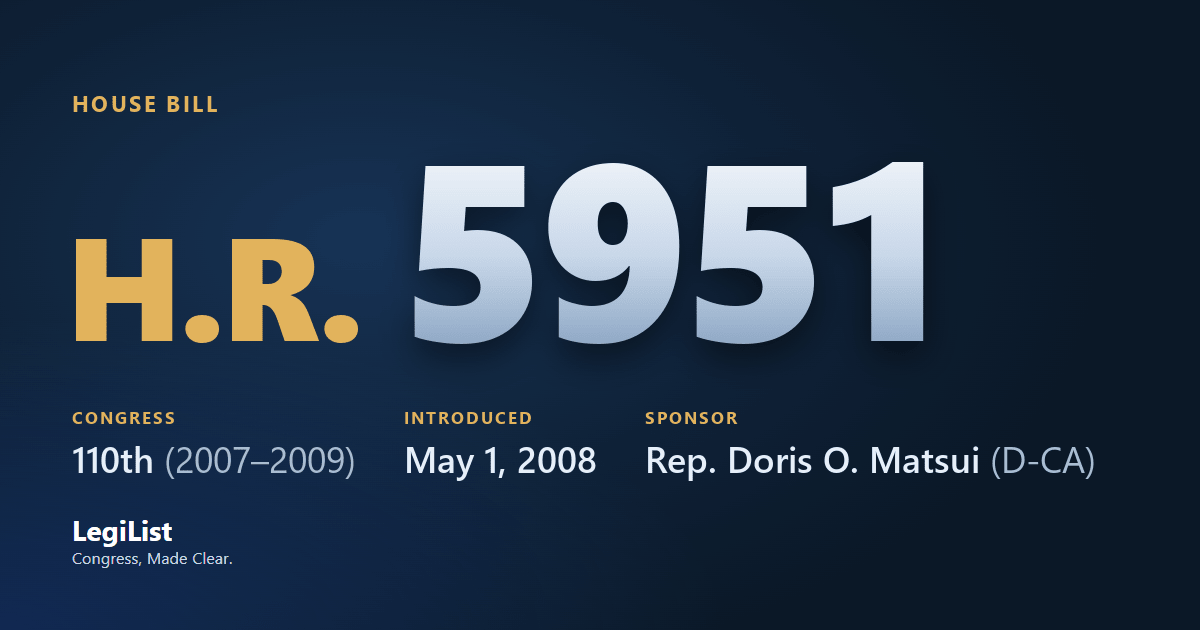
Safe and Complete Streets Act of 2008
Latest action · May 2, 2008 Referred to the Subcommittee on Highways and Transit.
Progress
Where this bill reached, and when. A stage with no date was not reached; one that failed a vote and later carried shows the date it carried.
- IntroducedMay 1, 2008
- Passed HouseNot reached
- Passed SenateNot reached
- To the PresidentNot reached
- Became lawNot reached
Summary
Safe and Complete Streets Act of 2008 - Requires each state to have in effect within two years a law, or each state department of transportation or metropolitan planning organization an explicit policy statement, that requires all federally-funded transportation projects to accommodate the safety and convenience of all users in accordance with certain complete streets principles.
Defines "complete streets principles" as federal, state, local, or regional level transportation laws, policies, or principles which ensure that the safety and convenience of all users of a transportation system, including pedestrians, bicyclists, and transit users as well as children, older people, motorists, and those with disabilities, are accommodated in all phases of project planning and development.
Allows such law or policy to make exemptions from such principles only if: (1) affected roadways prohibit specified users by law from using them, the cost of a compliance project would be excessively disproportionate to the need, or the population and employment densities or level of transit service around a roadway is low enough that there is no need to implement such principles; and (2) all project-specific exemptions are properly approved.
Requires states to ensure that every agency responsible for a project within an approved transportation improvement program reviews and certifies that the project incorporates complete streets principles.
Requires the U.S. Access Board to issue final standards for accessibility of new construction and alterations of pedestrian facilities for public rights-of-way.
Cosponsors 19
Members who signed on, in the order they did. Signatures ran from May 19, 2008 to Sep 11, 2008.
| Seat | Cosponsor | Signed on | |
|---|---|---|---|
| D-CA | Barbara Lee | May 19, 2008 | |
| D-OR | Earl Blumenauer | May 19, 2008 | |
| D-TN | Steve Cohen | May 19, 2008 | |
| D-CA | Lynn C. Woolsey | May 22, 2008 | |
| D-CA | Ellen O. Tauscher | Jun 18, 2008 | |
| D-MO | Emanuel Cleaver | Jun 20, 2008 | |
| D-TX | Sheila Jackson Lee | Jul 16, 2008 | |
| R-CT | Christopher Shays | Jul 21, 2008 | |
| D-VA | James P. Moran | Jul 22, 2008 | |
| D-CA | Henry A. Waxman | Jul 24, 2008 | |
| D-MO | Russ Carnahan | Jul 28, 2008 | |
| D-AZ | Raúl M. Grijalva | Jul 31, 2008 | |
| D-NC | David E. Price | Aug 1, 2008 | |
| D-IA | Bruce L. Braley | Sep 9, 2008 | |
| D-CA | Fortney Pete Stark | Sep 9, 2008 | |
| D-GA | John Lewis | Sep 9, 2008 | |
| D-GU | Madeleine Z. Bordallo | Sep 9, 2008 | |
| D-IL | Daniel Lipinski | Sep 10, 2008 | |
| D-IA | David Loebsack | Sep 11, 2008 |
Committees 1
Where it was sent and what each committee and subcommittee did with it, in order.
| Chamber | Committee | What it did |
|---|---|---|
| House | Transportation and Infrastructure Committee | Referred May 1, 2008 |
| Highways and Transit Subcommittee | Referred May 2, 2008 |
Actions 4
Everything that happened, newest first.
- May 2, 2008Referred to the Subcommittee on Highways and Transit.
- May 1, 2008Introduced in House
- May 1, 2008Sponsor introductory remarks on measure. (CR E798-799)
- May 1, 2008Referred to the House Committee on Transportation and Infrastructure.
In the Congressional Record 1
Days the Record’s own index lists this bill, newest first, with the pages and the members it names. Pages starting H are the House, S the Senate, E Extensions of Remarks.
| Where | In the Record | Members | Date |
|---|---|---|---|
| Extensions | Debate and remarks E798 | Doris O. Matsui D-CA | May 1, 2008 |
Research
What has been written about this bill: committee reports, cost estimates, the sponsor’s authority statement, printed hearings and the Congressional Research Service’s work.
Printed hearings 1
Hearings whose printed record names this bill, newest first: hearings on it, and wider hearings where it came up.
| Number | Hearing | Committee | Held |
|---|---|---|---|
| Serial No. 110-101 | ECONOMIC RECOVERY AND JOB CREATION THROUGH INVESTMENT IN AMERICA328 pages | Ways and Means Committee | Oct 29, 2008 |
CRS reports 1
Congressional Research Service work that CRS links to this bill or the law it became, newest first.
Cite it 1
Products on other subjects that cite it, usually among other measures.
| Product | Title | Kind | Published |
|---|---|---|---|
| R47947 | Complete Streets: A Primer | Report | Aug 11, 2026 |
Related bills 1
Companion bills and other measures the record links to this one.
| Bill | Title | Relationship | Latest action |
|---|---|---|---|
| S 2686 | Complete Streets Act of 2008 | Related bill | Mar 3, 2008 |
Titles 2
Every title it has carried, official and short, at each stage.
- Official Title as Introduced
- To implement a safe and complete streets program.
- Short Titles as Introduced
- Safe and Complete Streets Act of 2008
Subjects
Assigned by the Library of Congress. Policy area: Transportation and Public Works.
- Administrative procedure
- Bicycles
- Child safety
- Disabled
- Economics and Public Finance
- Families
- Federal aid to transportation
- Government Operations and Politics
- Highway finance
- Infrastructure
- Law
- Mass rapid transit
- Pedestrians
- Road construction
- Social Welfare
- Standards
- Traffic accidents and safety
- Transportation and Public Works
- Transportation and the aged
- Transportation and the disabled
- Transportation engineering
- Transportation planning
- Transportation safety
Text 1
Each version as it was printed, newest first.
- May 1, 2008Introduced in House
Support LegiList
This page is free, carries no paywall, and is built and maintained by one person. If the record here is useful to you, a few dollars keeps it going.
Everything here is as published by Congress: the summary is the Congressional Research Service's, the action wording is the clerks', and the subjects are the Library of Congress's. How far it got is read from the actions themselves, taking the most recent one of each kind, so a bill that failed a vote and later passed is shown as having passed. Records come from this bill on Congress.gov and govinfo.gov; cost estimates are the Congressional Budget Office's, and the hearings are the printed hearings GovInfo publishes, which can appear months after the hearing.