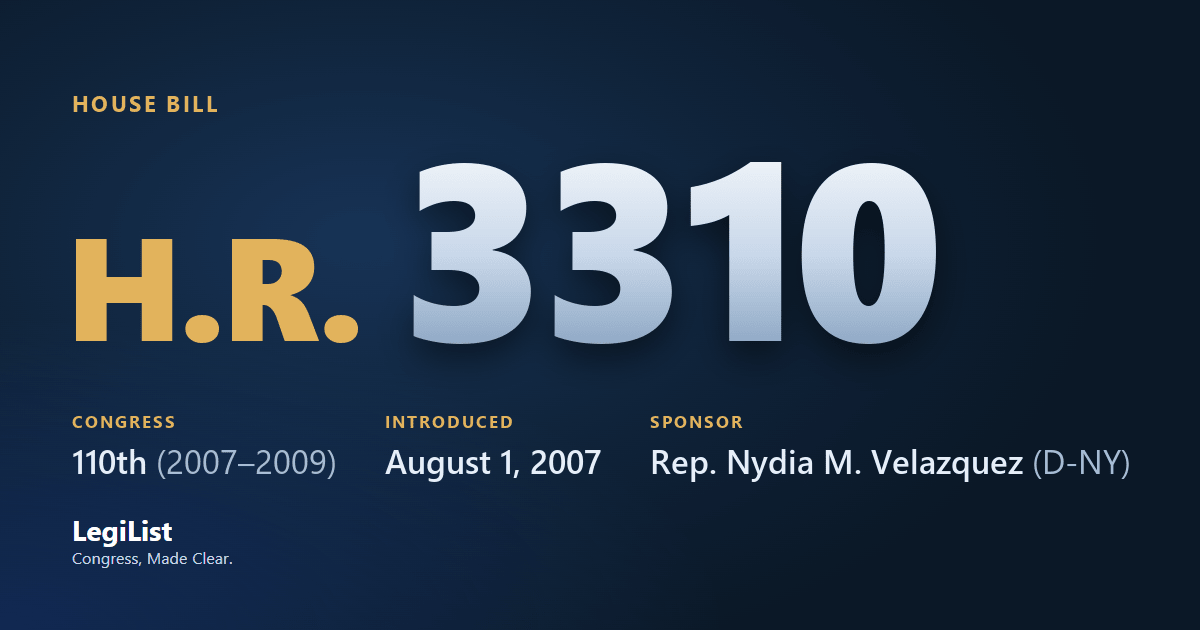
Earning and Living Opportunities Act
Latest action · Jan 11, 2008 Referred to the Subcommittee on Housing and Community Opportunity.
Progress
Where this bill reached, and when. A stage with no date was not reached; one that failed a vote and later carried shows the date it carried.
- IntroducedAug 1, 2007
- Passed HouseNot reached
- Passed SenateNot reached
- To the PresidentNot reached
- Became lawNot reached
Summary
Earning and Living Opportunities Act - Amends the Housing and Urban Development Act of 1968 to set forth as a condition of federal housing and community development assistance that: (1) a public or Indian housing agency or contractor shall require that at least 20% of employee hours be performed by low- or very low-income persons; and (2) a recipient of assistance for housing rehabilitation, construction, or other public construction projects and their contractors shall require that at least 20% of new employee hours be performed by low- or very low-income persons.
Directs the Secretary to require a public or Indian housing agency and other recipients of federal housing and community development assistance to: (1) establish a section 3 committee of interested parties to oversee all aspects of compliance with section 3 of such Act; (2) advertise training and employment opportunities generated by development assistance; and (3) maintain a registry of eligible low- and very low-income persons who express interest in those opportunities.
(Section 3 declares the policy of the Congress to ensure that the employment and other economic opportunities generated by federal financial assistance for housing and community development programs shall, to the greatest extent feasible, be directed toward low- and very low-income persons, particularly those who are recipients of government assistance for housing.)
Prescribes requirements for: (1) contractor compliance and job training; and (2) agency recruitment and referral.
Establishes fines for noncompliance.
Cosponsors
Members who signed on, in the order they did.
Committees 1
Where it was sent and what each committee and subcommittee did with it, in order.
| Chamber | Committee | What it did |
|---|---|---|
| House | Financial Services Committee | Referred Aug 1, 2007 |
| Housing and Insurance Subcommittee | Referred Jan 11, 2008 |
Actions 3
Everything that happened, newest first.
- Jan 11, 2008Referred to the Subcommittee on Housing and Community Opportunity.
- Aug 1, 2007Introduced in House
- Aug 1, 2007Referred to the House Committee on Financial Services.
Titles 2
Every title it has carried, official and short, at each stage.
- Official Title as Introduced
- To amend the Housing and Urban Development Act of 1968 to ensure improved access to employment opportunities for low-income people.
- Short Titles as Introduced
- Earning and Living Opportunities Act
Subjects
Assigned by the Library of Congress. Policy area: Housing and Community Development.
- Administrative procedure
- Advertising
- Apprenticeship
- Building construction
- Commerce
- Community development
- Congressional reporting requirements
- Construction workers
- Department of Housing and Urban Development
- Directories
- Economics and Public Finance
- Employee selection
- Employee training
- Federal aid to housing
- Fines (Penalties)
- Government contractors
- Government Operations and Politics
- Government paperwork
- Housing and Community Development
- Housing authorities
- Housing management
- Indian housing
- Infrastructure
- Labor and Employment
- Law
- Maintenance and repair
- Minorities
- Minority business enterprises
- Minority employment
- Native Americans
- Public housing
- Recruiting of employees
- Residential rehabilitation
- Skilled labor
- Social Welfare
- Urban affairs
- Women
- Women in business
- Women's employment
Text 1
Each version as it was printed, newest first.
- Aug 1, 2007Introduced in House
Support LegiList
This page is free, carries no paywall, and is built and maintained by one person. If the record here is useful to you, a few dollars keeps it going.
Everything here is as published by Congress: the summary is the Congressional Research Service's, the action wording is the clerks', and the subjects are the Library of Congress's. How far it got is read from the actions themselves, taking the most recent one of each kind, so a bill that failed a vote and later passed is shown as having passed. Records come from this bill on Congress.gov and govinfo.gov; cost estimates are the Congressional Budget Office's, and the hearings are the printed hearings GovInfo publishes, which can appear months after the hearing.