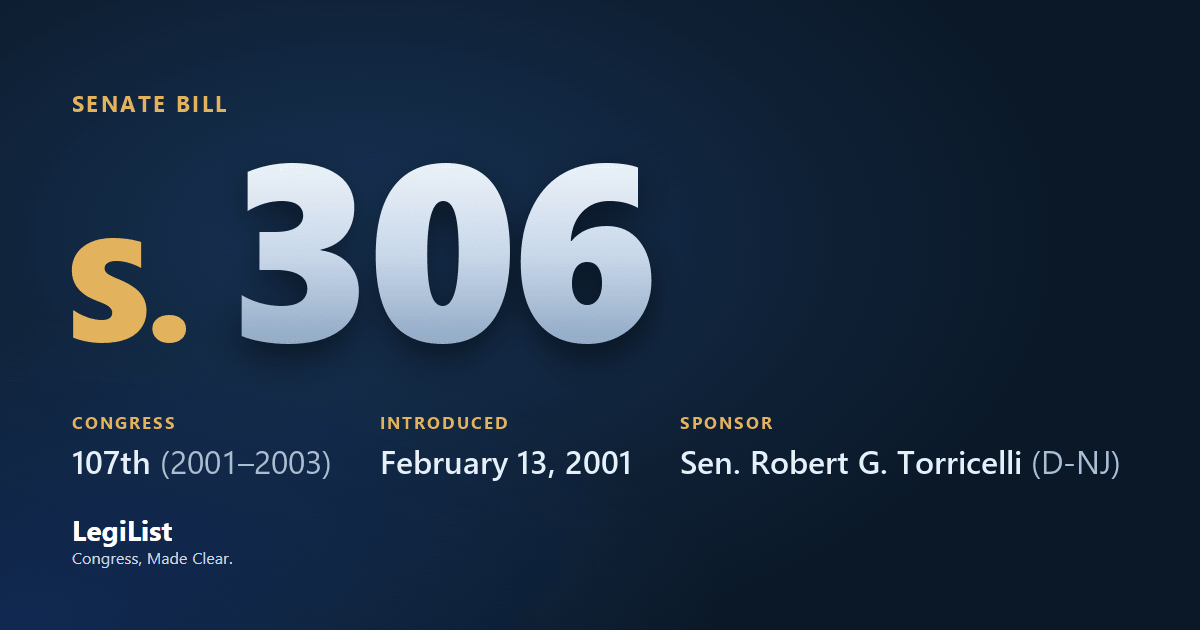
Coverdell Education Savings Accounts Act of 2001
Latest action · Feb 13, 2001 Read twice and referred to the Committee on Finance.
Progress
Where this bill reached, and when. A stage with no date was not reached; one that failed a vote and later carried shows the date it carried.
- IntroducedFeb 13, 2001
- Passed SenateNot reached
- Passed HouseNot reached
- To the PresidentNot reached
- Became lawNot reached
Summary
Renames such educational IRAs as Coverdell education savings accounts.
Excludes from gross income: (1) employer contributions to such accounts on behalf of an employee or employee family member; and (2) account distributions.
Cosponsors 17
Members who signed on, in the order they did. Signatures ran from Feb 13, 2001 to Mar 6, 2001; 16 are original cosponsors, there from the day it was introduced.
| Seat | Cosponsor | Signed on | |
|---|---|---|---|
| R-NE | Chuck Hagel | Original | Feb 13, 2001 |
| R-TN | Fred Thompson | Original | Feb 13, 2001 |
| R-OH | George V. Voinovich | Original | Feb 13, 2001 |
| R-AL | Jeff Sessions | Original | Feb 13, 2001 |
| D-LA | John B. Breaux | Original | Feb 13, 2001 |
| R-AZ | Jon Kyl | Original | Feb 13, 2001 |
| I-CT | Joseph I. Lieberman | Original | Feb 13, 2001 |
| R-NH | Judd Gregg | Original | Feb 13, 2001 |
| D-GA | Max Cleland | Original | Feb 13, 2001 |
| R-WY | Michael B. Enzi | Original | Feb 13, 2001 |
| R-OH | Mike DeWine | Original | Feb 13, 2001 |
| R-PA | Rick Santorum | Original | Feb 13, 2001 |
| R-KS | Sam Brownback | Original | Feb 13, 2001 |
| R-AR | Tim Hutchinson | Original | Feb 13, 2001 |
| R-TN | William H. Frist | Original | Feb 13, 2001 |
| D-GA | Zell Miller | Original | Feb 13, 2001 |
| D-CA | Dianne Feinstein | Mar 6, 2001 |
Committees 1
Where it was sent and what each committee and subcommittee did with it, in order.
| Chamber | Committee | What it did |
|---|---|---|
| Senate | Finance Committee | Referred Feb 13, 2001 |
Actions 2
Everything that happened, newest first.
- Feb 13, 2001Introduced in Senate
- Feb 13, 2001Read twice and referred to the Committee on Finance.
Research
What has been written about this bill: committee reports, cost estimates, the sponsor’s authority statement, printed hearings and the Congressional Research Service’s work.
Printed hearings 1
Hearings whose printed record names this bill, newest first: hearings on it, and wider hearings where it came up.
| Number | Hearing | Committee | Held |
|---|---|---|---|
| S. Hrg. 107-90 | U.S. ENERGY TRENDS124 pages | Energy and Natural Resources Committee | May 15, 2001–Jun 21, 2001 |
Titles 3
Every title it has carried, official and short, at each stage.
- Official Title as Introduced
- A bill to amend the Internal Revenue Code of 1986 to expand the use of education individual retirement accounts, and for other purposes.
- Short Titles as Introduced
- Coverdell Education Savings Accounts Act of 2001
- Popular Titles
- Education Savings Account bill
Subjects
Assigned by the Library of Congress. Policy area: Taxation.
- Arts, Culture, Religion
- Books
- Clothing
- College costs
- Commemorations
- Computer-assisted instruction
- Computers in education
- Congress
- Congressional tributes
- Cost of living adjustments
- Disabled
- Economics and Public Finance
- Education
- Education of disabled students
- Education of disadvantaged children
- Education savings accounts
- Educational finance
- Elementary and secondary education
- Elementary education
- Ex-Members of Congress
- Families
- Georgia
- Higher education
- Income tax
- Indexing (Economic policy)
- Married people
- Members of Congress (Senate)
- Names
- Personal income tax
- Science, Technology, Communications
- Secondary education
- Social Welfare
- Special education
- Tax exclusion
- Tax returns
- Taxation
- Teaching materials
- Textbooks
- Tuition tax credits
Text 1
Each version as it was printed, newest first.
- Feb 13, 2001Introduced in Senate
Everything here is as published by Congress: the summary is the Congressional Research Service's, the action wording is the clerks', and the subjects are the Library of Congress's. How far it got is read from the actions themselves, taking the most recent one of each kind, so a bill that failed a vote and later passed is shown as having passed. Records come from this bill on Congress.gov and govinfo.gov; cost estimates are the Congressional Budget Office's, and the hearings are the printed hearings GovInfo publishes, which can appear months after the hearing.