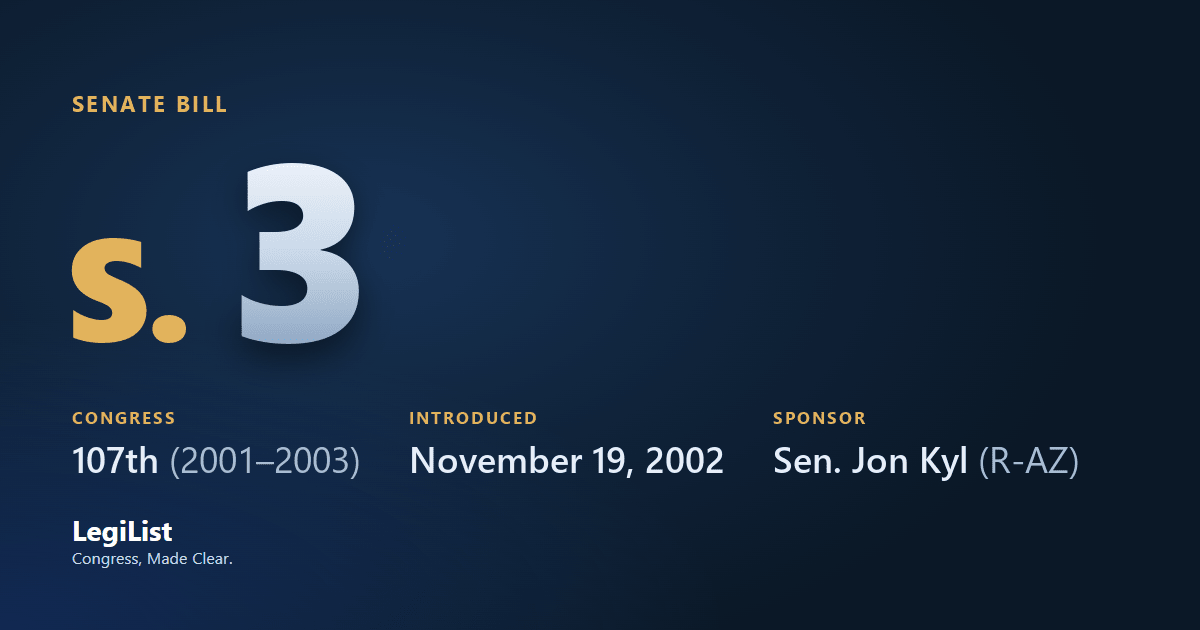
Contract With Investors
Latest action · Nov 20, 2002 Sponsor introductory remarks on measure. (CR S11575-11576)
Progress
Where this bill reached, and when. A stage with no date was not reached; one that failed a vote and later carried shows the date it carried.
- IntroducedNov 19, 2002
- Passed SenateNot reached
- Passed HouseNot reached
- To the PresidentNot reached
- Became lawNot reached
Summary
Amends the Internal Revenue Code to: (1) accelerate individual income tax rate reductions; (2) accelerate the repeal of estate and generation-skipping transfer taxes; (3) reduce maximum capital gains tax rates for individuals; (4) increase capital loss limitations for individuals; (5) accelerate contribution increases for certain retirement plans; (6) increase the age for mandatory retirement and pension plan distributions; and (7) exclude from gross income dividends received by individuals from domestic, publicly traded C corporations, with exceptions.
Expresses the sense of the Senate that Congress should: (1) pass legislation to safeguard workers' pension and retirement accounts; (2) modernize international tax provisions to permit U.S. companies to better compete internationally; (3) repeal outdated regulatory burdens on U.S. investors and companies; (4) enact tort reform; and (5) simplify the Federal tax code and reduce the cost recovery periods for businesses.
Cosponsors
Members who signed on, in the order they did.
Committees 1
Where it was sent and what each committee and subcommittee did with it, in order.
| Chamber | Committee | What it did |
|---|---|---|
| Senate | Finance Committee | Referred Nov 20, 2002 |
Actions 3
Everything that happened, newest first.
- Nov 20, 2002Sponsor introductory remarks on measure. (CR S11575-11576)
- Nov 19, 2002Introduced in Senate
- Nov 19, 2002Read twice and referred to the Committee on Finance.
In the Congressional Record 1
Days the Record’s own index lists this bill, newest first, with the pages and the members it names. Pages starting H are the House, S the Senate, E Extensions of Remarks.
Research
What has been written about this bill: committee reports, cost estimates, the sponsor’s authority statement, printed hearings and the Congressional Research Service’s work.
Printed hearings 1
Hearings whose printed record names this bill, newest first: hearings on it, and wider hearings where it came up.
| Number | Hearing | Committee | Held |
|---|---|---|---|
| Serial No. 107-19 | THE EU DATA PROTECTION DIRECTIVE: IMPLICATIONS FOR THE U.S. PRIVACY DEBATE106 pages | Energy and Commerce Committee | Mar 8, 2001 |
Titles 2
Every title it has carried, official and short, at each stage.
- Official Title as Introduced
- A bill to repeal the sunset of the provisions of the Economic Growth and Tax Relief Reconciliation Act of 2001, and for other purposes.
- Short Titles as Introduced
- Contract With Investors
Subjects
Assigned by the Library of Congress. Policy area: Taxation.
- Age
- Business income tax
- Capital gains tax
- Civil Service pensions
- Commerce
- Congress
- Corporation taxes
- Cost effectiveness
- Cost of living adjustments
- Depreciation and amortization
- Dividend tax
- Dividends
- Economics and Public Finance
- Estate tax
- Finance and Financial Sector
- Foreign Trade and International Finance
- Government and business
- Government Operations and Politics
- Government regulation
- Income tax
- Indexing (Economic policy)
- Individual retirement accounts
- Inheritance tax
- International competitiveness
- Investors
- Labor and Employment
- Law
- Legislation
- Local employees
- Minimum tax
- Pension funds
- Personal income tax
- Social Welfare
- State employees
- Sunset legislation
- Tax cuts
- Tax deductions
- Tax exclusion
- Tax rates
- Tax-deferred compensation plans
- Tax-exempt organizations
- Taxation
- Taxation of foreign income
- Torts
Text 1
Each version as it was printed, newest first.
- Nov 19, 2002Introduced in Senate
Everything here is as published by Congress: the summary is the Congressional Research Service's, the action wording is the clerks', and the subjects are the Library of Congress's. How far it got is read from the actions themselves, taking the most recent one of each kind, so a bill that failed a vote and later passed is shown as having passed. Records come from this bill on Congress.gov and govinfo.gov; cost estimates are the Congressional Budget Office's, and the hearings are the printed hearings GovInfo publishes, which can appear months after the hearing.